Get Full Government Meeting Transcripts, Videos, & Alerts Forever!
Get email alerts on the Traffic Management topic
No spam. Unsubscribe anytime.
Committee reviews neighborhood traffic management program; city plans online portal and cost-share rules reiterated
Summary
The Environmental Quality and Public Works Committee heard an overview of Lexington's Neighborhood Traffic Management Program, including petition-driven project rules, cost-sharing for physical traffic-calming measures, criteria for speed tables and upcoming Citizen Connect portal to track requests.
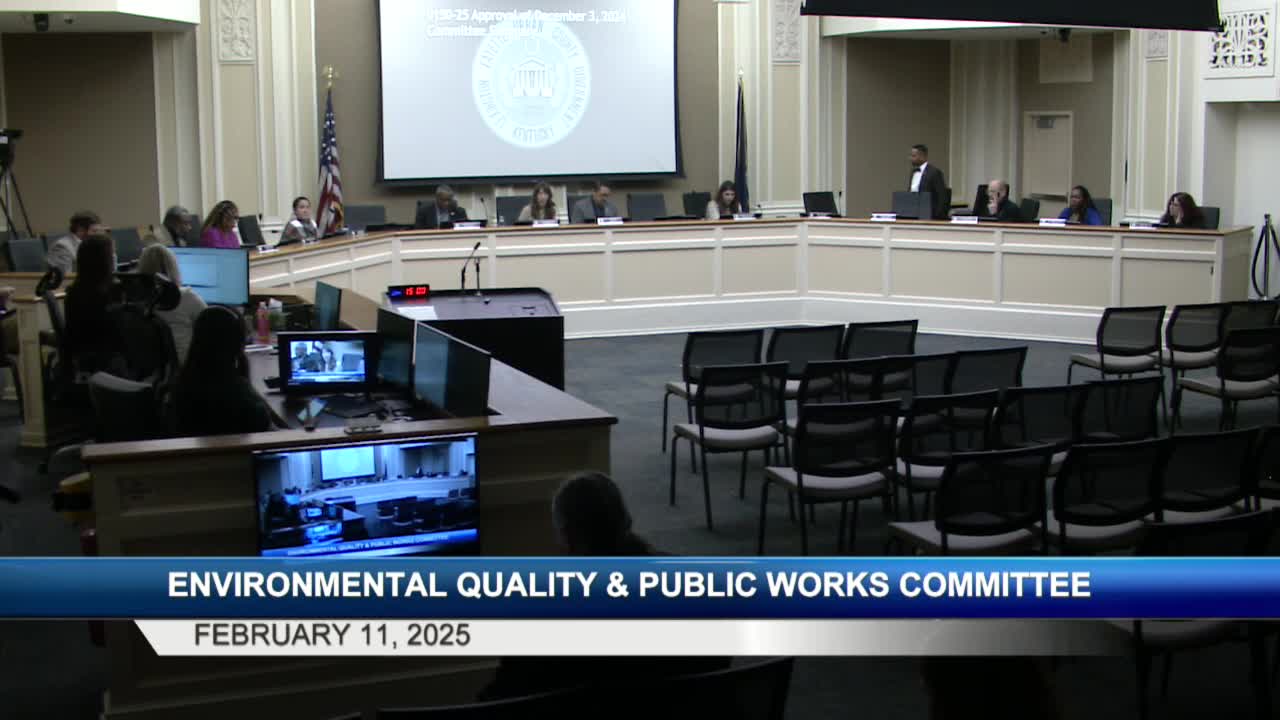
The Environmental Quality and Public Works Committee on Feb. 11 heard an overview of the Neighborhood Traffic Management Program (NTMP) from Roger Mulvaney, section manager in the Division of Traffic Engineering, detailing how residents can request traffic calming and what tools the city uses.
Mulvaney told the committee the NTMP is a citizen-driven program that begins with a petition to demonstrate neighborhood support and then uses traffic data to determine whether Type 1, Type 2 or Type 3 interventions are appropriate. "The NTMP is a program targeted at traffic calming efforts on our locals and collector residential streets," Mulvaney said. "Petitions are an important part of this process to demonstrate the majority of the neighbors support our efforts."
The program uses three intervention tiers. Type 1 measures are educational or enforcement actions and basic signage; Type 2 includes vertical measures such as speed tables and horizontal measures like curb extensions; and Type 3 covers roadway diversions or closures, which Mulvaney said are rarely recommended. He said the cost-sharing policy applies only to Type 2 and Type 3 installations and is graduated based on a neighborhood's average property value.
Mulvaney provided operational details: the signs-and-NTMP group has eight employees split between the Phoenix building (two engineers, one associate engineer, one senior engineering technician) and a four-person sign shop and installation crew. The division maintains an inventory of roughly 60,000 traffic signs. He described the program's historical basis, saying the NTMP was established about 25 years ago and revised in 2012 and 2015.
Councilmembers pressed staff for more specifics and for improved communication to district offices and residents. Councilmember Gray asked for periodic status updates for council offices, saying, "a periodic update, like, maybe once monthly or every other month" would help track projects. Councilmember Savigny said he has used capital funds to cover local projects and supported regular district-level reports. Several members, including Morton and Curtis, asked for clarity on speed-table criteria and on what the program labels as "basic interventions." Mulvaney said the common threshold for recommending a speed table is roughly 1,000 vehicles per day and an 85th-percentile speed about 5 mph above the posted limit; he characterized basic interventions as Type 1 actions such as installing a sign or requesting police enforcement.
On technology and customer service, Mulvaney described a planned Citizen Connect portal intended to centralize traffic-calming requests and provide mapping and project-status tracking. "The portal is intended to be a uniform traffic calming inquiry tool ... We anticipate that this will be online later this year," he said, adding an optimistic timeline of summer for initial availability. The portal will integrate GIS and LFUCG software and include public-facing maps showing active and past projects.
Councilmembers suggested features they want in the portal, including filters by council district and a reporting view accessible to council offices to reduce back-and-forth email traffic. Members also raised practical concerns: Curtis asked whether speed tables can be plowed; Mulvaney replied that properly designed speed tables can be plowed by city snow trucks, while shorter speed humps can cause problems with plows.
Mulvaney said the NTMP currently has more than 100 active projects across stages from petition collection to analysis to installation and that 2024 produced unusually high request volumes (about 1,400 LexCall/NTMP-related contacts handled by the section, with 257 traffic-calming requests in 2024). He told the committee that typical projects can take several months and, in complex cases, up to two years from inception to completion, and that the Citizen Connect portal is intended in part to reduce staff project-management burden.
The committee offered several process suggestions — periodic district-level reporting, an accessible filter for council offices in the portal, and assistance or alternatives for petitioning when residents face mobility or other barriers. Mulvaney said staff will continue to copy council offices on petitions and completed studies and that individual council offices may set up recurring meetings with NTMP staff to review outstanding items.
The discussion closed without formal policy changes; members and staff agreed to continue working on the portal design and on communications about petitioning and cost-share rules for neighborhoods.