Get Full Government Meeting Transcripts, Videos, & Alerts Forever!
Get email alerts on the State Lands Fencing topic
No spam. Unsubscribe anytime.
Committee approves bill clarifying who pays for boundary fences adjacent to state trust lands
Summary
The committee passed Senate File 63 to amend Wyoming's fencing statute so state trust lands pay half the cost of a boundary fence only when the parcel is vacant; if state land is leased the lessee must pay the lessee's share. The bill passed 8-1.
The Agriculture, State & Public Lands & Water Resources Committee on Tuesday voted 8-1 to advance Senate File 63, a bill that amends Wyoming's fencing statute to clarify who pays when a boundary fence is built between private property and state trust lands.
Senator Barry Crago, the bill sponsor, told the committee the change creates "a separate section for state lands" in W.S. 11-28-106 and was intended to make state lands subject to the same fence-splitting rule as private land but with one tweak: "if the state land is leased, the lessee would be responsible for the cost of the fencing," Crago said. "It's pretty straightforward."
The bill matters because the Office of State Lands and Investments (OSLI) told lawmakers there is no clear statutory answer today when adjoining private owners and state trust lands disagree about building and paying for boundary fencing. Cody Booth, assistant director for OSLI's Trust Land Management Division, told the committee the office manages about 3,400,000 acres and that roughly 99% of those acres are leased for grazing or agriculture, leaving about 1% to 2% vacant. Booth said the agency estimates there are "between 5 and 6" current conflicts and that fence construction costs run roughly $5 to $7 per linear foot — about $15,000 to $37,000 per mile. He said the fiscal note before amendment estimated state exposure between $100,000 and $1 million, though that estimate preceded changes moving costs onto lessees.
Supporters including the Wyoming Stockbrokers Association, Rocky Mountain Farmers Union and other ranching interests said the bill levels the playing field between state and private landowners and asked that the agency's future rulemaking address details such as who participates in planning and how improvements are treated when leases change hands. Jim McGagna, testifying for the Wyoming Stockbrokers Association, asked that "a current lessee is a part of the discussion before there's agreement to build the fence" and raised questions about whether a new lessee should reimburse previous lessees if the state pays initially.
Committee members asked about costs and scope. Representative Johnson asked how many parcels could be affected; Crago and Booth said they did not have a precise statewide count but that the number of vacant parcels triggering the rule would be small and that the lessee-liability language should limit state exposure. Representative Davis asked whether the statute would require a particular type of fence or split material versus installation costs; Booth said those specifics would be addressed in rulemaking. The bill also explicitly grants rulemaking authority to the Board of Land Commissioners and OSLI.
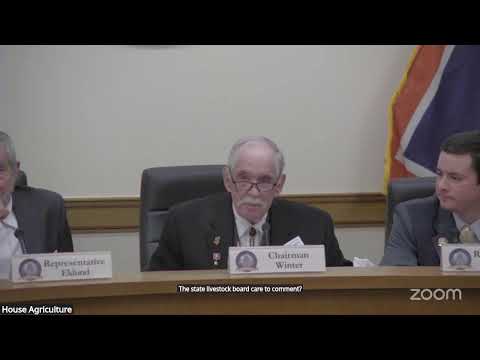
The committee moved and seconded the bill and recorded the committee vote as follows: Representative Banks, aye; Representative Davis, aye; Representative Eklund, aye; Representative Johnson, no; Representative Otman, aye; Representative Provenza, aye; Representative Schmidt, aye; Representative Strauch, aye; Chairman Winter, aye. The clerk announced the bill passed the committee, 8-1.
The bill now moves to the next stage of the legislature. Staff and agency witnesses told the committee they will need to promulgate rules to implement the change and that OSLI may request an appropriation or other budget remedy if it is required to pay for fence construction on vacant parcels before rulemaking or lease adjustments are complete.