Get Full Government Meeting Transcripts, Videos, & Alerts Forever!
Get email alerts on the Downtown Parking topic
No spam. Unsubscribe anytime.
Consultant urges parking “reset” for downtown Eau Claire as council prepares to consider study
Summary
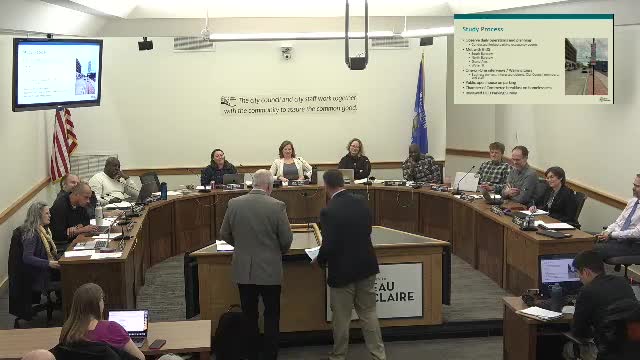
City leaders and residents heard a public discussion Feb. 10 on a downtown parking study that recommends a policy reset, dedicated parking leadership and pricing changes to better align on‑street and off‑street parking with demand.
City leaders and residents heard a public discussion Feb. 10 on a newly completed downtown parking study that recommends a “reset” of parking policy, new leadership for parking operations and changes to pricing and management to better match on‑street and off‑street supply with demand.
Deputy City Manager Dave Solberg introduced the work and said the council resolution to be considered the following day asks only that council accept the study as complete; acceptance would not implement recommendations automatically. “This simply says the document of the study was done to our satisfaction,” Solberg said. If council accepts the document, staff will begin stakeholder outreach and planning for possible policy actions that could be included in the 2026 budget process.
John Forrester, the consultant with Fishback Incorporated who led the study, told council that current pricing creates an “inverted price paradigm” in which premium on‑street spaces are the least expensive option and therefore over‑used. “Your premium spots, your on street spots, are also your least expensive,” Forrester said. He recommended a strategic rate structure to open on‑street spaces for short visits and move all‑day parkers to lower‑priced off‑street facilities.
Among key findings and recommendations Forrester presented: - Set on‑street pay rates to support availability; consultant recommended $1 per hour on‑street from 9 a.m. to 9 p.m., Monday through Saturday, with Sundays free. Off‑street rates should be lower than on‑street to encourage employees to use parking facilities. - Create a single leadership role or department accountable for parking policy, operations and strategic planning rather than the current dispersed responsibilities across city staff. - Plan now for replacement supply as aging parking ramps (Riverside and Gibson) near the end of their useful lives; structured parking costs are high (consultant cited $40,000–$50,000 per stall as a planning figure). - Use parking benefit district tools to keep parking revenue within downtown operations and potentially fund capital and alternative transportation projects.
Forrester supplied financial context: annual parking system revenue is “a little under $800,000 a year,” while annual operating expenses exceed $1 million. The city currently transfers about $250,000 from the general fund to cover the parking deficit; Forrester said the projected deficit for 2025 is roughly $350,000. He warned that deferred maintenance would worsen the system if funding gaps are not addressed.
Forrester also urged regular occupancy counts and transparent reporting: “Initiate on‑street paid parking, adjust your hours, strategically replace supply that’s being removed, and then measure, evaluate, and adjust all the time,” he said.
Public comment dominated the remainder of the discussion, with more than a dozen speakers, many urging caution about removing or redeveloping the Schlegelmilch parking lot (the city‑owned surface lot adjacent to the transit center). Representatives of Christchurch Cathedral, Unitarian Universalist Congregation, Mr. Kitty’s Cat Café, Acoustic Cafe and other downtown businesses said the lot is heavily used for Sunday worship, rehearsals, volunteer activities and business operations, and warned redevelopment without replacement parking could displace congregations and small businesses.
Deb Marshall, chair of the newly formed Downtown Neighborhood Association, said enforcement and repairs in ramps such as the Galloway ramp should be prioritized to address safety and noise issues, and urged stronger enforcement against individuals using ramps for illicit or unsafe activity. “We strongly support the parking Galloway Ramp… and address the safety and noise issues in the Galloway Ramp,” she said.
Several business and BID leaders spoke in favor of the study and the concept of clearer parking governance. The Chamber of Commerce and multiple business improvement district representatives asked council to support a review that maintains downtown vitality, noting BIDs voluntarily invest in downtown improvements.
Deputy City Manager Solberg told council that if the council accepts the study tomorrow, staff would begin stakeholder discussions within one to two weeks and could bring policy options to be considered for the 2026 budget. He described a multi‑meeting stakeholder process that would include business owners, BIDs, neighborhood groups and public forums.
Council members asked about specific items including Schlegelmilch’s future, enforcement in ramps, and options to add on‑street spaces through street redesigns. Staff and the consultant said some on‑street capacity gains are possible with redesigns, but that redeveloping surface lots without replacing supply would create downtown parking shortages, especially if Gibson and Riverside ramps are removed and not replaced.
The council was scheduled to act on acceptance of the study at its next meeting; any operational or rate changes would require further council policy decisions, budget action and implementation steps.