Get Full Government Meeting Transcripts, Videos, & Alerts Forever!
Get email alerts on the Cimd Affordability Covenant topic
No spam. Unsubscribe anytime.
Council workshop reviews draft CIMD affordability covenant; debate centers on monitoring and tenant verification
Summary
City staff presented a revised covenant for CIMD affordability at the Feb. 10 workshop. Developers signaled differing comfort levels with monitoring and tenant‑verification language; staff and council members debated simplifying compliance while ensuring program integrity. Council expected to consider the covenant at its next meeting.
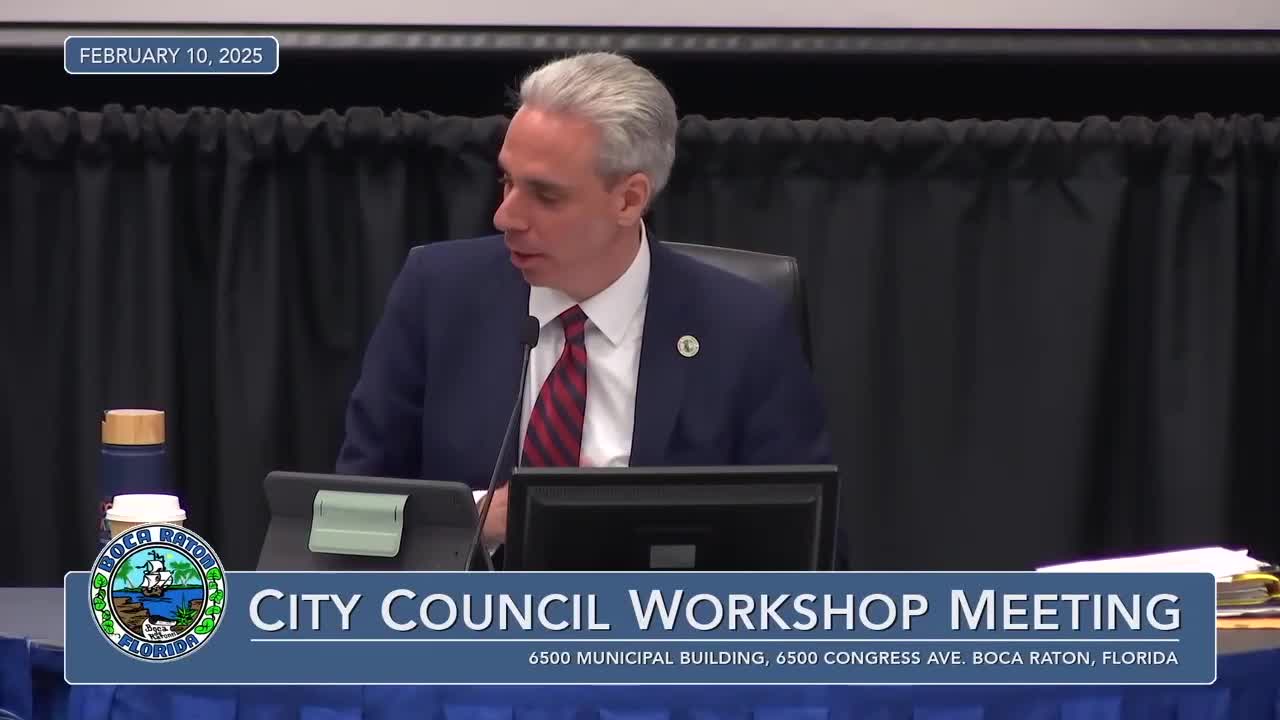
Boca Raton — City staff presented a revised draft covenant governing affordability obligations for community and municipal development (CIMD) projects at a City Council workshop on Feb. 10, prompting council members, developers’ representatives and residents to weigh how much monitoring the city should require for workforce and affordable units.
The presentation and discussion Brandon Shadd, the city’s development services director, told the council staff had worked with applicants since October to draft covenant language and that a new draft distributed the morning of the workshop “substantially addresses and resolves all of the comments other than one minor thing,” namely a suggested change — circulated to the mayor on Friday — that would require income verification only by prior‑year tax returns rather than by projecting income for the lease year and substantiating with pay stubs, bank statements and tax returns.
Bonnie Miskell, representing an applicant with an Office Depot‑area project, told the council her client could accept the revised definition of "affordable" presented Monday and urged the council to put the covenant on the next council meeting agenda so projects could proceed. “We really want to see this get on an agenda tomorrow night,” she said.
Council debate: simplification vs. verification Councilmembers debated the tradeoff between reducing administrative burden and ensuring that a small number of city‑required affordable units actually go to qualifying households. Councilmember Wigdahl argued the covenant initially contained an “onerous application process” that risked undermining the statute’s intent to expedite approvals. He recommended simplifying monitoring and said sworn certifications under penalty of perjury by landlords and tenants should suffice in many cases.
Other council members said they supported stronger compliance safeguards because Boca has approved relatively few CIMD projects and receives a small percentage of units as workforce/affordable housing; they said tighter verification reduces the risk that units intended for qualifying households end up leased to higher‑income tenants.
Monitoring mechanics and staffing The draft covenant retains an annual compliance‑reporting requirement to the city’s development services department and gives staff the ability to request documentation and — if necessary — inspect records. Staff said project monitoring language focuses on record keeping rather than routine interior inspections. Shadd said the community‑improvement division would receive and review reports; if there were compliance problems staff could pursue remedies including code enforcement or other remedies depending on the violation.
Status and next steps Councilmembers asked that the remaining disagreements — including the income‑verification mechanics and the scope of monitoring — be finalized in time for further discussion at the council meeting the next evening. Shadd said staff had sought confirmation from applicants and that one applicant (Office Depot’s representative) had signaled agreement. Councilmembers said they expected to hear from other applicants absent agreement and to take any final amendments as motions when the covenant reaches the council agenda.
Why it matters The covenant will govern how the city enforces affordability commitments for projects that receive CIMD benefits. Council members framed the issue as a balance between (1) minimizing bureaucratic obstacles so projects can deliver affordable units quickly and (2) protecting a small pool of public‑benefit units with verification and recordkeeping so they reach eligible households.
Clarifying points from the workshop - Staff said the revised draft treats tenant income as a projection for the lease year supported by tax returns, pay stubs and other documentation unless the council adopts an alternative; one applicant proposed using prior‑year tax returns only. - The draft includes utility allowances in affordability calculations (a point some applicants questioned). - City staff said compliance reports will go to the development services department’s community improvement unit; additional staffing needs could be considered if monitoring workload grows.
Council action: none taken Monday. Councilmembers agreed to continue the discussion at the next meeting and to allow applicants to propose final, project‑specific clarifications if desired.