Get Full Government Meeting Transcripts, Videos, & Alerts Forever!
Get email alerts on the Policy Arts And Pd topic
No spam. Unsubscribe anytime.
Board hears first reading of policy manual updates; staff present arts-credit change and professional-development overview
Summary
At the Chatham County Schools meeting, staff presented a first reading of NCSBA policy manual updates, explained a new state arts credit requirement and diploma endorsement options, and outlined professional-development funding and plans, including a district digital-learning conference.
Chatham County Schools staff presented a package of information items to the school board, including a first reading of proposed updates to the board policy manual, an explanation of a state arts-credit change and new diploma endorsements, and an overview of district professional-development funding and activities.
Dr. Amanda Moran, assistant superintendent for academic services and instructional support, told the board the North Carolina law change (effective for students entering grade 6 in the 2022–23 cohort) directs the State Board of Education to require one arts education credit during grades 6–12. Moran said most Chatham middle schools already offer arts courses that meet the 90-minute-per-week minimum, but scheduling in schools with cohort programs (dual language, AVID, band) may require adjustments.
Moran described a new arts diploma endorsement requiring students to complete at least four standard-course-of-study arts classes, earn a grade-point average of 3.0 or higher in those courses and complete a minimum of 40 hours of arts-related extracurricular activities not graded as part of a course. She said the endorsement will appear on diplomas in the coming school year after the state’s data systems complete a changeover; this year the district will issue a seal and a letter for eligible students.
Moran also described a proposed citizenship-proficiency diploma endorsement that would let students attempt a state-provided assessment up to once per semester; students must answer six of 10 questions correctly to earn the endorsement.
On policy updates, Dr. Moran said the district is reviewing the NCSBA February series (2000 series: board operations) and recommended language changes including removing specific dollar amounts from board-compensation policy and consolidating several policies into a revised policy on policy development. The materials linked in the packet color-code recommended changes; staff presented this item as a first reading.
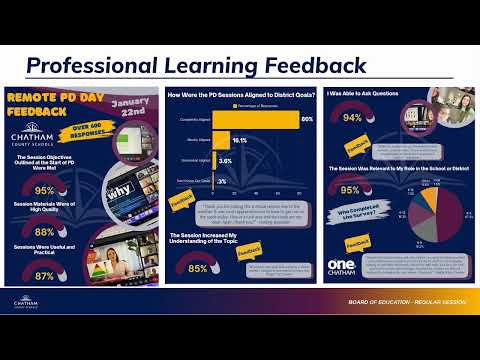
Dr. Kelly Batten, assistant superintendent for human resources, and Moran described professional-development investments and delivery. Batten and Moran said the district estimates roughly $576,000 in identified professional-development funds for the current school year (while acknowledging total spending is higher due to supplements and other lines). The district uses local, federal (Title I/II/IV), program funds and grants, and partners with community organizations such as the Chatham Education Foundation. Virtual and in-person delivery options were described; staff reported a high response rate to a recent PD survey and generally positive ratings for the district’s virtual professional-development day.
Staff also noted an upcoming district digital-learning conference focused on artificial intelligence and digital tools, run under a digital-learning grant; presenters listed included Eric Kurtz and Amber Ivy. Moran described use of the P-TECH (Piedmont Triad Education Consortium) to access nationally known presenters and additional resources for district staff. No formal board votes on these information items were recorded at the meeting; the policy manual updates were presented for first reading.