Get Full Government Meeting Transcripts, Videos, & Alerts Forever!
Get email alerts on the School Budget topic
No spam. Unsubscribe anytime.
Charlottesville leaders hash out school budget, capital needs and safety-audit priorities
Summary
At a Feb. 10 joint work session, Charlottesville City Schools presented a fiscal request that seeks $4.9 million above the local formula, outlined collective-bargaining cost pressures and pressed the city for more capital funding and project management to address a recent safety audit and aging buildings.
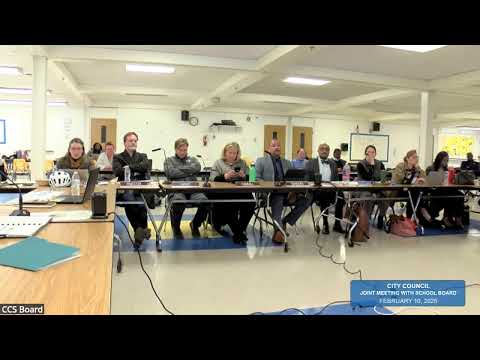
Charlottesville City Schools and the Charlottesville City Council met in a joint work session Monday evening, Feb. 10, to review the school division’s proposed operating budget, capital projects and a recent safety audit.
The most immediate item was the division’s operating request, which school staff described as $4,900,000 over the standard local formula allocation. Dr. Gurley, who presented the budget, said the division’s “priorities have remained the same since our last meeting, improving student outcomes, class sizes, enhancing student achievement and equity, improving our student attendance, competitive salary, competitive wages benefits, retract attracting and retaining, teachers and staff, and the modernization in our schools and the sustainability and sustainability initiatives.”
Why it matters: School officials said salary and benefits account for roughly 74% of expenditures and that compensation, workforce retention and changing state funding formulas are the division’s chief budget pressures. School leaders asked the city to consider adding recurring dollars to the capital improvement program (CIP) and to help prioritize items from a recently completed safety audit.
Key operating details and bargaining costs
School staff laid out revenue and expenditure trends, noting the city appropriation remains the largest single revenue source followed by state aid. Presenters attributed a recent drop in state share to a higher Local Composite Index (LCI), which the division said rose to about 77.2%, reducing the state’s share of Standards of Quality (SOQ) funded positions to about 22.98%.
School staff estimated an additional $538,000 in state revenue tied to SOQ compensation supplements, lottery and at-risk funding and English learner funding. On the expenditure side, the division reported an estimated personnel cost increase of about $3.5 million once raises, step adjustments and other items are included. Specific components presented by staff included:
- One-time equalization of salary steps (presented as a one-time cost; transcript figure presented as about $2.2 million). - A collective-bargaining package that staff described as including a step plus a percent raise; staff gave a figure for the related cost of roughly $2.5 million–$2.6 million. - A proposed average 3% increase aligned to the governor’s SOQ recommendation for SOQ positions. - Health-care premium growth the division estimated at about 6% (presented as roughly $585,000). - A VRS (retirement) savings item presented as about $2.5 million that offsets some personnel costs.
Staffing and program requests
The budget includes requests for new or converted positions: three additional English-learner (ELL) positions (revised down from an earlier estimate of five), two division-level specialists (one reading, one math), a family engagement liaison, a half-time health/medical sciences position, a recruitment specialist and some previously grant-funded clinical social-worker positions moved into the operating budget through June 2026. The division also proposed a one-time retention bonus for licensed staff ($2,000) and support staff ($1,500), to be paid in two equal installments in December and May 2026.
Capital, safety audit and project management
School staff and councilors spent substantial time on facilities: many school buildings are decades old, some approaching 50–100 years, and the division urged increased investment in modernization and critical maintenance. The division asked the council to consider increasing the annual small-cap modernization amount by $250,000.
The division summarized findings from a recent safety and security audit and said items range from relatively small maintenance and lighting improvements to larger projects such as secure vestibules and structural work. Staff and councilors agreed pieces of the audit should be prioritized; school staff emphasized the need for a dedicated project manager or liaison who could coordinate projects and speed delivery across city and school responsibilities.
Fund balance and specific projects
The school board has approved using fund balance for a furniture package to support a grade reconfiguration (presented as about $379,000). Board and council members discussed the CHS track lighting project: officials said the Black Knight Athletic Club and community donors, together with a Perry Foundation match and additional donors, have raised $78,575 for the project. The total project cost was discussed but not specified clearly in the meeting record.
City–school funding formula and year-to-year reconciliation
City staff presented an analysis of the longstanding “40% formula,” which ties a portion of local tax growth to the schools. The analysis compared budgeted revenue-based calculations to actual revenue collections across recent years and found the division netted about $9.5 million more by using the budgeted formula than it would have if the calculation used actual collections over the reviewed period. Separately, the division presented that $908,000 remained unspent across transportation and maintenance budget lines in the last three fiscal years combined, but staff cautioned those end-of-year balances do not capture other related expenditures (for example, a bus-driver incentive payment the division said cost about $332,000).
Next steps and process
Both sides signaled willingness to continue negotiations and to take the funding-formula and agreement structure (the division identified about four distinct city–school agreements covering construction, transportation, maintenance and parks/grounds) as topics for further joint work. Councilors asked for a prioritized list of safety-audit items and a timeline for what could be done when. School and city officials said they expect to continue budget discussions over the coming weeks and to close the operating gap before the city’s budget adoption.
Public comment
A Charlottesville High School teacher, Peter Davis, spoke during public comment and urged more ambitious modernization: “I love Charlottesville City Schools,” he said, and asked decision-makers to “spend the day walking through and trying to work in these spaces,” pointing to classroom lighting, ceilings and bathrooms as areas needing improvement.
What was not decided
No new formal appropriation or new recurring city funding was approved during the joint session. The meeting recorded the school board’s earlier approval to use fund balance for the furniture transition and noted the need for further joint work on the CIP, the funding formula and safety-audit prioritization.
Ending
Officials scheduled follow-up work in the weeks ahead. The school board’s next meeting was announced as Feb. 20 for budget approval, with a regularly scheduled board meeting on March 6.