Get Full Government Meeting Transcripts, Videos, & Alerts Forever!
Get email alerts on the Zoning Change topic
No spam. Unsubscribe anytime.
Moab planning commission forwards negative recommendation on rezoning at 198 East Center Street
Summary
The Moab City Planning Commission voted 4-0 to recommend that City Council deny a proposed rezoning of 198 East Center Street from C2 to C3, citing limited justification under map-amendment criteria, the property—orming an island of differing zoning, and alternatives including code text amendments.
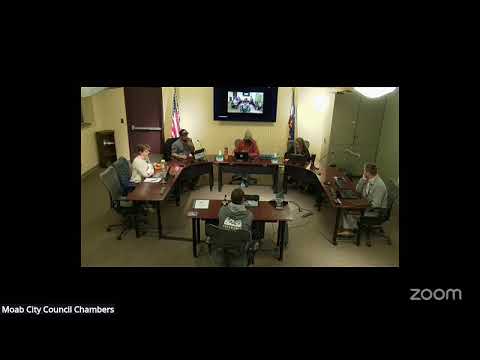
The Moab City Planning Commission voted 4-0 to forward a negative recommendation to City Council on proposed Ordinance 2025-02, a zoning map amendment that would reclassify the parcel at 198 East Center Street (parcel 010B130016) from C2 (commercial/residential) to C3 (central commercial).
The proposal, brought by property owner Taylor Lawrence, was re-noticed for this special meeting and remained open for public hearing before commissioners entered deliberations. Lawrence told the commission he had spoken with adjacent neighbors and that the neighbors to the west and the Baileys, the large private landowner to the south, were supportive. Lawrence said he wanted to encourage mixed-use redevelopment on the site and told commissioners, “I assure you there will never be a gas station in that area.”
Commissioners and staff focused discussion on the city—s map-amendment criteria and on whether the requested upzone met the limited, discretionary grounds for a rezoning. Planning staff identified two central concerns: the parcel would create a noncontiguous C3 zoning island in an otherwise C2 area, and long-standing development standards tied to the C2 district—notably a 25-foot setback—left the property largely noncompliant under current rules.
Staff member Corey demonstrated zoning maps and said the C2 districts in Moab are geographically scattered and vary in character; he told the commission that text amendments or a broader zoning-title update might be a more appropriate way to reconcile inconsistent standards across small downtown parcels than piecemeal upzones. He said the city has begun the zoning-title update process, has hired an associate planner, and estimated a public-hearing-ready draft of the first module could appear by late fall.
Commissioners repeatedly described rezoning as a last resort and urged that property-specific compliance problems not be resolved by upzoning alone. Commissioners noted differences between C2 and C3 standards that affect future uses: C2 allows ground-floor dwellings and, in their view, can better accommodate mixed-use development with residential above retail, while C3 permits certain commercial uses not allowed in C2 but restricts ground-floor housing. Several commissioners warned of setting a precedent if the city permits an upzone primarily to remedy setbacks or existing nonconforming structures.
Commissioners also discussed whether potential tenants (Lawrence said an organic market had expressed interest) would change the calculus. Staff and commissioners pointed out that some use-specific development standards (for example, minimum retail square footage or required buffers) can prevent certain businesses regardless of zoning unless the standards themselves are amended.
After deliberation, commissioner Kai Marenfeld moved to forward a negative recommendation to City Council on Ordinance 2025-02; Miles Lofton seconded. The commission voted 4-0 to approve the negative recommendation. Commissioners present who cast votes were Kai Marenfeld (yes), Miles Lofton (yes), Carolyn Conant (yes) and Jill Tatton (yes). The Planning Commission record shows the item will proceed to City Council, which may accept the recommendation, reject it, table it for more information, or take other action.
The commission and staff emphasized several options the owner might pursue if Council does not approve an upzone: (1) pursue a text amendment to modify setback or use-specific standards; (2) seek a redevelopment package with adjacent property owners to remove the —island— concern; or (3) await the city—s zoning-title update, which staff said could address inconsistencies among C2 districts. Staff also noted short-term administrative tools (for example, limited exceptions at the time of redevelopment) that may be available but would require separate review.
The commission closed the public hearing and adjourned the special meeting. City Council is scheduled to consider the ordinance on its upcoming agenda; staff and several commissioners said the council might request more time to evaluate alternatives and the broader zoning-title update before making a final decision.