Get Full Government Meeting Transcripts, Videos, & Alerts Forever!
Get email alerts on the Elections Residency topic
No spam. Unsubscribe anytime.
Lynnwood council asks city attorney to draft clearer residency rules after public uproar
Summary
After public complaints and a string of disputed records, Lynnwood City Council debated residency and eligibility rules for elected officials and asked the city attorney to draft code language clarifying proof and consequences for loss of residency.
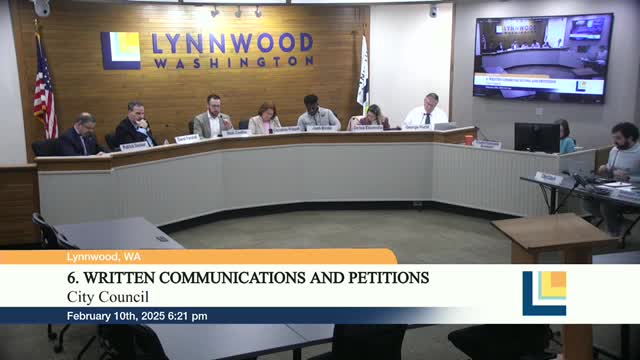
Lynnwood City Council members spent more than two hours on Feb. 10 debating whether the city’s municipal code gives clear guidance on who qualifies to hold an elected seat, and directed the city attorney to draft proposed code language to clarify residency proof and vacancy procedures.
The discussion followed public comments and written communications alleging that a sitting council member had not maintained residency in Lynnwood. The council did not adopt an ordinance or remove any official at the meeting; instead members asked legal staff to draft code changes for future consideration.
Why it matters: Council members said the dispute has eroded public trust and prompted repeated requests for clarity about residency, what counts as proof, and how long a council member may be absent from the city before a seat is considered vacant. Several residents and outside commenters urged immediate action; other council members cautioned that state case law and procedural limits complicate unilateral local action.
Public commenters raised the issue directly. On Zoom, Joe Kunzler said he had filed a Public Disclosure Commission complaint and urged the council to “ask mister Binda to resign,” and to follow state law. Resident Ted Heichel and a written commenter, Phong Nguyen, urged stricter enforcement of eligibility rules. Several speakers also expressed concern about aggressive news coverage and harassment of officials.
Council members diverged on how to respond. Council member Coelho summarized relevant state rules and said the difference between an “inactive” voter status and losing voter registration matters: “Having an inactive status on your voter registration ... does not preclude you from remaining a legally registered voter in the jurisdiction,” he said, recounting guidance from the county auditor and the Municipal Research and Services Center (MRSC).
Council member Hurst and Council member Decker pushed for clearer local standards. Hurst asked the city attorney to draft language that would, among other things, require proof of continuous residency for 12 months before election, require 365 days’ residency before filing, and specify that losing residency immediately vacates a seat unless otherwise determined. Decker said the public needs “confidence that every single one of us lives in the city,” and proposed a concise list of acceptable documentation tied to Washington State Department of Licensing standards.
Council member Binda responded to the allegations and described family circumstances and temporary housing arrangements, saying he remains “dedicated to continuing the important work we are doing together.” Several other council members urged caution and noted that case law on “incompatible offices” and residency disputes can be complex and expensive to litigate.
City attorney and staff cautioned that some remedies require court intervention. The city attorney said declaratory or quo warranto actions in superior court are possible but likened them to “expensive” fact-finding processes and warned that courts sometimes decline to resolve such disputes unless procedural requirements are met. She advised that MRSC guidance and Washington case law inform but do not wholly determine outcomes.
Outcome and next steps: The council did not adopt new rules at the meeting. Council member Decker formally asked the city attorney to draft proposed code language clarifying residency proof, allowed exceptions (for hardship) and vacancy procedures; the attorney accepted the assignment. The draft will be returned to council for review in a future meeting or work session before any ordinance is proposed.
Meeting context: The topic drew extended debate and repeated public comment, and was discussed alongside other agenda items. Council members signaled differing priorities—some urged immediate code changes to restore public trust; others warned against ad hoc rules tailored to a single circumstance. The city attorney said producing enforceable, defensible language will require careful drafting.
A selection of remarks from the meeting: “Removal from an elected position due to no longer maintaining the residency requirement is not automatic,” Mayor Frizzell said, reading MRSC guidance. “If the elected official denies that they have moved and refuses to give up their position, then a court would need to decide the matter.” Council member Decker said, “If you do not live in city limits, you do not qualify to hold elected office and your seat is immediately vacant,” reflecting the stricter interpretation pressed by several residents.
What comes next: The city attorney will prepare draft code language for council review. No vote or formal amendment was taken on Feb. 10; any change would require later formal introduction and vote.