Get Full Government Meeting Transcripts, Videos, & Alerts Forever!
Get email alerts on the Animal Services Strategic Plan topic
No spam. Unsubscribe anytime.
Animal Advisory Commission recommends City adopt Animal Services strategic plan with edits, requests targets and clearer intake metrics
Summary
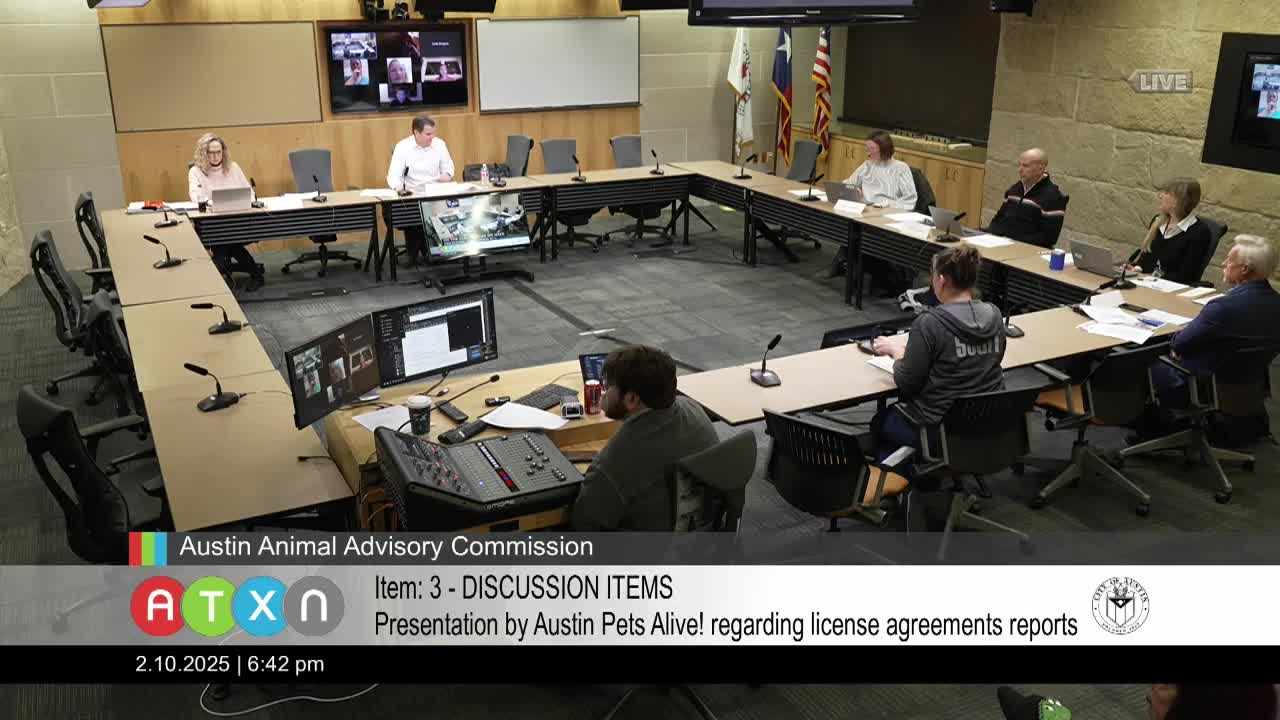
The Travis County Austin Animal Advisory Commission voted to recommend the City of Austin Animal Services Office strategic plan to City Council, adding language on community-cat programs, media outreach in English and Spanish, and a requirement to disaggregate intake metrics for strays versus owner surrenders.
The Travis County Austin Animal Advisory Commission voted to recommend the City of Austin Animal Services Office strategic plan to City Council after the commission approved several edits and asked staff to return with measurable targets and regular reporting.
The commission’s recommendation, passed by voice vote, directs staff to forward the draft to the Austin Public Health Committee for review on March 5 and then to City Council for adoption and implementation guidance. Assistant City Manager Susana Carvajal told commissioners the plan “represents the priorities of staff, the city's partners, stakeholders, and our community” and that staff will seek the council’s adoption and follow its direction for implementation.
Why it matters: Commissioners and public commenters said the plan could help rebuild public trust and guide operations at Austin’s shelter system—if the strategic goals are paired with clear targets and regular, transparent data that show whether outcomes are improving.
Commissioners made a set of specific edits during discussion and confirmed their recommendation to council with those changes. Key changes the commission adopted include: - Spay/neuter and community-cat language: broadened the wording to emphasize partnering with volunteers and community organizations that “support community cats” and to include reducing barriers to, and maximizing the impact of, trap-neuter-return (TNR) programs. - Open-intake triage: added language to develop methods to identify and prioritize emergency cases and animals judged most at risk for immediate intake, while commissioners debated the precise scope and application of that language. - Breed-restriction review: directed staff to analyze breed restrictions as part of the policy review list. - Media partnerships: added a strategy to “develop and implement plans to foster media partnerships and increase opportunities for media coverage in English and Spanish.” - Satellite adoption locations: asked staff to analyze and explore opportunities for fixed satellite adoption centers in higher-traffic locations to increase visibility and adoptions. - Metrics and reporting: directed staff to categorize open-intake measures by stray intakes and owner surrenders and to report numbers of animals as well as numbers of people; commissioners also requested quarterly reporting to the commission showing changes in measures over time.
Commissioners repeatedly pressed for numeric targets that would turn the document from “words” into a measurable plan. Public speaker Pat Valestreas told the commission, “This is not a plan. These are just words,” arguing the document needed specific year-by-year targets before it was forwarded. Commissioner Smigula said she was concerned the measures currently lack targets showing whether the metrics represent meaningful improvement: “there's nothing in the measures that give a way to track if they're moving forward.”
Staff said the next step is for Animal Services to develop targets informed by historical baselines and feedback, and to present those targets and the implementation schedule after council direction. Vice Chair Linder noted that converting counts into percentages and publishing them regularly is feasible: “I do foresee that opportunity to happen and converting the numbers into percentages is certainly something that we can do.” Carvajal confirmed the plan will be presented to the Austin Public Health Committee on March 5 as the next step before council consideration.
What the plan does not yet do: Commissioners and staff agreed the draft does not bind operational choices—staff retained discretion to recommend policy or operational changes to council. Several commissioners emphasized the need for staff-developed targets before the commission treats the document as a fully actionable five-year plan.
The commission’s formal recommendation was approved with the edits described above. Commissioners also asked staff to add the targets and return with a quarterly progress report to the commission once implementation begins.
Next steps: staff will transmit the revised draft to the Austin Public Health Committee (scheduled for March 5) and seek City Council adoption. The commission asked staff to return with targets and to publish progress data so the community can track implementation over time.
Ending: Commissioners closed discussion by thanking staff, volunteers and consultants who contributed to the plan, and the commission’s recommendation will move to the public-health committee and then to council for final action.