Get Full Government Meeting Transcripts, Videos, & Alerts Forever!
Get email alerts on the Water Metering topic
No spam. Unsubscribe anytime.
Committee advances HB 143 to revise water‑metering requirements and ease costs for farmers
Summary
The Natural Resources & Environment subcommittee voted to send House Bill 143 to the full committee after Environmental Protection Division staff described changes intended to preserve usable meter data, reduce compliance backlog—especially in Southwest Georgia—and allow limited EPD staff meter work in emergencies.
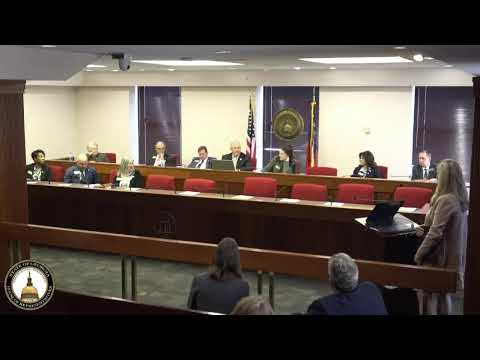
Members of the Natural Resources & Environment subcommittee voted to move House Bill 143, which updates the state's water‑metering rules and compliance procedures, to the full committee after a presentation by Environmental Protection Division (EPD) staff.
The bill, described to the panel as a package of technical and compliance changes, is intended to preserve the integrity of EPD's metering data while reducing installation costs and backlog for farmers. EPD staff told the committee the measure would not change how the agency calculates water use but would change which parties are responsible for meter costs in some cases, remove a trigger that has generated many compliance cases, and authorize limited in‑house EPD meter maintenance and installations in emergencies.
EPD staff said the proposal codifies three principal changes: restore a clear division of cost responsibility tied to permit date (the state pays for meters on permits issued before Feb. 2003 and permittees pay for meters on permits issued after that date); remove language that can shift meter costs to farmers when a pre‑2003 permit is later modified; and allow trained EPD staff to perform emergency repairs or installations when contractors are unavailable. "This bill will not change EPD's metering data," Chairman Dickey said during the committee discussion, adding the measure is intended to "give EPD the flexibility to move forward, keep the program strong, but take some of the cost off of them and the farmer." (Chairman Dickey made this remark while introducing the bill.)
EPD staff told the committee the department's records show three categories of responsibility have caused confusion: permits issued before Feb. 2003 (state pays), permits issued after Feb. 2003 (permittee pays), and pre‑2003 permits that were later modified or transferred after April 20, 2018 (which currently can shift costs to the permittee). EPD said that last category has produced compliance cases and confusion among permit holders.
An EPD presenter described the scale of the backlog in Southwest Georgia: the agency has about 3,700 sites it has identified that lack the infrastructure needed for metering, and if the agency attempted to pursue all of those cases under current rules it could result in roughly $9 million in metering costs for farmers. The presenter said the department currently has 11 active compliance cases that would, combined, bill farm permittees about $280,000 under current rules.
EPD staff also said the department contracts meter reading work statewide (noting a recent contract with the Georgia Forestry Commission to read more than 13,000 meters this year) and that hydrology staff determine how many usable meter readings are required in each basin. The presenter said the program's immediate priority remains Southwest Georgia basins, which the presentation listed as the Flint, Chattahoochee, Suwanee and Oglotany basins, but that EPD plans to expand work to other basins over time as resources allow.
Committee members and stakeholders framed the bill as an attempt to balance the state's need for defensible water‑use data with the practical and economic burdens on farmers. Shirley Smith, participating in the discussion, praised earlier work on the metering program and called the bill another step forward for records and stewardship. EPD staff emphasized the bill is also meant to reduce the department's backlog of compliance cases and to allow staff to address time‑sensitive meter failures that could threaten crops if repairs wait for unavailable contractors.
After discussion, the subcommittee took a voice vote on moving HB 143 to the full committee. The chair called for "aye"; members responded "Aye." No recorded roll call tally was provided on the transcript. The chair said, "I think we will try to, move this to full committee."