
Guam committee holds public hearing on Resolution 279‑32 COR to study ferry service to CNMI
Get AI-powered insights, summaries, and transcripts
Sign Up Free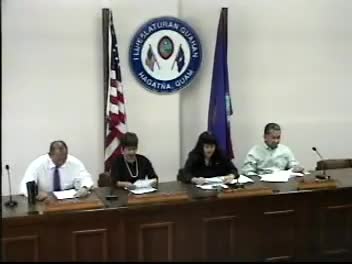
Summary
The Committee on Municipal Affairs, Tourism, Housing and Restoration and Redevelopment of the Guam Legislature held a public hearing on Resolution 279‑32 COR, which seeks to promote affordable regional transportation between Guam and the Commonwealth of the Northern Mariana Islands (CNMI) by means of ferry service or a similar vessel.
The Committee on Municipal Affairs, Tourism, Housing and Restoration and Redevelopment of the Guam Legislature held a public hearing on Resolution 279‑32 COR, which seeks to promote affordable regional transportation between Guam and the Commonwealth of the Northern Mariana Islands (CNMI) by means of ferry service or a similar vessel.
The resolution drew testimony from CNMI and Guam officials, local elected leaders and residents who urged the committee to authorize feasibility work and consider a pilot route — most often suggested as Guam–Rota — while flagging safety, wave conditions and long-term financing as issues that must be resolved before service could begin.
The resolution matters because proponents say a ferry could provide an alternative to air service, support tourism and commerce, and serve as a lifeline during natural disasters or when air service is interrupted. Thomas Jacob Camacho, who identified himself as the governor’s special assistant for public transportation and chairman of the Commonwealth Public Transportation Advisory Board, told the committee the Commonwealth Office of Transit Authority (COTA) "stands ready to work with local stakeholders, implement those recommendations" should a sea route be found viable.
Camacho described COTA’s role and ongoing planning. He said COTA was created by statute and opened in August 2011, currently operates demand‑response services, and is selecting a consultant to conduct an inter‑island marine transportation facility study. Camacho said the original scope for that study included Rota and Guam but was reduced, on recommendation from the Federal Highway Administration, to focus on Saipan–Tinian due to limited funding. He said COTA supports a separate facility study for the Rota–Guam route and suggested the two territories consider an interlocal agreement or a consolidated regional body to coordinate and fund regional transit projects.
Martin Mendiola, who identified himself as board manager for the Commonwealth Ports Authority on Rota and a resident of Rota, urged support for the resolution and recommended a limited pilot project focused on the Guam–Rota route. Mendiola said Rota faces high fuel and import costs and that improved sea service could increase consumer demand, expand markets for local products and support tourism. He told the committee, "I am in favor and will continue supporting the intent of this resolution." He also offered to help garner local stakeholder buy‑in on Rota.
Private citizen Fred Schmidt, who described himself as a Guam resident and frequent traveler to Rota, said short weekend trips could encourage visitors to extend stays and benefit Guam tourism. Schmidt, who said he was not representing any company, told the committee private‑public cooperation between the territorial governments would be essential.
Committee members and other witnesses raised operational and financial questions. Members discussed whether an initial pilot should carry passengers only, rather than vehicles, to avoid cross‑jurisdiction vehicle licensing and registration hurdles. Vice Speaker B.J. Cruz said the resolution as drafted does not explicitly mention automobiles and suggested a passenger‑only pilot to test viability first. Camacho and other witnesses noted that including vehicle (roll‑on/roll‑off) capability increases revenue potential but also raises regulatory complexity.
Safety and sea conditions were repeatedly cited. A witness who identified himself as Fred Schmidt and a maritime consultant said wave and swell heights in some channels can reach 14 feet, and passenger comfort and safety were significant past issues when private ferry operations ceased. He said recent vessel designs in use elsewhere may mitigate comfort problems. A Rota official reiterated that resilient, U.S. Coast Guard‑certified vessels would be required for emergency preparedness.
On financing, Camacho and others recommended exploring public‑private partnerships, with one suggested ownership split of roughly 51 percent government (territorial) ownership and 49 percent private operation under service contracts. Suggested funding sources mentioned during testimony included the Federal Transit Administration’s ferry discretionary program, Federal Highway Administration formula grants and technical assistance, local revenues (fuel taxes, parking, concessions) and even international or multilateral funding sources such as the Asian Development Bank. Camacho told the committee the Tinian–Saipan feasibility study was funded at about $175,000 by the Federal Highway Administration.
Guam Regional Transit Authority (GRTA) submitted a written letter of support that was read into the record; the letter said GRTA would provide technical assistance and applauded regional planning for ferry service. The committee chair said she would seek to complete a committee report by the end of the week and asked for the resolution to be placed on the session floor during the following week’s January session.
No formal vote on Resolution 279‑32 COR was taken at the hearing. Committee members instructed staff and discussed next steps for a feasibility and pilot study, including seeking federal technical assistance and matching planning funds. The hearing record contains repeated calls from witnesses for a structured, stakeholder‑inclusive task force or committee between Guam and CNMI to guide pilot planning and to coordinate studies and funding.
The committee adjourned the public hearing without action at 11:25 a.m.; members indicated they planned to move a committee report and potentially place the resolution on the floor for consideration in the next session.