Get Full Government Meeting Transcripts, Videos, & Alerts Forever!
Get email alerts on the Public Safety Substation topic
No spam. Unsubscribe anytime.
Washington County sheriff pitches small substation in Virgin; residents raise traffic and neighborhood concerns
Summary
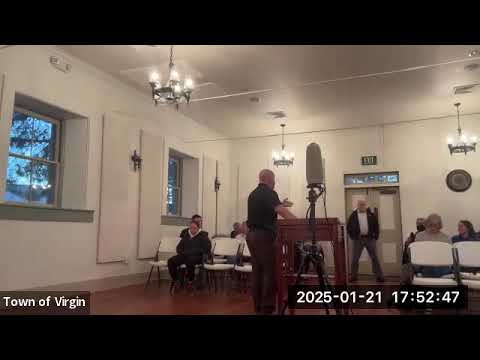
At a Jan. 21 Virgin Town Council meeting, Washington County Sheriff Nate Brooksby outlined a proposal to use space in the town's new hall as a substation to shorten response times and provide a base for deputies; residents asked about traffic, lights, hours and how contracted patrol hours will be tracked.
Sheriff Nate Brooksby, Washington County sheriff, told Virgin residents and council members on Jan. 21 that the sheriff's office is seeking space in the town's new town hall (the former LDS church) to use as a small substation for deputies assigned to contract patrol time in Virgin.
Brooksby said the substation would give deputies a nearby place to download body-camera and in-car video, complete reports and meet with residents, and it would provide a visible patrol presence in the community. "If we can get into this space and we have data capabilities, the deputy doesn't have to drive all the way back into our office," Brooksby said. "They can download their body camera and in car video. They can take a break, they can do reports."
The proposal was presented during a question-and-answer session before the council's regular meeting. Town staff and residents pressed Brooksby for operational details, and several residents said they supported a law-enforcement presence but were worried about increased traffic, lights and activity in a residential area.
Why it matters: The town is negotiating how to provide contract patrol time while remaining an incorporated municipality. Brooksby said the current contract with Virgin is about $15,000 a year and yields roughly "8 to 10 hours of focus patrol time in Virgin." He said the sheriff's office recorded about 400 calls for service in 2024, and that roughly 350 of those calls were opened when a deputy was logged as on contract patrol time in Virgin.
Brooksby described two rooms the office would use if the town approves space: one for deputies to do reports and rest briefly, and another private room for residents to fill out statements or be interviewed. "If we have a victim, it would save them the drive to the main office," he said. He added that the county covers about 2,500 square miles and that the substation would reduce travel time for deputies who otherwise must return to the main office by the fairgrounds in Hurricane.
Residents' concerns and sheriff's response: Several residents reiterated that they value the neighborhood's quiet, low-traffic character and asked whether police activity could bring additional noise, lights or round-the-clock traffic. Lori Reynolds, a nearby resident, said she was "deeply concerned about additional uses that are not compatible with our residential neighborhood" and worried about hours and extra traffic. Other residents asked whether emergency lights or sirens would be activated while leaving the substation, and where patrol vehicles would be parked.
Brooksby and other participants said the typical use would be limited: deputies would use the facility mainly for brief administrative tasks, evidence downloads and occasional meetings with residents. "We're not gonna use it 24 hours a day," Brooksby said, adding that resident visits might be "maybe once a month" and that nighttime use would most likely be a brief bathroom break. He also said deputies would be directed not to activate lights and sirens in residential areas except when required by an emergency response.
Operational and contractual details discussed: Council members and residents asked how the town's paid patrol hours would be tracked when deputies are physically at the substation but are not actively patrolling within Virgin town limits. Brooksby explained the current process: deputies notify dispatch when they enter town limits, and dispatch opens a specific call or log entry that is counted against the town's contract patrol time; when the deputy leaves town limits or responds to an outside priority call, that time is no longer billed to the Virgin contract. "The second that he leaves the Virgin town limits, then he's basically off the clock," Brooksby said. He said the office can produce call logs showing the times deputies were logged in Virgin so the town can reconcile billing.
Comparisons and context: Brooksby noted other locations where the sheriff's office has space or partnerships, including Enterprise (where a school resource officer is present during the school year) and Pine Valley Fire Station. He contrasted that arrangement with Springdale, where the town previously contracted with the Springdale Police Department at a higher cost (he said Springdale had been paying about $80,000 a year and sought $100,000), and he emphasized that his office does not operate to generate citation revenue.
Related local issues mentioned: Brooksby and residents discussed traffic on State Route 9 and local roads (including Sheep Ridge Road and Kolob Terrace Road), mentioning recent increases in tourism and concern about speeds and passing behaviors on two-lane roads. Brooksby said congressional funding for an asphalt project (initiated through the offices of Rep. Chris Stewart and later handled by Rep. Celeste Maloy, as discussed at the meeting) is expected to become available in March; he noted that pavement improvements may increase traffic and that road-borne safety changes could be considered in time.
Next steps: The council will decide whether to permit the sheriff's office to use the town hall space as a substation and any related budgetary adjustments for patrol hours. Brooksby said the sheriff's office will review the arrangement annually and that the town can discontinue the office's use of the space if problems arise. "If it becomes problematic, then we'll have no — we'll cancel it," a council member said during the meeting.
No formal motion or vote on the substation was recorded during the Q&A portion of the meeting.
Ending: Residents and council members asked that details be clarified in any agreement — specifically how contracted hours will be documented when deputies use the substation for administrative tasks, whether keys or after-hours access will be controlled, and how the town will reassess the arrangement if neighborhood impacts appear. The town did not take a formal vote at the meeting; a future council action was indicated as the next procedural step.