Get Full Government Meeting Transcripts, Videos, & Alerts Forever!
Get email alerts on the Election Integrity topic
No spam. Unsubscribe anytime.
Committee tightens public testing, notice and retest rules for voting machines (House Bill 278)
Summary
The committee passed House Bill 278 to clarify and strengthen requirements for pre‑election testing of voting machines and tabulators, adding public‑notice, retest and reporting requirements and several technical amendments requested by clerks and the secretary of state.
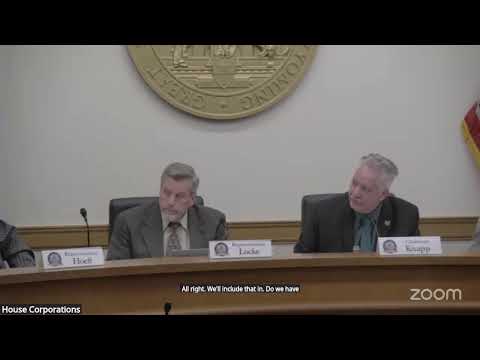
The Corporations, Elections & Political Subdivisions Committee passed House Bill 278, a measure that tightens public testing, notice and retest procedures for voting machines and tabulators used in Wyoming elections.
Sponsor Representative Locke presented the bill as a set of clarifications and added rigor to existing testing procedures, including minimum notice periods, an explicit requirement that machines to be used in an election be tested, and filing of test certifications with the secretary of state. The bill was prompted by questions raised after the 2024 elections about whether tests had consistently met statutory requirements.
Secretary of State Chuck Gray told the committee the bill’s “impetus . . . is really about ensuring clarity and rigor in the public testing of our voting equipment prior to elections. I'm fully in support of House Bill 278.” County clerks and election officials testified about current practices: Mary Lankford, representing county clerks, said “every voting machine was tested in this last election” and described common practices such as running ballot styles through machines, public test decks and logging seals. Fremont County Clerk Julie Fries asked for clear authority to retest if an error is found in the days before an election.
Key provisions and committee amendments adopted during the hearing include: - Public notice requirements for logic and accuracy testing: the bill sets minimum notice timing (sponsor language inserted 5 days before an initial test and 24 hours before a retest for some tests) and requires testing to be open to the public rather than limited to party representatives. - A requirement that a copy of the testing certification be filed with the secretary of state and that the county retain a copy; the county clerk retains the original certificate. - Clarification that seals on machines may be broken to perform a retest or to produce requested logs or printouts and then resealed; clerks testified seals are numbered and logged. - Stronger test content requirements: tests must include assignments for write‑in candidates and must exercise undervote and overvote conditions; the committee added language that such vote testing be done for each precinct and for each ballot style where appropriate, and for each machine type capable of producing an overvote. - Requirements that the county post detailed reports, precinct‑level results, complete audit logs and proof of testing and make those materials available on request.
County clerks sought modest drafting changes; clerks’ representatives preferred that the original certificate remain with the county and a copy be sent to the secretary of state. The secretary supported that change. Clerks and election‑integrity advocates also emphasized testing both the ballot‑marking stage and the tabulation stage of ‘‘express vote’’ or ballot‑marking devices: one speaker explained those devices require testing of the human‑readable printout and the underlying barcode used by tabulators.
Committee members also inserted an authorization allowing the secretary of state to permit retests or deviations when the two‑week notice period would otherwise prevent necessary corrections, and they changed a previously vague phrase (“if possible”) to a more precise formulation tied to the machine types that can record overvotes.
The committee adopted these amendments and then approved the bill on a roll‑call vote, 9–0. The vote record lists Representatives Brown, Locke, Heft, Johnson, Lucas, Webb, Weber, Yin and Chairman Knapp as voting aye. With that result, House Bill 278 passed the committee as amended.