Get Full Government Meeting Transcripts, Videos, & Alerts Forever!
Get email alerts on the Women Girls Rights topic
No spam. Unsubscribe anytime.
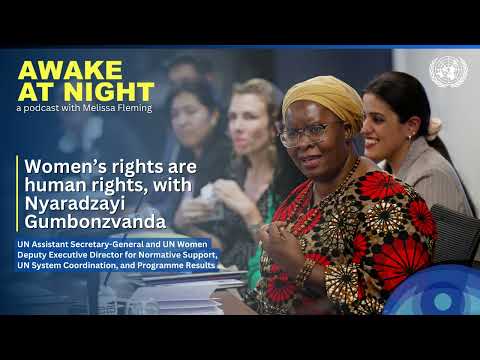
UN Women deputy: peace is prerequisite for girls’ education, urges more resources and accountability
Summary
Neeradzai Gompansvanda, a deputy executive director at UN Women, told host Melissa Fleming that conflict and poverty limit girls’ opportunities, called for funding and accountability for gender services, and highlighted a UN Women gender snapshot report and her charity work supporting survivors of gender-based violence.
Neeradzai Gompansvanda, UN assistant secretary-general and one of two deputy executive directors of UN Women, said peace is essential to allow girls to remain in school and for women to fulfill economic and caregiving roles, during an interview on the United Nations podcast Awake at Night.
Gompansvanda told host Melissa Fleming that growing up in a Zimbabwean village during the country’s liberation war shaped her view that “peace is a prerequisite. It’s so critical for development. It’s so critical for unleashing the potential of the little girls.” She described schools closing during the conflict, limits on movement and markets, and family losses that exacerbated poverty and curtailed educational opportunities.
The interview places Gompansvanda’s advocacy in personal context. She described being raised by her mother after her father’s death, living in a household supported by siblings and community networks, and returning to school after independence in 1980. She said early experiences — including relatives who contracted HIV and a sister who married at 16 — informed her focus on women’s rights and social supports.
“Peace is so important for enabling mothers, widows to give the best they can,” Gompansvanda said. She also emphasized community support systems: “it is those systems of support that enabled some of us to be able to then go to school.”
Turning to policy, Gompansvanda cited a UN Women gender snapshot report and a global spending figure, saying “we just launched our gender snapshot report and say $4,200,000,000,000 last year spent on military expenditure.” She framed that figure as indicative of trade-offs between military spending and investments in education and services for children affected by conflict: “What does it mean for the 19,000,000 kids who are out of school?”
Gompansvanda called for a shift from naming problems to funding and accountability for services. “What keeps me awake at night is how do we move the conversations from naming the issues, to move the conversation from defining the solutions, to actually having the resources for the services to flow and ensure accountability,” she said.
She described work she has supported directly through the Rosario Memorial Trust, which operates a short-term shelter for survivors of gender-based violence and provides skills training. The trust offers stays it intends to be three months long, though Gompansvanda said some clients remain up to a year because of limited options for safe housing and economic opportunity.
The guest also discussed disability and personal injury. Gompansvanda said a road traffic accident about two years earlier left her using a wheelchair and heightened her awareness of barriers faced by women with disabilities: “I feel privileged. I’m aware of my privilege that I can have somebody to help me stand up… but I know people who are just crawling on the sand, who do not have any possibilities.”
Throughout the interview she urged broader recognition of women’s economic and caregiving contributions, stronger property and decision-making rights for women, and prioritized prevention of conflict. “We can buy one helicopter less,” she said, referring to shifting resources away from military buildup to education and services.
Melissa Fleming opened and closed the interview and credited production staff and contributors; those credits were editorial and not part of Gompansvanda’s remarks.
Gompansvanda’s personal history and policy remarks formed the interview’s central theme: that sustained peace, adequate funding for gender-responsive services and accountable implementation are necessary to expand educational and economic opportunities for girls and women, especially in conflict-affected settings.