Get Full Government Meeting Transcripts, Videos, & Alerts Forever!
Get email alerts on the Advisory Neighborhood Commissions topic
No spam. Unsubscribe anytime.
Council hearing spotlights strain on Advisory Neighborhood Commissions and OANC efforts to modernize support
Summary
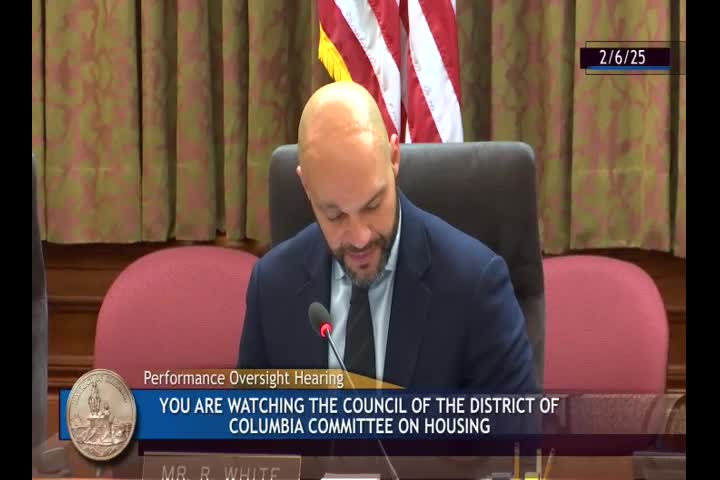
Council Member Robert White opened the Committee on Housing hearing by saying, “Performance oversight hearings are a key part of how we hold government agencies accountable,” and focused the committee on the Office of Advisory Neighborhood Commissions (OANC) and the volunteers who serve as Advisory Neighborhood Commissioners.
Council Member Robert White opened the Committee on Housing’s Feb. 6 performance oversight hearing by saying, “Performance oversight hearings are a key part of how we hold government agencies accountable,” and directed scrutiny at the Office of Advisory Neighborhood Commissions (OANC) and how it supports the District’s 46 ANCs.
ANC commissioners and community representatives told the committee that long-standing administrative burdens—especially financial reporting and treasurer responsibilities—are driving experienced commissioners away and making it difficult for volunteers to do the work expected of them. Testifying commissioners called for clearer notice procedures, centralized accounting support, stronger outreach to residents, and a practical fix to a childcare reimbursement law that has produced zero payments since it passed.
OANC Executive Director Kent Bace said the office has made “significant” progress on several fronts over the past year but stressed that the agency does not have enforcement or supervisory authority over ANCs. “The OANC does not have enforcement or supervisory authority over ANCs, nor does the statute entitle the OANC to discipline or remove elected commissioners,” Bace told the committee, and outlined new tools OANC has deployed to help commissioners carry out their duties.
Why it matters: ANCs are unpaid, hyper-local neighborhood bodies that advise city agencies and shape local development. Commissioners told the Council that procedural complexity and administrative overhead are reducing retention and limiting ANCs’ ability to deliver community input and oversight.
What commissioners said
- Commissioner Kathy Henderson (ANC 5D) described operational problems in her ANC and raised questions about an alleged misappropriation of funds; she told the committee she had repeatedly tried to get help and had “Not once did anyone answer the call. … That’s unacceptable,” when describing her attempts to contact agency staff about returning-citizen services (remarks to the committee appear in the public record). Henderson also pressed for a stronger mechanism to refer complaints about “rogue” commissioners while preserving voters’ authority.
- Former Commissioner Zach Israel and several sitting commissioners urged legislative fixes to a childcare reimbursement provision of the D.C. Code that has never resulted in payments to commissioners. Israel called the statutory language impractical and said it should be amended so commissioners can be reimbursed for reasonable babysitting while attending official meetings.
- Multiple commissioners recommended centralizing administrative tasks and financial management to reduce the burden on volunteer treasurers. Commissioner Paula Edwards, a certified public accountant, told the committee a centralized accounting process — similar to how other government offices handle purchase orders and reimbursements — would reduce errors and the risk of withheld allotments.
OANC’s response and recent changes
Bace described a set of agency initiatives the office has completed or advanced in FY 2024 and early FY 2025:
- New public website and tools. OANC moved a redesigned, ADA- and FOIA-compliant website into production on Feb. 1 with searchable materials, links to ANC bylaws and annual reports, a consolidated calendar and an RSS feed for ANC news. Bace told the committee he expects the site to improve public access to ANC records and provide a single place for commonly requested documents.
- Technology and training. OANC said it centralized Zoom and e-signature accounts, hired a land-use attorney and a training specialist, and is developing a learning management system (LMS) to deliver on-demand trainings with quizzes and certificates; that system is intended to let OANC track which commissioners complete trainings and identify recurring gaps.
- Financial process improvements. OANC reported work with the committee to update statutory financial provisions in the FY25 Budget Support Act, created a fiscal management working group composed of commissioners and is publishing treasury guidance and annual reports. Bace said OANC reviews grant applications in advance and provides written guidance to ANCs prior to votes.
Remaining disputes and priorities
Many commissioners and witnesses said the office has improved but still lacks the capacity to address the full set of needs across 46 ANCs. Common requests included: central accounting support to avoid private bank accounts and inconsistent treasurer practices; stronger outreach so residents know how and where to participate; more peer-to-peer commissioner convenings; a mediation option for intra-ANC disputes; and clearer legal guidance about the scope of commissioner communications and sign-on letters.
Several commissioners asked the Council to resist transforming OANC into an enforcement agency. OANC and multiple witness statements made a distinction between technical assistance (OANC’s statutory mission) and disciplining or removing elected commissioners (authority residing elsewhere).
Ending note
Bace told the committee OANC will continue to refine the new website, roll out the LMS and work with the committee to refine key performance indicators that measure impact rather than administrative outputs. The committee said it will conduct a survey of former commissioners to better understand why many do not seek re‑election and will consider structural changes to reduce administrative hurdles for volunteers.
Speakers quoted in this article are listed in the meeting record and were present at the Feb. 6 hearing.