Get Full Government Meeting Transcripts, Videos, & Alerts Forever!
Get email alerts on the Affordable Housing topic
No spam. Unsubscribe anytime.
Planning commissioners review RHNA progress, urge proactive strategies and ask subcommittee to refine recommendations
Summary
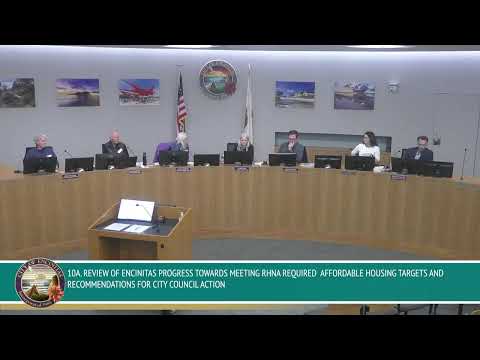
The Encinitas Planning Commission reviewed a subcommittee report on the city’s progress toward RHNA affordable‑housing goals and asked the subcommittee to refine and prioritize recommendations before sending them to the City Council.
The Planning Commission on Feb. 6 reviewed a subcommittee report on the city’s progress toward meeting RHNA (Regional Housing Needs Allocation) affordable‑housing targets and discussed recommended next steps, including issuing targeted requests for proposals (RFPs) on public parcels, pursuing public‑private partnerships (P3s), and exploring community land trusts and smaller unit types. Commissioners asked the subcommittee to refine the report and return with a shorter, prioritized draft to forward to the City Council.
Commissioners Susan (subcommittee co‑lead) and Bob (subcommittee co‑lead) presented the draft review and said staff produce a RHNA “tracker” but the subcommittee had compiled an independent spreadsheet to clarify which approved projects provide below‑market units and which do not. The presenters told the commission the city’s current mix of projects yields what one presenter called an “80/20” pattern—many market‑rate units and relatively few deed‑restricted low‑ or very‑low‑income units—and they urged the commission to consider alternative approaches to generate a higher share of affordable units without large‑scale upzoning of vacant residential land.
“Is there a basis? Would there really be 2,016 of these above moderate?” one presenter asked while discussing projected above‑moderate units shown on the spreadsheet. The presenters proposed several approaches: issue RFPs for city‑ or agency‑owned parcels (for example, North County Transit District properties or city lots); consider public‑private partnerships and community land trusts that retain land ownership while selling or leasing housing; pursue smaller unit types or “micro” units; and pilot on‑demand transit or ride‑share services to reduce required parking and lower construction cost.
Public comment reflected a range of views. Scott Campbell, who said he reviewed HCD’s public dashboard, argued the city is performing well against state averages and urged caution before aggressive actions: “As a city, we're … doing really well. Let's stop stressing out.” Bob Kent, a public speaker who cited local market data, said rent and displacement pressures are real and urged the commission to pursue proactive solutions and to present the Affordable Housing Task Force report to council. Ellen Burr asked commissioners to clarify whether proposed projects could apply income or occupation set‑asides, saying financing arrangements sometimes require tailored occupant criteria. Rachel Graves said she worried the scope of the ad hoc work risked duplicating the Affordable Housing Task Force and asked for greater transparency about the committee’s role.
During deliberations commissioners emphasized several practical constraints: rezoning certain public parcels could trigger a vote under the city’s initiative (Prop A) or require long timelines; funding and financing for deed‑restricted projects typically require complex capital stacks (tax credits, grants and subordinated loans); and state laws (for example, density bonus and recent ADU/land‑use changes) shape what the city can and cannot require of private developers. Staff clarified that existing naturally occurring affordable housing (NOAH), such as mobile‑home parks and privately held small units, cannot be counted forward toward RHNA targets; RHNA counting requires permitted/new units or deed‑restricted affordable units, and the city’s annual progress reports and no‑net‑loss tracking are the official records used for state reporting.
Outcome and next steps Commissioners did not forward a final package to the City Council. Instead, by consensus the commission directed the ad hoc subcommittee (Commissioners Susan and Bob) to revise and substantially shorten the draft, prioritize recommended actions, and return with a refined version for further commission consideration and possible transmission to the City Council. Staff confirmed the city already files the annual progress report with HCD and maintains no‑net‑loss tracking; commissioners asked staff to help verify project lists and data used by the subcommittee.