Get Full Government Meeting Transcripts, Videos, & Alerts Forever!
Get email alerts on the Transportation Utility Fee topic
No spam. Unsubscribe anytime.
Far West reviews transportation utility fee study as council weighs road funding options
Summary
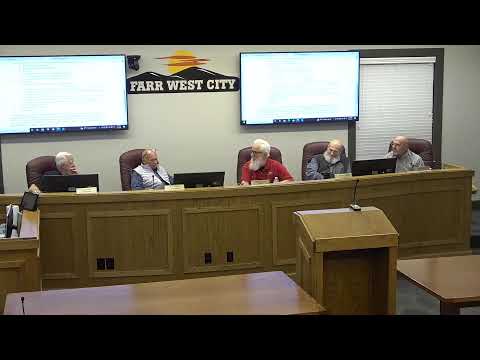
Zach, an engineer with Jones and Associates who also serves as city engineer for Fruit Heights, presented a Transportation Utility Fee (TUF) study to the Far West City Council during a Feb. 6 work session, laying out options for a per-property fee to fund street maintenance.
Zach, an engineer with Jones and Associates who also serves as city engineer for Fruit Heights, presented a Transportation Utility Fee (TUF) study to the Far West City Council during a Feb. 6 work session, laying out options for a per-property fee to fund street maintenance.
The study found the city’s current annual street funding — roughly $382,000 from Class C and state gas-tax sources, according to the presentation — does not cover the work needed to maintain the citywide pavement remaining service life (RSL). Zach said a citywide average RSL has declined since the 2020 condition survey and that delaying preservation work increases repair costs.
Zach said the study used an equivalent residential unit (ERU) methodology and industry trip-generation data (ITE) to assign relative fees across residential, commercial and other parcel types. He reported the city’s inventory includes about 2,431 residential units and a modeled total of about 7,796 ERUs; the spreadsheet in the presentation also showed about 22,924 daily trips tied to residential land uses in the model.
The consultant ran nine fee scenarios, from $3 to $10 per ERU (monthly), and projected 10-year RSL trends for each. At the low end the model showed the current downward RSL trend continuing; at higher fee scenarios the city could stabilize or improve the average RSL. Zach used examples such as a $7-per-ERU monthly fee that would begin to “get ahead of the curve” and a $10-per-ERU option that would generate substantially more annual revenue and allow more extensive reconstruction and widening projects.
Council members focused questions on how the ERU is defined and billed, who would pay, transparency, appeals for large commercial users and reporting frequency. The consultant explained an ERU is assessed per household-equivalent for billing equity (not by household occupancy), that businesses would be assigned ERUs based on trip-generation rates and building characteristics (square footage, stalls, rooms, as applicable), and that the fee would generally be billed monthly (for example, added to utility or water billing).
On appeals and exemptions, Zach said the ordinance can include an appeal process for businesses that can demonstrate lower trip generation (for example, a facility that has moved to remote operations), but any exception should be governed by objective, data-driven criteria so it is applied uniformly.
Council members also asked about reporting and accountability. Zach recommended the city publish annual project descriptions and periodic pavement-condition updates tied to the fee, and he suggested the study be refreshed on a schedule the council finds appropriate; he said Fruit Heights updates their study every 10 years but that, for accountability, Far West might prefer a five-year review if the fee is new.
Zach listed work the TUF could fund, including crack seal, chip seal, patching, milling, overlays, reconstruction and associated curb, gutter and sidewalks; he cautioned that treatment choices affect long-term RSL projections and stressed a consistent preservation strategy rather than one-off “band-aid” repairs.
The council did not take action on the presentation; members asked staff to include the study in upcoming budget discussions and to return with an ordinance and draft billing approach if the council decides to pursue a TUF.