Get Full Government Meeting Transcripts, Videos, & Alerts Forever!
Get email alerts on the School Bond Referendum topic
No spam. Unsubscribe anytime.
Stafford leaders present long‑range facilities options; community urges bond vote
Summary
Stafford Municipal School District (SMSD) and the City of Stafford on Monday held a joint public meeting to review a comprehensive needs assessment, bond market scenarios and community feedback and to hear public comment on whether the district should seek voter authorization for school building bonds.
Stafford Municipal School District (SMSD) and the City of Stafford on Monday held a joint public meeting to review a comprehensive needs assessment, bond market scenarios and community feedback and to hear public comment on whether the district should seek voter authorization for school building bonds.
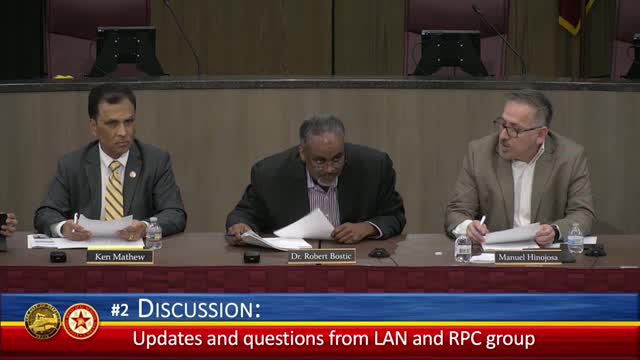
Dr. Robert Bostic, superintendent of Stafford Municipal School District, told the joint meeting: “For the record, you do not have a bond. You don't have a bond at all,” and said the session was intended to share the comprehensive needs assessment and obtain community input before any formal ballot decision.
The meeting centered on a facilities assessment prepared by LAN and financing scenarios produced by RBC Capital. LAN’s facility survey and subsequent Long Range Planning Group ranking produced a menu of projects that, depending on the scope, ranged from about $80 million (described by presenters as an amount that could be borrowed with no additional tax increase) to larger packages that would cover additional renovations and alternate projects. Dr. Bostic and presenters said one aggregate total of all identified projects reached roughly $246,576,931 when alternate projects were included. Consultants also noted that a prior $62,000,000 bond authorization, adjusted for inflation and current construction cost estimates, is now roughly equivalent to about $90–92 million.
Why it matters: the school district’s capital projects (buildings, bus fleet, grounds and other non‑operational assets) are funded from the district’s Interest & Sinking (I&S) debt service and are separate from Maintenance & Operations (M&O) taxes that pay for teacher salaries and day‑to‑day operations. Presenters stressed that I&S currently carries about 21¢ of the tax rate; M&O was described at about 78¢ after state compression. The district and consultants said the state’s funding and local property value growth affect available operating revenue and the risk of “recapture.”
Public comment was strongly in favor of placing a bond referendum before voters. Multiple residents and past trustees said improved facilities, safety and technology are needed to keep Stafford competitive and to support career/technical programs, band and athletics. “I recommend that we allow the community to decide how our tax dollars are allocated,” said Letty Almendarez, identifying herself as a Stafford resident. Long‑range planning group members and volunteers said they toured facilities, ranked priorities and completed surveys; presenters said 33 of 41 members responded to the initial ranking and later events expanded participation.
Board and city officials reviewed financing scenarios and voter‑impact estimates prepared by RBC Capital. Presenters showed example homeowner impacts (presented for an effective taxable value example) such as an annual increase of about $30.65 on one scenario and larger impacts on higher‑cost scenarios; consultants said the packet distributed at the meeting intentionally left blanks for the formal referendum amounts until community feedback could be incorporated. Dr. Bostic noted the statutory and calendar constraint that February 14 is a final cut‑off date for either body to place an item on the May ballot, and urged continued public input so the board and city could act before the deadline.
Several speakers emphasized process and transparency. Vice President Hamani (board vice president) and other trustees described a longer community‑led planning process than the district’s previous bond attempt, saying the Long Range Planning Group and key communicators had more opportunities to review LAN’s assessment and to question RBC Capital’s assumptions. The district’s bond attorney, Marcus Dietz, and legal counsel in the room reiterated that elected officials and staff may not use city or district resources, property or official time to advocate for a ballot measure; elected officials retain First Amendment rights to speak on their own time.
What’s next: the board and city will return with more specific referendum amounts and a proposed ballot resolution at follow‑up meetings. Dr. Bostic and several trustees asked the public to return for a district meeting and a separate city meeting next week; consultants and staff were scheduled to present updated numbers at that time. No vote was taken during the joint session to place a bond on the ballot.
Votes and formal actions recorded at the meeting were procedural: the Stafford Municipal School District board received a motion to adjourn from Board Secretary John Battista, seconded by Trustee Matilongo, and the motion carried unanimously; the city side also moved and seconded adjournment and the joint meeting concluded at 8:50 p.m.