Get Full Government Meeting Transcripts, Videos, & Alerts Forever!
Get email alerts on the Kalaupapa Transition topic
No spam. Unsubscribe anytime.
Maui Council committee hears state plan to add Kalawao (Kalaupapa) to Maui County; community leaders press for inclusion and clarity
Summary
State health and land officials outlined legislation and operational questions about bringing Kalawao County (Kalaupapa) into Maui County. Department of Health said it will phase out direct patient care after the last resident dies; community groups and DHHL urged fuller beneficiary consultation and clearer funding, leases and roles.
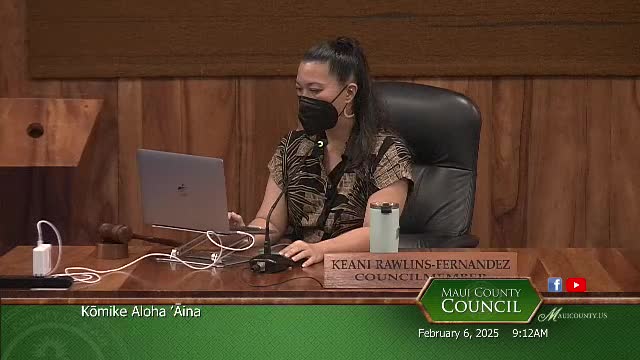
Maui County Council members and state agency representatives met Feb. 6 to discuss proposed state legislation (SB1432) that would add Kalawao County (commonly called Kalaupapa) to Maui County and to amend Hawaii Revised Statutes (HRS) chapter 3-26 governing Kalawao/Kalaupapa.
The meeting brought Department of Health officials, Department of Hawaiian Home Lands staff and local community groups together for presentations and public testimony. Dr. Diana Felton, administrator of the Department of Health’s Communicable Disease and Public Health Nursing Division, told the Committee that the draft bill would largely take effect one year after the last registered Kalaupapa resident dies and would “repeal components of HRS 3-26 that pertain to DOH’s patient care responsibilities.” She said the department intends to continue environmental remediation and monitoring after patient care ends but expects to transfer many day-to-day operational responsibilities to the National Park Service (NPS) over time.
Why it matters: Kalaupapa is a historic peninsula on Molokai created under 19th-century isolation laws for people with Hansen’s disease (leprosy). State and federal agencies, descendants and community organizations have long debated who should steward the land, cultural resources and ongoing maintenance once the population falls to zero. Changing the county status and statutes would reshape which local, state and federal rules apply and who pays for services.
Key points from presentations and public testimony
- Current patient care and staffing: Felton said the state’s Hansen’s disease registry lists seven patients, aged roughly in their mid-80s to early 100s. DOH currently funds about 33 positions at Kalaupapa, about 12 of them for direct patient care; some patients live in private homes at Kalaupapa and others in a care home or off-island (Halema‘ala Care Home on Oahu).
- What SB1432 would do: According to DOH, the bill in its draft form would (a) amend HRS 3-26 so provisions tied to DOH’s daily patient-care role are repealed once there are no remaining patients, (b) add Kalawao County to Maui County, and (c) create a state historic-area designation with boundaries coterminous with Kalaupapa National Historical Park and the existing county carve‑out. The bill was described in committee as a framework intended to begin public and legislative shaping rather than a final plan.
- Unresolved operational and fiscal questions: Felton and county officials said many responsibilities remain unresolved — for example, whether county requirements such as permitting, taxation or zoning would be exempted for the area as they are now; which agency would bear costs for utilities, waste removal, road maintenance, animal control and other services; and whether funds now used by DOH for patient care could be reallocated later to support any county responsibilities. The number and scope of exemptions are significant: DOH noted roughly 76 separate statutes currently except Kalawao County from ordinary county laws.
- Memorial and construction funds: Testifiers and DOH staff discussed a $5 million state appropriation for a Kalaupapa memorial that was enacted in 2022. Felton said the contract was delayed primarily because state procurement rules require a lease before the state can enter a construction contract; DOH said it has developed a task-order approach that would allow the agency to encumber the funds without a final lease and had secured comptroller approval to avoid lapse of the appropriation.
- Community requests for inclusion and oversight: Ka‘ohana o Kalaupapa, a nonprofit founded by residents and descendants, told the committee it has long done outreach and stewardship work and said it has been left out of transition planning. Executive Director Valerie Monson urged immediate inclusion of Ka‘ohana and other Upper Molokai community groups in any transition team, saying, “What is true? We just don’t know.” Other testifiers asked that beneficiaries, descendants and longtime local stewards have formal roles and “teeth” in oversight, and they expressed mistrust of opaque processes to date.
- Landholder and beneficiary concerns: Nancy McPherson, planner and community liaison for the Department of Hawaiian Home Lands (DHHL), said DHHL is neutral on the historic-area idea but insisted that Hawaiian Homes Commission land‑use authority and beneficiary consultation be respected. DHHL described a years‑long beneficiary working-group process and said its Molokai island plan must be updated; it warned that any change that affects Hawaiian homeland land use would require commission approval and further beneficiary consultation.
How county officials responded
Maui County representatives said they want to proceed only after fuller discussion. Council Chair Kiani Rollins Fernandez said she submitted testimony asking the state to defer action this session so the county and community could continue discussions and clarify the operational and fiscal implications. Managing Director Josiah Nishita and mayor’s office representative Mahina Martin said the administration supports careful, community-driven planning and requested an itemized breakdown of current DOH costs to inform future budgeting.
Formal action and next steps
The committee did not take a formal vote on the bill or on transferring jurisdiction. By unanimous consent the item was deferred for further discussion and follow-up; the chair said the committee intends more meetings and community engagement before the council takes any legislative position. DOH, DHHL and NPS staff said they have been exchanging operational transition details and that many responsibilities already are governed by existing federal leases, cooperative agreements and Kalaupapa National Historical Park planning documents.
What remains uncertain
The timeline is triggered by the unknown date of the “last patient” and includes a one‑year post‑event phase in the draft bill. Many details are unresolved: which county functions would be applied or exempted; how the county would fund any new responsibilities; the exact terms of leases between DHHL and NPS; and precisely how nonprofit groups, descendants and beneficiaries will be included in decision-making and stewardship roles. Community speakers urged that any statutory change not preempt or short‑circuit meaningful beneficiary consultation.
Ending note
The committee’s next publicly scheduled steps were not set at the hearing. Committee members and agency staff said they will continue interagency meetings and community outreach; several testifiers asked that the council formally add Ka‘ohana o Kalaupapa and Upper Molokai community representatives to transition talks.