Get Full Government Meeting Transcripts, Videos, & Alerts Forever!
Get email alerts on the Comprehensive Plan Imagine Austin topic
No spam. Unsubscribe anytime.
Staff seeks City Council initiation of Imagine Austin update, proposes citywide future‑places map
Summary
City planning staff told the Housing and Planning Committee they plan to bring a resolution to Council in March to begin updating Imagine Austin, proposing a new citywide 'future places' map and a target completion in spring 2027 to reflect growth since 2012 and Project Connect.
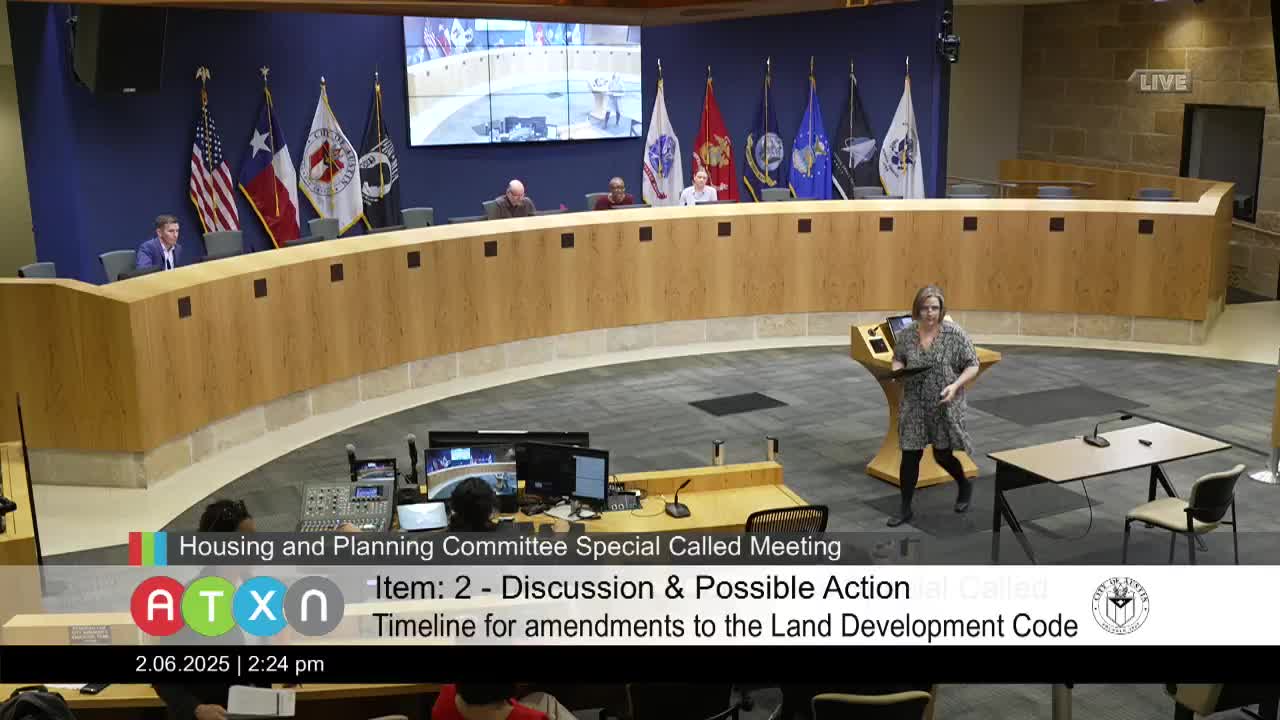
City of Austin planning staff asked the Housing and Planning Committee on Feb. 6 to support initiating an update to Imagine Austin, the city's comprehensive plan adopted in 2012.
Erica Leek, development officer for the Planning Department, said the long-range planning group will return to the committee in April with cost estimates for several projects currently in scoping and that staff plan to bring a resolution to City Council in March to initiate a citywide update of Imagine Austin.
Evelyn Mitchell, principal planner for comprehensive planning, told the committee the update aims to reflect population growth, demographic change, climate events and the Project Connect transit program since 2012. Mitchell said staff have met with the Imagine Austin sub‑quorum and each City Council office to identify priorities and are targeting a spring 2027 completion date.
One substantive proposal is the creation of a citywide “future places” map, a character‑based map intended to guide growth by place type (for example, centers, corridors and different residential intensity levels) rather than parcel‑level uses. Mitchell presented an example from Denver and said a future places map can offer flexibility and help align many more recent plans with the comprehensive plan.
Committee members asked how a future‑places map would interact with traditional zoning and rezoning processes. Mitchell clarified that the map would be character- and place-based, not a direct rezoning: “Our work and the community conversations around…place making are not rezoning properties. Folks that want to do that would have to come through a proper rezoning to actually change the use,” she said.
Council members raised outreach and accessibility questions for planned engagement events. Mitchell said staff will pursue multiple outreach approaches including ambassador programs and paid focus groups to engage historically underrepresented communities. She also announced a public speaker series event on Feb. 19 at the Carver Museum on city demographics and planning.
Several committee members emphasized the need to explain technical topics to the public in accessible terms, and suggested using the future‑places visualization to illustrate the policy and economic reasoning behind place types and what different investments (for example, grocery anchors or retail mixes) enable in neighborhood strategies. Mitchell said staff will bring scopes and cost estimates back to the committee in April and continue to refine outreach.