Get Full Government Meeting Transcripts, Videos, & Alerts Forever!
Get email alerts on the Zoning topic
No spam. Unsubscribe anytime.
Derby BZA approves temporary exception to allow gravel lot for vehicle sales at 2430 N. Nelson Dr.
Summary
On Feb. 6, 2025, the City of Derby Board of Zoning Appeals voted 9-1 to grant a one-year, renewable exception permitting a gravel parking/display lot for a vehicle sales business at 2430 North Nelson Drive, subject to conditions including annual business-registration review and maintenance requirements.
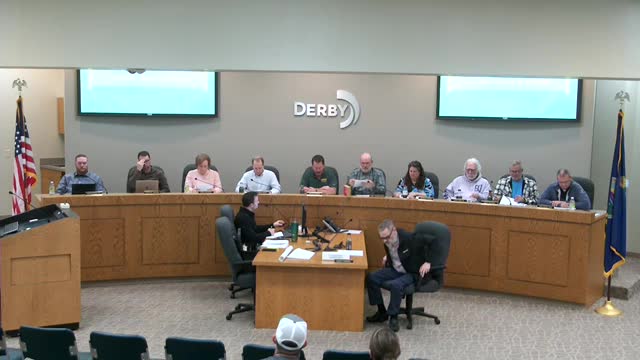
The City of Derby Board of Zoning Appeals on Feb. 6, 2025, adopted a resolution allowing a gravel parking and display area for vehicle sales at 2430 North Nelson Drive, voting 9-1 to grant a temporary exception to the city’s paving requirement for vehicle-sale lots.
City staff said the one-year exception — renewable through the city’s annual business-registration process — is intended to allow the business to operate while the K‑15 area road improvements and broader redevelopment envisioned in the K‑15 Area Plan proceed. Everett Haynes, assistant city planner, told the board the property lost its prior “nonconforming” status after a registered business on the site was not active for more than 10 years; the most recent registered business on the property appeared in 2015.
Haynes told the board the property has been a gravel lot since the 1980s and said strict compliance (paving) would impose a heavy financial burden because future redevelopment tied to the city’s K‑15 improvements could require removing any newly installed pavement. He recommended approval with conditions: a one‑year validity period through Jan. 31, 2026, annual renewals tied to business registration, maintenance requirements (keep vehicle display and mill/ gravel areas free of weeds, dust, trash and debris), that the exception be limited to the subject site, and termination if the business is discontinued for six consecutive months or if site improvements exceed 50% of the appraised value — triggering site-plan review and compliance with current standards.
Haynes also described a staff parking analysis showing roughly 37 parking spaces could be provided on the lot and that Derby’s code requires 10 parking spaces for the building; staff assumed half the remainder could be used to display vehicles for sale, leaving the site with an estimated 12 spaces to serve both customers and displayed inventory. He said the city’s engineering and fire departments reviewed the proposal and flagged that access will be reconstructed as part of the K‑15 road project; the city will coordinate construction timing with the applicant.
Applicant Crystal Bell addressed the board and said the business will not operate as a salvage yard. “At this time, we’re not doing any salvage vehicles,” Bell said, adding that maintenance and repairs occur inside the building and vehicles placed in the frontage will be ready for sale.
Board members asked whether salvage operations would be allowed (they are not permitted under the B‑5 district), whether contamination from leaks was a concern, and whether the site falls within other improvement plans; staff said the property lies in the K‑15 Area Plan area, not the West Side/West End plan. Several findings of fact presented by staff concluded the exception would not substantially injure nearby property values, would not dominate the neighborhood, and is compatible with surrounding uses given the prevalence of gravel/mill-surface lots in the area. Staff noted the city has required paved display lots in its zoning regulations since the 1980s but that many properties were developed prior to annexation in 1997 and remain legal nonconformities until abandoned.
Weston Heflin moved the resolution to grant the exception, and a second was recorded. The board adopted the resolution with a roll-call-style vote of nine in favor and one opposed. The approved conditions require staff review and annual renewal through business registration and limit the exception to the described parcel.
Why it matters: the decision allows a vehicle-sales business to begin operations in a commercially transitional corridor while preserving the city’s leverage to require paving and full redevelopment when property owners invest in the area or when the K‑15 improvements spur redevelopment. The board’s decision balances immediate business activity with the long-term goals of the K‑15 Area Plan.
The board closed the public hearing on the item and had no further BZA business that evening.