
DBH and OUC pilot shows mixed results; council presses agency on 988, Access Helpline and crisis response times
Get AI-powered insights, summaries, and transcripts
Sign Up Free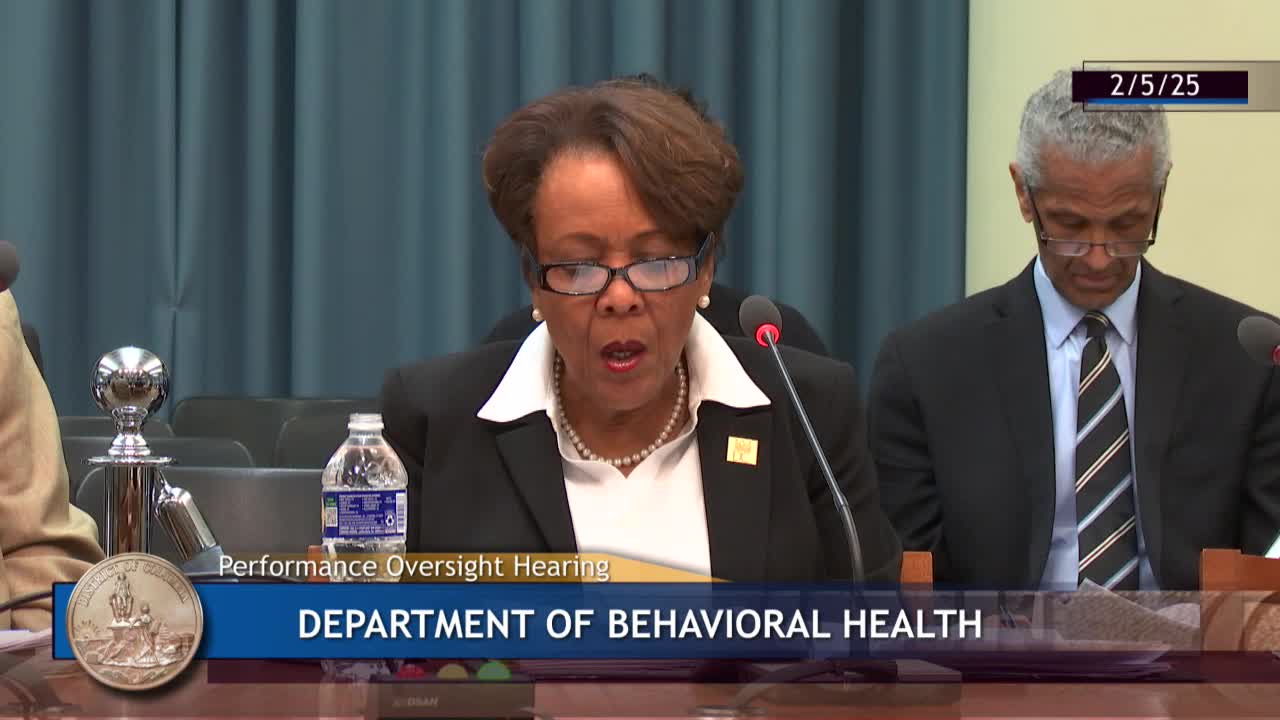
Summary
Council members pressed DBH leaders on 988 staffing, call transfers from the Office of Unified Communications and Community Response Team response times at a Feb. 5 oversight hearing.
At-large Councilmember Christina Henderson, chair of the Committee on Health, and members pressed DBH leaders about 988 staffing, the Access Helpline and the District’s Community Response Team (CRT) during the Feb. 5 oversight hearing.
Dr. Barbara Bazaron, director of the Department of Behavioral Health, said 988 remains a priority and described expanded access channels: “The access helpline, which is our 988 is now fully staffed with the hiring of additional crisis counselors.” In the same hearing DBH staff clarified the structure: specialized 988 staff are colocated with the broader Access Helpline but have distinct allocations and, according to DBH, there are vacancies within 988.
DBH provided usage figures for FY2024: about 10,200 calls to 988, up from 9,700 in FY2023, and reported that an added chat and text function went live in September. Committee members pressed DBH on abandoned-call spikes and transfers from the Office of Unified Communications (OUC). Council members cited OUC data showing attempted transfers that were not picked up: one cited example for December where OUC attempted 36 transfers and only seven were answered. Dr. Bazaron and other DBH staff said they will work with OUC to address transfer technology and training issues.
Henderson asked detailed staffing questions about 988 and the Access Helpline. DBH said 28 staff are currently assigned to the Access Helpline; DBH also told the committee there are seven budgeted additional positions for 988, “so, a total of 14” budgeted for the 988-specific line, according to testimony. Officials said the Access Helpline includes licensed clinicians on shift and an increased use of co-location at the Office of Unified Communications to improve diversion of mental-health-related 911 calls from an automatic police response.
Councilmembers further questioned CRT response time and staffing. DBH acknowledged operational limits: co-location and neighborhood “launchpads” are being explored to reduce travel time; DBH told the committee average CRT arrival can be roughly 30 to 40 minutes but may extend to an hour depending on location and traffic. DBH reported CRT vacancy counts (19 vacancies were referenced in committee exchange) and confirmed ongoing recruitment and plans to co-locate staff in business-improvement districts to shorten response times.
DBH said it would follow up with the committee on detailed abandonment and transfer metrics and pledged to do additional “secret-shopper” checks and process testing to measure improvements.