Get Full Government Meeting Transcripts, Videos, & Alerts Forever!
Get email alerts on the Environment Fisheries topic
No spam. Unsubscribe anytime.
Coosa Riverkeeper asks Cleburne County to oppose DNR tournament slot limits
Summary
A representative of Coosa Riverkeeper urged the Cleburne County Commission to consider a model resolution opposing a proposed Alabama Department of Conservation and Natural Resources slot limit for bass tournaments, citing economic and fishery-health concerns.
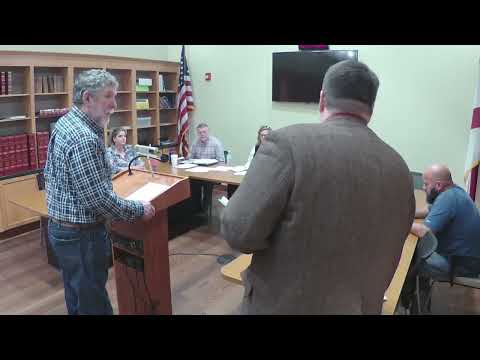
Richard, a community organizer for Coosa Riverkeeper, asked the Cleburne County Commission during its work session to consider adopting a resolution opposing proposed slot limits on tournament bass fishing by the Alabama Department of Conservation and Natural Resources (DCNR).
"This resolution that we're asking you to consider is from our state legislators that we're working with," Richard said, identifying his organization and explaining the request. He told commissioners that DCNR had "taken a study that they did on 1 lake in Le Henry and applied it along the entire Coosa," and that the regulation would "really hamper" tournaments and local tourism, including hotels, restaurants and fuel sales.
Coosa Riverkeeper described the proposal as a DCNR rule that would apply a slot limit—restricting the retention or scoring of fish in a particular size range—to tournament fishing. Richard said the group is working with state legislators, including Representatives Lipscomb and Robinson and Senator Kelly, and that neighboring counties had already adopted similar resolutions.
Richard also framed the group as science-focused: Coosa Riverkeeper conducts weekly water sampling at about 50 locations, issues a swim guide and promotes fish consumption advisories. He noted water-quality stressors—"low dissolved oxygen, high nutrient loading, and industrial pollution"—and said those issues should be addressed alongside any fisheries rules.
Commissioners and staff asked questions about jurisdiction and the mechanics of tournaments. One commissioner noted that recreational anglers could still keep fish under the proposed rule while tournament scoring would be affected; Richard replied that many tournaments are catch-and-release but that tournament practices (holding fish in livewells, transporting and releasing them away from their capture site) present other risks. He suggested alternative tournament methods such as weigh-in-and-release procedures.
No formal action or vote on a resolution occurred during the session. Richard left the commission with a copy of the model resolution and said he would provide more materials to staff.
Ending: The commission did not take a vote during the work session; Richard said he would make materials available and planned to visit additional county and city bodies to seek adoption of the model resolution.