Get Full Government Meeting Transcripts, Videos, & Alerts Forever!
Get email alerts on the Student Discipline Drugs topic
No spam. Unsubscribe anytime.
Conewago Valley subcommittee pauses changes to controlled-substances policy after wide debate over discipline for student possession
Summary
Following an extended discussion about how the district should treat prescription and over-the-counter medications found at school, the policy subcommittee agreed to delay any change to Policy 227 (controlled substances and paraphernalia) and asked staff to draft clarifying language on progressive discipline and handling of student medications.
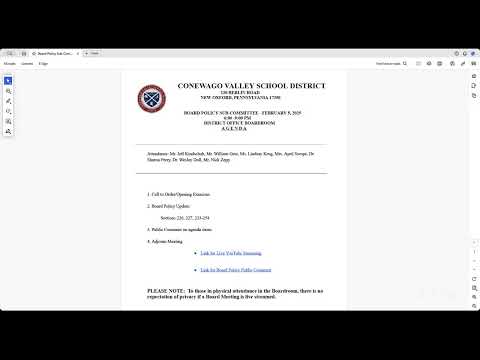
The Conewago Valley School District Board Policy Subcommittee on Feb. 5 debated revisions to Policy 227, the district's policy on controlled substances and paraphernalia, and decided to table the item so members and administration could draft clarifying language on discipline and medical exemptions.
Board members spent more than an hour discussing whether the policy as written could expose students to severe discipline for carrying prescription or over-the-counter (OTC) medications. Several members urged clearer language that distinguishes possession (for example a student who forgets a prescribed medication in a bag) from distribution or unlawful possession that could warrant suspension or referral to law enforcement. Staff described current practice that requires parental authorization and storage of most medications in the nurse's office; they noted inhalers are commonly permitted on a student's person for medical reasons.
The subcommittee's concern focused on two linked points: how the policy defines "controlled substances" (the draft language listed "prescription or nonprescription medications" among examples), and how the discipline matrix connects to levels of misconduct. Several board members called for a progressive-discipline framework so an inadvertent possession would not automatically escalate to suspension or expulsion. Administrators said routine instances typically result in counseling and parent contact and that suspension is reserved for more serious cases such as confirmed distribution or misuse.
Staff described existing steps for managing student medications: parents submit physician authorization and school nurses maintain medication records and locked storage; medications requiring refrigeration are kept in the health room. Administrators said those practices are intended to reduce safety risks from unobserved self-medication or inadvertent sharing of medication.
After extensive back-and-forth about potential "weaponization" of broad policy language by a future administrator, the subcommittee asked the administration to draft proposed clarifying language. That draft should (according to subcommittee direction) differentiate possession from distribution, describe the role of the nurse and parental authorization, and outline progressive discipline and threat-assessment steps. The subcommittee agreed to review the redraft at its next policy meeting.
The discussion also touched on related procedures (threat assessment, mandatory reporting, and coordination with law enforcement) and on whether language about "shall investigate" could be read to require school investigations of incidents that occurred entirely off campus; members sought clearer limits tying the policy to district property or authorized district functions.
The subcommittee did not adopt new policy language at this meeting and left Policy 227 pending further drafting and review.