Get Full Government Meeting Transcripts, Videos, & Alerts Forever!
Get email alerts on the Legal Counsel Litigation topic
No spam. Unsubscribe anytime.
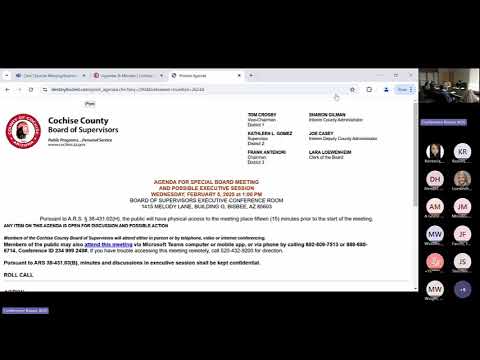
Cochise County supervisors hire outside counsel to study claims against insurer and former county attorney
Summary
The Cochise County Board of Supervisors voted 2-0, with one member absent, on Feb. 5 to retain outside counsel to research whether the county has claims against ACIP and former County Attorney Brian McIntyre and to evaluate whether an insurance bad-faith or legal-malpractice action is viable.
The Cochise County Board of Supervisors voted 2-0, with one member absent, on Feb. 5 to retain outside counsel to research whether the county has claims against ACIP and former County Attorney Brian McIntyre and to evaluate whether an insurance bad-faith or legal-malpractice action is viable.
The vote followed an extended public discussion during a special meeting in the Board of Supervisors executive conference room about the handling of election-related litigation and whether the county attorney’s conduct contributed to denied insurance coverage for some supervisors. Supervisors raised concerns about a single legal opinion driving criminal or civil exposure and about the broader effect of open meeting law interpretations on their ability to consult privately on political strategy.
The board’s motion instructed staff to hire outside counsel to perform a coverage analysis and, if warranted, assess legal-malpractice and insurance bad-faith claims. The board recorded the motion as passing 2-0, with one supervisor absent when the vote was taken.
Supervisors discussed retaining attorney Mick Rusing of Tucson to do preliminary research on the viability of claims, including reviewing ACIP’s coverage decision and whether there were grounds to pursue malpractice claims against McIntyre. The board’s discussion noted that outside counsel would need time and resources to "do the research" and that fee arrangements could include negotiated or contingent components; exact fee amounts or contract terms were not specified in the meeting.
Board members repeatedly framed the item around two related concerns: whether the county was wrongfully denied insurance coverage for legal defense in the election-related matters, and whether the former county attorney’s reported disclosures or testimony created a conflict that should be scrutinized. The board asked outside counsel first to determine whether coverage existed and, second, to evaluate possible insurance bad-faith or malpractice theories.
Separately, supervisors spent substantial time debating Arizona’s open meeting law and how it is being applied to three-member boards. Several supervisors described the law’s interpretation as having a "chilling effect" on political speech and routine coordination among elected officials, and they discussed pursuing legislative changes or seeking judicial clarification so the county’s elected officials could seek second legal opinions without triggering adverse consequences.
Later in the meeting the board voted to go into an executive session for legal advice under Arizona Revised Statutes governing attorney-client executive sessions; the meeting record shows a brief executive session occurred and the board returned to regular session. After the executive session, the county attorney provided the board with a written "scope of representation" document, which the attorney said reflects recent Arizona Supreme Court ethics guidance clarifying the role of government lawyers and the limits of attorney-client privilege for government entities.
The board directed staff to proceed with contacting the proposed outside counsel to begin a coverage review and legal viability assessment and said the county would review the outside counsel’s findings before deciding whether to pursue litigation. The supervisors did not commit to filing suit; they authorized only the research and preliminary legal work.
The board set no timetable during the meeting for when outside counsel would report back, and no dollar amount for retention was approved on the record. The motion and vote recorded in the minutes do not specify contract length or a maximum fee, and the board said further recommendations would return to a public meeting for any decision to file suit.
The meeting closed after the county attorney offered to meet with supervisors or department directors to review the scope-of-representation memo and to hold a work session if the board wanted deeper discussion.