Get Full Government Meeting Transcripts, Videos, & Alerts Forever!
Get email alerts on the Cdbg Funding topic
No spam. Unsubscribe anytime.
Committee reviews CDBG spending, home repair and 2025 plan; staff says $1.8 million on hand
Summary
City staff reviewed 2024 Community Development Block Grant spending and outlined the 2025 annual action plan, including park upgrades, a home weatherization pilot with ECAN and increased funding for minor home repairs.
City staff told the Committee that Overland Park carried about $1.8 million in Community Development Block Grant (CDBG) funds on hand and reviewed how federal dollars were spent in 2024 and planned to be used in 2025.
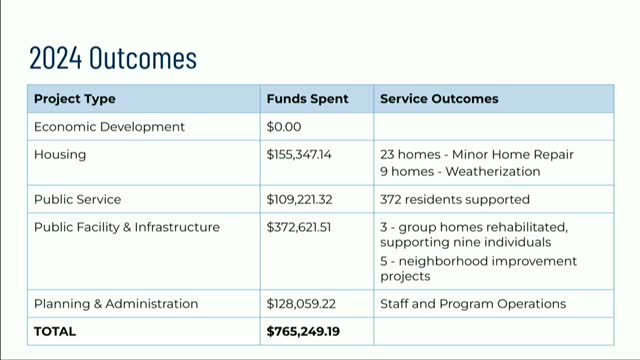
The city’s CDBG spending in 2024 included roughly $155,000 for housing (supporting about 23 minor home‑repair projects and nine weatherization projects), $109,000 for public services serving about 372 residents, and about $372,000 for public‑facility and infrastructure projects. Park work in 2024 included about $228,000 on turf and playground upgrades at Brown, Gregory Meadows, Kessler, Maple Hills and Robinson parks; Crestview and Hickory Hills projects were completed but CDBG reimbursements were timed to match project accomplishments. Staff said three group‑home rehabilitation projects and five park projects were funded, and $120,000 was budgeted for planning and administration.
Why it matters: CDBG funds are federally funded and flow through HUD to cities for housing, public services and public facilities; the committee’s recommended spending and timing affect which local projects proceed and when.
Staff said the 2025 annual action plan (part of the 2025–2029 consolidated plan the Committee approved last month) earmarked an anticipated $700,000 per year for 2025–2029, but the plan had not yet been submitted to HUD because the city had not received its final 2025 allocation. HUD typically notifies communities of award levels between March and May, staff said, and the city will finalize and submit the plan after it receives the number. Staff described the usual HUD review and grant‑execution timeline: HUD review takes several months and, barring delays, grant agreements generally are executed between August and October, with subrecipient agreements following that execution.
Staff also reviewed neighborhood and park projects scheduled for 2025. The presenter said Gregory Meadows and Maple Hills parks are included in anticipated neighborhood improvement work for 2025; work at Gregory Meadows had paused several times due to weather, and Maple Hills was complete though not all funds had yet been expended. North Park was described as having approximately $350,000 in CDBG funds allocated and is expected to receive a significant redesign; the public‑works department is using CDBG funds for sidewalk connectivity and ADA improvements in the Graney Auk and Westbrook neighborhoods, projects that began in the fall but paused for winter weather.
On housing programs, staff said the home‑weatherization pilot with ECAN is scheduled to end April 30 but will continue as an ongoing partnership. The pilot had served 11 properties to date and primarily paid for windows and doors and some water‑heater work; the original 2023 pilot budget was $150,000 and capped help at up to $15,000 per household. Staff said ECAN’s other programs (Department of Energy and state funds) typically serve lower‑income households and that using CDBG area‑median‑income guidelines allowed the city to assist households who otherwise would have been denied by DOE income limits.
Staff also said the minor home repair program funding for Johnson County Housing Services will be increased from about $100,000 historically to $125,000 for 2025; a minor‑repair arrangement with Habitat for Humanity was scheduled to end June 30. Staff noted roughly $288,000 of funds were already allocated to subrecipients for housing and public‑service projects and that grant agreements exist for those partners.
Councilors asked for clarifications about program mechanics and funding timing. One councilor asked about application pauses and how ECAN prioritized applicants; staff replied that ECAN paused applications for the CDBG‑funded portion after receiving more requests than the pilot budget could serve, which prompted the city to fund the program ongoing. Another councilor asked whether the “$700,000” figure was an annual expectation; staff said allocations fluctuate but the 2025–2029 plan used $700,000 as a reasonable anticipated annual allocation and noted that the city’s allocation has declined from earlier years (about $800,000 in 2018 versus roughly $691,000 in 2024).
Staff closed by noting the typical nine‑month to one‑year lag between plan approval and actual spending because of HUD’s award and review timing.
Ending: Committee members had no formal action on the item beyond questions; staff invited further questions and noted they will submit the annual action plan to HUD once the city’s 2025 award is known.