Get Full Government Meeting Transcripts, Videos, & Alerts Forever!
Get email alerts on the Stillbirth Prevention Day topic
No spam. Unsubscribe anytime.
Ohio health committee holds first hearing on bill to designate Sept. 19 as Stillbirth Prevention Day
Summary
Representatives introduced House Bill 4 and the Ohio House Health Committee held a first hearing on the proposal to designate Sept. 19 as Ohio’s Stillbirth Prevention Day. Sponsors Representatives Holmes and Thomas said the designation is intended to increase public awareness and to direct attention to existing resources for pregnant people, particularly those with limited access to care.
Representatives introduced House Bill 4 and the Ohio House Health Committee held a first hearing on the proposal to designate Sept. 19 as Ohio’s Stillbirth Prevention Day. Sponsors Representatives Holmes and Thomas said the designation is intended to increase public awareness and to direct attention to existing resources for pregnant people, particularly those with limited access to care.
Supporters told the committee the measure is intended to elevate prevention efforts and grief support. Representative Holmes said U.S. Centers for Disease Control and Prevention data show about 1 in 175 births are affected by stillbirth nationally and that stillbirths are more common among African American mothers. He said Ohio’s most recent available data show hundreds of stillbirths each year, and cited a 2021 total of 760 stillbirths and an Ohio fetal-death rate of about 6.2 per 1,000 live births.
The bill’s proponents described both prevention and support goals. Representative Thomas said the designation could help target existing maternal-health resources to families most in need and that research indicates nearly one-third of stillbirths are preventable. Dr. Michael Bullock, president of the nonprofit Miles’ Mission, testified about the organization’s work supplying resources and peer support to families after pregnancy and infant loss and described partnerships with hospitals, counseling agencies and other nonprofits. Jennifer Bullock Moore, who said she lost her son at 33 weeks’ gestation, described gaps she encountered in prenatal care and said better awareness and standardized clinical practices could help other families.
Committee members asked witnesses factual and procedural questions. Ranking Member Simani asked the sponsors to clarify definitions; Dr. Bullock said the Ohio Department of Health typically groups pregnancy loss into three ranges for reporting purposes (which he summarized as miscarriage in early gestation, stillbirth in later gestation and infant loss around full term) and said those reporting categories reflect CDC practice rather than a statutory definition. Representative Miller and other members asked about clinical monitoring, placental conditions such as placenta accreta and whether different prenatal testing or scheduled delivery planning could alter outcomes; witnesses and a physician in the room described placenta accreta as a spectrum in which the placenta implants abnormally and noted improvements in ultrasound detection over time but not in every case.
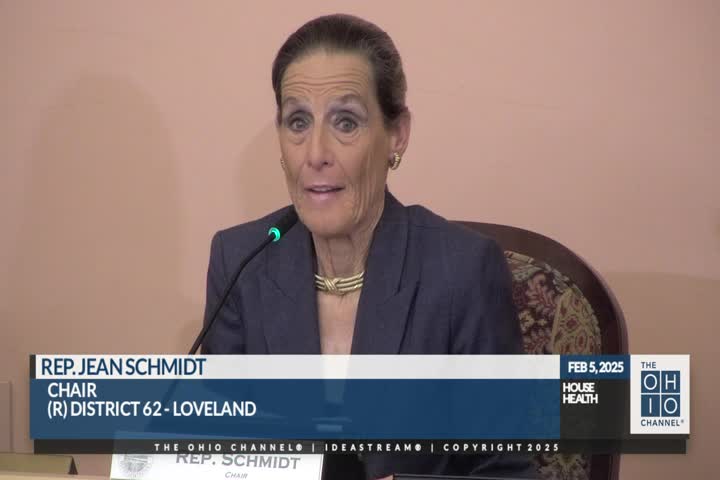
No final action was taken on the bill at the hearing. Chair Schmidt told the committee the panel could meet again as soon as the following day with a possible vote. Committee staff instructed witnesses and members on testimony and amendment submission deadlines and the committee moved on to additional agenda items.
Ending: The committee concluded the first hearing on House Bill 4 with no vote recorded and left open the possibility of scheduling a vote at a subsequent meeting.