Get Full Government Meeting Transcripts, Videos, & Alerts Forever!
Get email alerts on the Immigration Policy topic
No spam. Unsubscribe anytime.
Hundreds of residents press Oxnard council to adopt sanctuary-city protections; council asks staff to research options
Summary
Dozens of speakers urged the Oxnard City Council on Feb. 4 to upgrade a 2017 “safe city” declaration to a full sanctuary-city ordinance, citing recent ICE activity. Council members pledged follow-up research and outreach but made no formal policy change at the meeting.
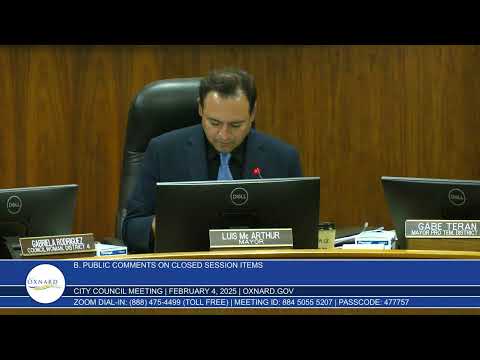
Dozens of community members filled the City Council chambers Feb. 4 to press the Oxnard City Council to adopt a sanctuary-city ordinance that would limit city cooperation with federal immigration enforcement.
The demand came during a long public-comment period in which many speakers described fear in immigrant communities after recent immigration enforcement activity in Oxnard. “We must ensure our community remains safe, informed, and supported,” Veronica Hernandez, a community organizer for MICOP (Mixteco Indigena Community Organizing Project), told the council. “We are asking you to take proactive measures so you can update the 02/2017 resolution and make Oxnard a sanctuary city.”
Supporters said they want city rules that go beyond the 2017 “safe city” language and would bar city resources and personnel from being used for immigration enforcement, protect children and youth from family separation, and prevent federal immigration agents from entering hospitals, clinics, schools and colleges. Miguel Angel Mote Hernandez, a local farm-worker organizer, said agricultural workers are particularly frightened: “We are so afraid. We are asking you for practical measures to update the 02/2017 resolution and truly make Oxnard a sanctuary city.”
The council did not vote on a sanctuary ordinance. Instead, several council members asked staff to compile options and resources. Councilwoman Mikayla Perez (District 6) asked staff to “vet credible resources and create a section on the City of Oxnard website for know-your-rights information in multiple languages, including indigenous languages,” and to explore grants to fund community education. Perez said she wanted to work with community organizations to review and revise the 2017 language.
Mayor McArthur and other council members acknowledged the concern but cautioned about unintended consequences. Councilwoman Wilma Basua warned that stronger local protections could put federal funding at risk, saying the city must weigh “what our decisions are going to cost the residents of Oxnard.” Basua described personal encounters with community members whose programs rely on federal grants, and said she did not want to “give false hope.”
City Manager (name not specified) addressed cooperation with federal authorities, saying, “our police department does not cooperate with ICE. That is not only a City police department policy, that’s also California state law.” The council asked staff to report back with options — including whether to form a community committee to help draft language — and to schedule follow-up briefings. Several speakers asked the council to place the subject on the agenda at the next meeting.
Youth organizers and students who led recent walkouts were prominent among speakers. Student Justin Tolteca told the council that classmates have been reduced to organizing walkouts because “the people that are supposed to look out for us aren’t looking out for us,” and said students are worried about losing family members to enforcement.
Many nonprofit leaders also urged immediate action and concrete protections. “Symbolic measures are not enough,” Vanessa Turan said. “We need local legislation that provides real protections.” Other speakers recommended specific steps such as a public hotline, “Know Your Rights” workshops and a public transparency policy requiring the city to notify the community if ICE is operating in Oxnard.
What happened next: Council members requested staff research and outreach. No ordinance or formal policy change was adopted at the Feb. 4 meeting. The council directed staff to return with vetted options and suggested community partners; speakers pressed for the matter to be agendized at the next regular meeting.
Why it matters: The issue cuts to the core of local-federal relations and to residents’ daily safety. Oxnard officials must balance community requests for protections with concerns about funding, legal constraints and enforcement jurisdiction.
The council meeting record shows broad community demand for sanctuary-city protections; staff must now produce options that respond to the community’s requests without exceeding the city’s legal or fiscal authority.