Get Full Government Meeting Transcripts, Videos, & Alerts Forever!
Get email alerts on the Supplemental Budgets topic
No spam. Unsubscribe anytime.
Judiciary Committee rejects bill that would limit supplemental budget requests to emergencies
Summary
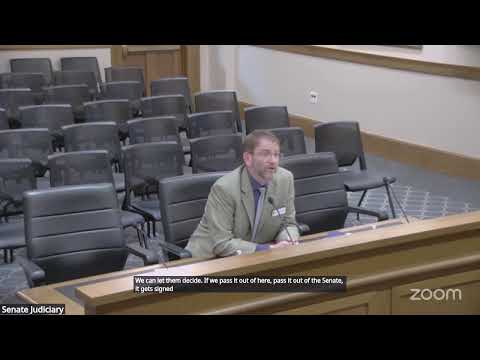
Senate File 180, a bill that would have codified statutory limits on supplemental budget recommendations to emergency uses, failed on a 2-3 roll call before the Judiciary Committee.
Senate File 180, a bill that would have codified statutory limits on supplemental budget recommendations to emergency uses, failed on a 2-3 roll call before the Judiciary Committee.
Senator Darren Smith, the bill sponsor, told the committee the measure "just codifies what nearly every governor and every legislature said about the supplemental budget. And that's that it's for emergencies." Smith described the draft language as a baseline to distinguish ordinary biennium spending from true emergencies.
Proponents said the bill would curb recurring or nonurgent supplemental requests from agencies. Kevin Lewis, a Laramie County resident who testified in support, said agencies "turn[ ] it into a yearly endeavor" and argued the bill would help stop requests that are not true emergencies.
Opponents, including the governor's office and the Department of Health, warned the limitations could create statutory conflicts and hinder the executive branch's ability to present informed recommendations. Betsy Anderson, Deputy Chief of Staff and General Counsel for Governor Gordon, said the governor "opposes Senate File 180" and cautioned that placing enumerated restrictions on supplemental recommendations could be "overly burdensome," citing past examples such as CARES and ARPA funding that did not fit neatly into an emergencies-only list.
Stefan Johansen, director of the Department of Health, told the committee the department is subject to statutory requirements that sometimes compel it to submit requests in a supplemental year. He cited Title 21 requirements for developmental preschool external cost adjustments and a Title 35 provision requiring requests tied to state nurse salary adjustments that could arise outside a biennium session.
Committee debate ranged from procedural concerns about separation of powers to examples members said might fall outside the bill's enumerated categories. Some members asked whether the bill would strip the governor of the ability to recommend alternative supplemental budgets; language in the bill's repealer drew particular scrutiny. Supporters said the legislature — not the executive — should be the principal controller of appropriations; opponents said the governor's budget process and statutory balanced-budget limits already constrain recommendations.
The committee adopted two amendments during markup: one, added at a member's request, expanding enumerated exceptions to include "technology upgrades" for immediate needs to replace failing computer systems; another amendment struck language at a specified line (described in committee as deleting a section referenced on page 3, line 9). Both amendments were adopted by voice votes. The final roll call vote on Senate File 180 recorded two ayes and three noes (Aye: Senator Hicks, Senator Kohl; No: Senator Crago, Senator Crum, Chairman Olsen), and the bill did not pass out of committee.
Discussion items noted by the committee included: - How the bill would interact with existing statutes that require agencies to bring certain requests in supplemental years (Department of Health examples cited). - Whether an enumerated list can reasonably anticipate events such as pandemics, federal funding that arrives after a session (CARES/ARPA), or strategic economic opportunities (members cited hypothetical infrastructure for a new mine). - Concerns about separation of powers and the governor's authority to recommend budgets and alternative proposals.
No further committee action on the bill was recorded after the roll call.
Ending: The committee chair encouraged the sponsor to continue refining the proposal and moved on to other business on the agenda.