Get Full Government Meeting Transcripts, Videos, & Alerts Forever!
Get email alerts on the Early Literacy Policy topic
No spam. Unsubscribe anytime.
Education committee advances reading bill after adding department-led details; advocates urge interim work
Summary
The Senate Education Committee approved Senate File 178 on Feb. 5, advancing a measure that tightens screening and planning for students with reading difficulties while adding department-suggested details and prompting calls for more interim stakeholder work.
The Wyoming Senate Education Committee on Feb. 5 approved Senate File 178 as amended, a bill that expands early reading screening, requires individual reading plans for students identified with reading difficulties and mandates specific professional-development expectations for district staff. The committee recorded a 3–2 vote and sent the bill forward amid broad testimony urging additional work in the interim.
Sponsor Senator Curt Scott said the amendment the committee adopted added “more detail on the functions that are there,” including a more complete statutory definition of reading difficulty, clearer timing for diagnostic follow-up, and a requirement that students identified with reading difficulty receive an individual reading plan that outlines evidence-based interventions. He told the committee the department and bill drafters had worked to remove drafting errors and that the amended language was intended as a solid step, not the final word.
Shelley Hamill of the Wyoming Department of Education, speaking for Superintendent Megan Degenfelder, thanked the committee for collaboration and said the superintendent still had concerns the statute did not yet reach its full objectives but welcomed the amended language as an improvement. The adopted amendment added screening and diagnostic detail, clarified a previously mistyped 15-day requirement, and spelled out interventions and supports to be provided when students are retained or otherwise identified for intensive help.
The bill drew extensive public testimony from practitioners, associations and parents. Annie Griffin, a 26-year educator and current Wyoming superintendent and literacy consultant, said statewide screening and intervention are important but warned that the statewide summative test used for accountability (WY-TOP) is not a comprehensive reading measure and that a single-day test “is not indicative of who [a child] is as a learner.” Griffin and other educators urged early, in-year intervention and professional learning supports rather than mandatory retention.
Dr. Erin Pazinski, k–12 literacy instructional facilitator in Weston 1 and a national literacy trainer, supported the bill’s direction and urged ensuring strong, ongoing professional development. “A 60% proficiency rate means that 4 out of 10 of our students are not reading at grade level,” she told the committee, arguing that the bill’s thresholds could allow districts to opt out of more intensive state support if they meet a 60% proficiency standard.
Opponents — including the Wyoming Education Association, district superintendents and school boards representatives — asked for an interim process to refine the measure. Tate Mullen of the WEA cited 75 years of research showing that retention can have lasting negative effects, and said recent studies that support retention include important caveats about long-term outcomes and necessary supplemental supports. Nick Bellag of the Wyoming School Boards Association raised concerns about assessment alignment and teacher licensure implications tied to specific exams.
A parent and literacy advocate, Megan Hesse, urged the committee to keep dyslexia visible in statute and criticized language that she said risks minimizing the condition; she also argued evidence-based instruction and stronger professional learning are critical. Multiple witnesses asked the Legislature to fund or provide state-level literacy specialists to support struggling districts, and several recommended using the interim to build stronger alignment between assessments, the science of reading and teacher development.
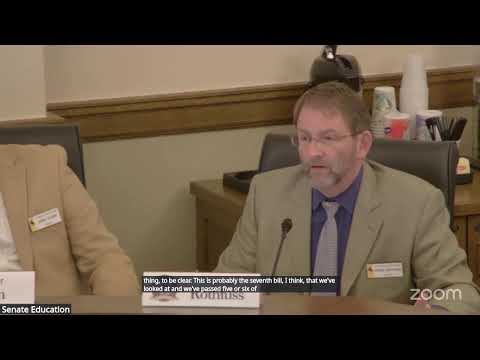
The committee accepted two major sets of changes: (1) the department-led compromise amendments that add diagnostic detail, the individual-reading-plan requirement and expanded professional development language; and (2) a later amendment that removed a clause authorizing broad civil relief provisions and narrowed the civil remedy language. After those amendments the committee voted: Senator Bridal — aye; Senator Olson — aye; Senator Rothfuss — no; Senator Scott — no (record shows he voted no on final committee tally); Chairwoman Schueller — no. The clerk announced a 3–2 result in favor of due pass as amended; the bill will now go to the full Senate. (Committee roll-call recorded in hearing minutes.)
Committee members and witnesses broadly agreed on the goal of improving early literacy but differed on the path — assessment choice, the role of retention, whether counties or the state should supply coaches or specialists, and how to balance parental rights with district planning. Several witnesses urged further stakeholder work in the interim to align instrument, instruction and teacher preparation to the science of reading before the Legislature enacts broad statutory remedies.