Get Full Government Meeting Transcripts, Videos, & Alerts Forever!
Get email alerts on the School Maintenance Funding topic
No spam. Unsubscribe anytime.
Senate committee restricts use of K–12 major maintenance funds, allows grandfathering for projects in progress
Summary
The Wyoming Senate Education Committee on Feb. 5 passed Senate File 156, which narrows allowable uses of state major maintenance funds and lets districts finish projects already under way; the measure passed 3–2.
The Wyoming Senate Education Committee on Feb. 5 passed Senate File 156, a bill that restricts how school districts may use state major maintenance dollars and requires reporting and grandfathering for projects already underway, sending the measure to the full Senate 3–2.
Sponsor Senator Eric Driscoll said the bill was aimed at ensuring “when we say major maintenance, we mean major maintenance,” and that the change would prevent districts from using the state-funded major maintenance program to finance new buildings or other enhancements going forward. The committee approved an amendment to allow districts to finish projects whose planning, design or construction expenditures occurred before the bill’s effective date and required districts to report amounts transferred from the foundation program that were used on such projects.
The bill sets a limit on how major maintenance grants and foundation-program transfers may be used, and draws a clear line between state-funded major maintenance and locally funded enhancements. Under the amendment the committee adopted, a district may complete a project in progress if it made planning, design or construction expenditures before the act’s effective date, and must report expenditures on such projects to the State Superintendent of Public Instruction and the State Construction Department by July 1 of each fiscal year in which the funds are spent. The Wyoming Department of Education and the State Construction Department must report to the Joint Education Interim Committee, the Select Committee on School Facilities and Joint Appropriations by Sept. 1 each year on those reports.
District officials and facility directors testified that districts have long relied on flexibility — commonly described in statute and practice as allowing up to 10% of major maintenance funds for enhancements — to maintain buildings or facilities that exceed the state’s “allowable square footage” or to fund items not fully covered by other state programs. Dan Celeroli, director of facilities for Sweetwater County School District No. 1, told the committee that enhancements sometimes reflect older buildings that taxpayers originally built and that districts follow School Facilities Commission procedures and show funding responsibility when proposing additions.
Teresa Chalk, superintendent of Lincoln 1, said she opposed the bill in its entirety but supported the amendment protecting projects already underway. Chalk told the committee many districts rely on depreciation reserve, sinking funds and the 10% flexibility to maintain enhancements once voters have approved construction and to provide upkeep once sinking funds expire.
Leaders from Laramie County School District No. 1 described programmatic reasons for additional square footage in Title I elementary schools — extra intervention rooms, specialist spaces and larger gyms — and cited water and turf decisions as cost and maintenance drivers. Jon (Jed) Ziccarelli, chief financial officer for Laramie County School District No. 1, said districts also use a mix of local reserves, ESSER funds and other sources for projects and contingencies such as insurance deductibles.
The Wyoming Association of School Administrators and other witnesses urged a more deliberative interim process rather than immediate statutory change. Boyd Brown, executive director of the Wyoming Association of School Administrators, warned the bill as written could be read to bar any use of foundation-program money for a range of purposes and asked for a collaborative interim review.
Committee members acknowledged the intent of the bill — to preserve state major maintenance dollars for core building repair and longevity — but several said they were concerned about unintended consequences for districts that have used the existing flexibility to fund security projects, turf fields, agricultural facilities, parking and other work. The Department of Education, represented by Dickie Schoener speaking for Superintendent Megan Degenfelder, supported the amendment that grandfathered projects in progress and asked the committee to clarify transition rules.
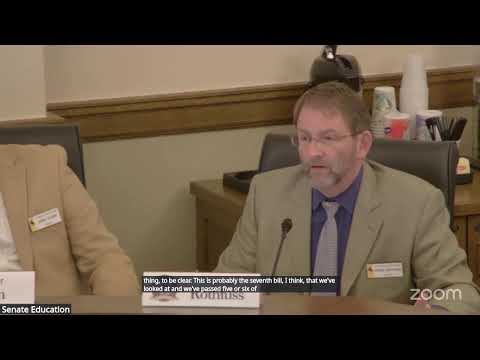
The committee approved the Driscoll amendment to allow districts to finish projects in progress and to require the reporting timeline described above. The amendment passed by voice vote. On final passage the committee recorded votes: Senator Bridal — aye; Senator Olson — aye; Senator Rothfuss — no; Senator Scott — aye; Chairwoman Schueller — no. The tally was 3 ayes, 2 noes. The committee sent the bill to the Senate floor as amended.
Next steps: the bill goes to the full Senate for further consideration. The committee record shows lawmakers and district officials expect additional technical refinements or an interim study if the Senate pursues broader reforms to how Wyoming funds and defines school facilities and maintenance.