Get Full Government Meeting Transcripts, Videos, & Alerts Forever!
Get email alerts on the Civil Rights Lgbtq topic
No spam. Unsubscribe anytime.
Beaverton resident urges city to declare LGBTQ+ sanctuary and boost safety for employees and minority residents
Summary
A lifelong Beaverton resident asked city council to adopt an LGBTQ+ sanctuary-city resolution and to take steps to protect city employees and visible minorities amid recent increases in threats, citing local and national examples.
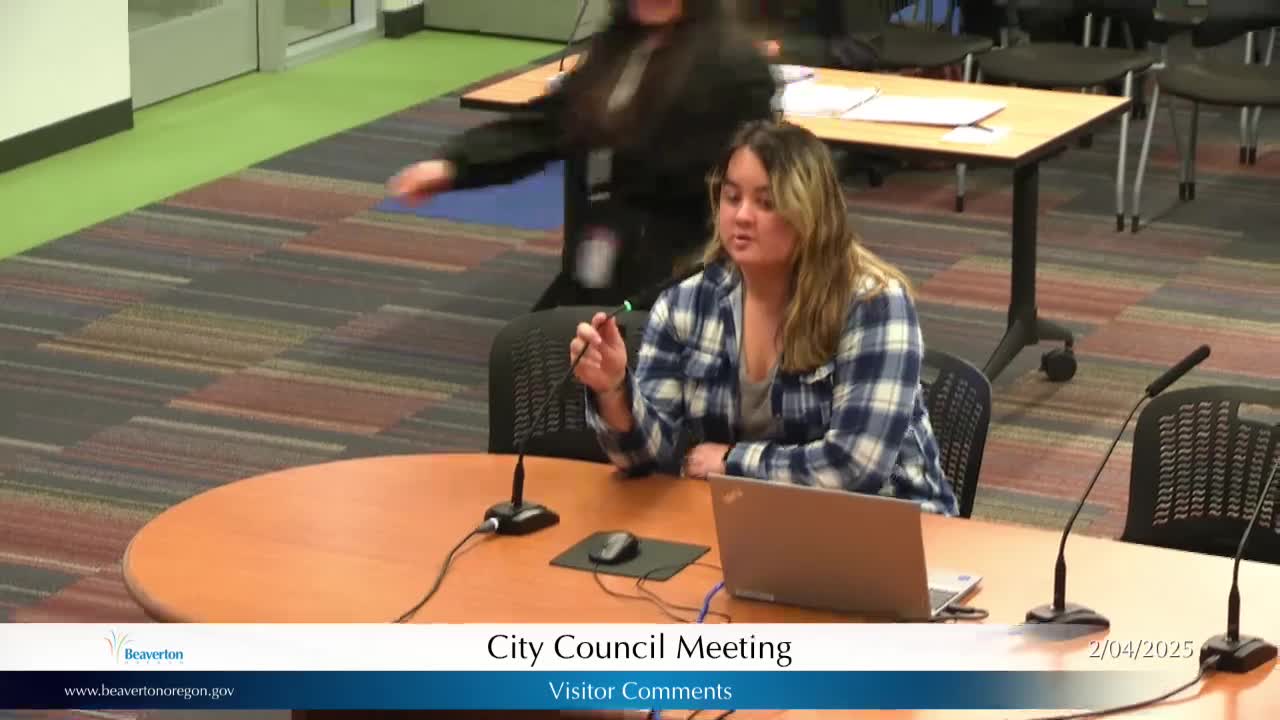
Evelyn Coacher, a lifelong resident of Beaverton’s Elmonica neighborhood, used the public-comment period to urge the city to take steps to protect city employees and residents who are members of racial, gender and disability minorities and to consider a municipal resolution designating Beaverton an LGBTQ+ sanctuary.
Coacher, who identified her pronouns as she/they and said she graduated from Beaverton High School, told the council that threats against visible minorities have risen nationally since the 2020 presidential election and that Oregon and Beaverton have not been immune. "I am here today to encourage you… to take all measures possible to ensure that their safety during this time of heightened tensions and increased threats," she said.
On the sanctuary proposal, Coacher referenced other U.S. cities that have declared themselves safe havens for transgender health care and pledged not to comply with state or federal actions that would adversely affect LGBTQ+ people. "Numerous cities around the country — seven cities between California, Washington, Pennsylvania, and Missouri — have declared themselves as cities for the LGBTQ plus community," she said, and urged Beaverton to consider the step. Coacher added that while Beaverton is already an immigrant sanctuary city, it would be the first in Oregon to adopt an LGBTQ+ sanctuary designation if the council moved forward.
Coacher concluded by urging the council to review a sanctuary-city resolution blueprint and to consider advancing it. The council did not take action during public comment and did not schedule a vote at the meeting; city staff (the city manager or recorder) were offered as the staff contacts for any requested follow-up.
Why this matters: Coacher’s remarks asked elected officials to consider formal municipal protections and to prioritize protective measures for workers and marginalized residents at a time when speakers across the country have raised concerns about threats to LGBTQ+ and minority communities.