Get Full Government Meeting Transcripts, Videos, & Alerts Forever!
Get email alerts on the Transit Marta topic
No spam. Unsubscribe anytime.
MARTA tells DeKalb commissioners of next‑gen bus redesign, South DeKalb and Stonecrest transit hubs and timelines
Summary
MARTA officials briefed the DeKalb County Board of Commissioners on Feb. 4 on ridership trends, a draft bus‑network redesign that would increase frequent service, planned rapid‑transit and transit‑hub projects in South DeKalb and Stonecrest, and related planning and funding steps including federal grant pursuit and local real‑estate work.
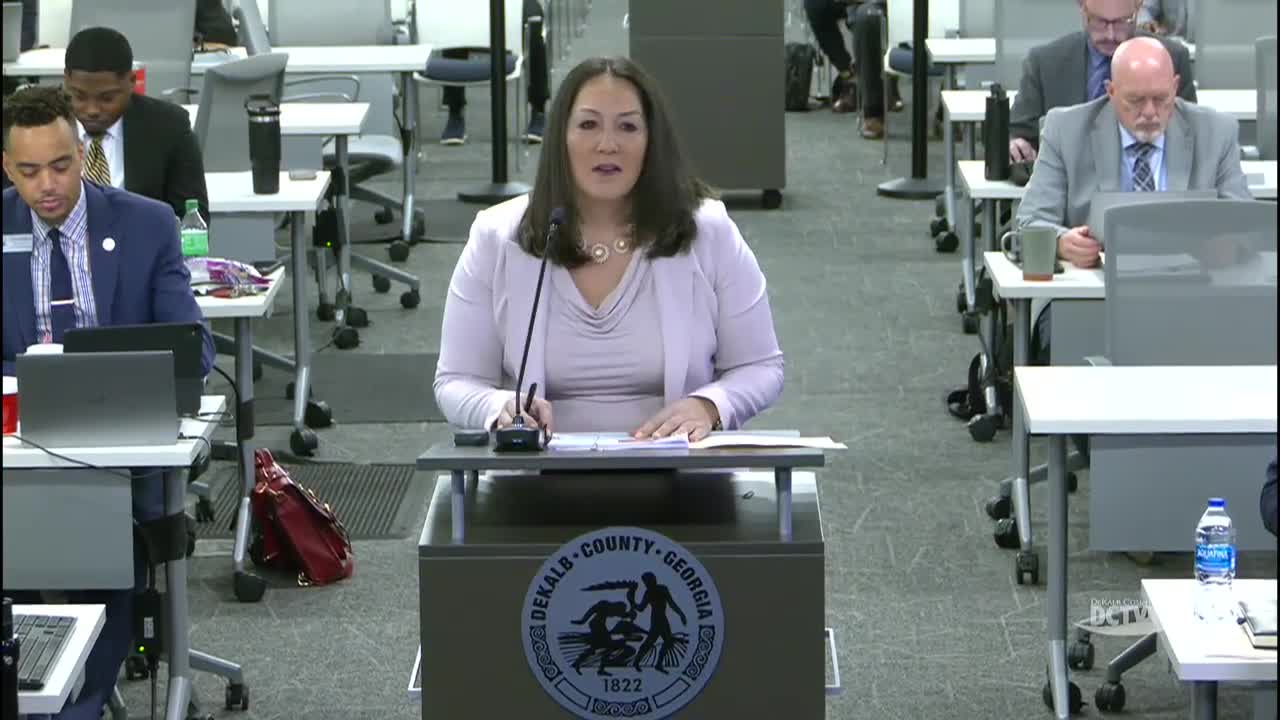
Good morning: MARTA officials updated the DeKalb County Board of Commissioners on Feb. 4 about the agency’s quarterly performance, a draft “next‑gen” bus network and a slate of capital projects in DeKalb County, including arterial rapid transit projects on Buford Highway and Candler Road and future transit hubs at South DeKalb and Stonecrest.
The agency’s chief capital officer, Carrie Rocha, told commissioners that “the state of MARTA is strong” as the authority moves forward on fleet upgrades, station rehabilitation and a bus network redesign intended to move more people to more destinations in less time. MARTA’s presentation emphasized a shift from a coverage model toward a ridership‑focused approach that would increase frequent service on high‑demand corridors, expand access to jobs and pair service changes with capital work such as new transit hubs.
Why it matters: The projects discussed would reshape bus service and station infrastructure across DeKalb County and carry long lead times, federal coordination and real‑estate work. Commissioners asked detailed questions about how projects would affect local districts, project schedules, costs and opportunities for transit‑oriented development and community amenities.
MARTA’s proposals and schedules MARTA said ridership is recovering slowly and that system improvements aim to sustain that trend. The authority is moving a set of capital projects that were memorialized in what Rocha described as the fifteenth amendment to the rapid transit contract and assistance agreement and funded in part by the core penny sales tax levied by county jurisdictions.
Safe Routes to Transit: MARTA identified a first wave of 38 pedestrian improvement sites in DeKalb that will be delivered through a design‑build procurement. The work may include high‑visibility crosswalks, curb extensions, refuge islands and pedestrian beacons to improve walkability for high‑ridership bus corridors.
Next‑gen bus network: MARTA’s draft bus network focuses frequent, faster service on high‑ridership corridors and includes on‑demand zones similar to the MARTA REACH pilot. Rocha said the draft would provide more frequent service in many places — in some cases delivering 15‑minute or better headways — and that the draft network would increase the number of jobs reachable within 60 minutes by transit by about 21 percent. Public engagement on the draft continues through winter and early spring, after which MARTA’s planning and capital programs committee will review the maps and the MARTA board will consider final approval.
Arterial Rapid Transit and BRT discussion: Two arterial rapid transit (ART) projects were highlighted: Buford Highway and Candler Road. Both are transitioning from 30 percent to final design; Rocha said final design is expected to take roughly 18 months before construction procurement. Commissioners pressed MARTA about converting ART to bus rapid transit (BRT) on Buford Highway; Rocha said an ART‑to‑BRT feasibility study is under way and that converting mid‑process could require rework and additional analysis. MARTA will present the feasibility study and related options to DeKalb’s Public Works and Infrastructure Committee on Feb. 18.
Transit hubs and timing: MARTA described two county‑funded transit hubs — adjacent to the Gallery at South DeKalb and at Stonecrest Mall — as part of the fifteenth amendment. Both hubs are in design; South DeKalb and Stonecrest are at roughly 30 percent design. Rocha said Stonecrest’s real‑estate process is more complex and that the two hubs have projected openings in the 2027–2028 range, subject to final design, federal approvals and property acquisition. MARTA is pursuing federal grant funds where possible; when federal grants offset local costs, Rocha said those grants also helped mitigate post‑pandemic cost increases on some projects.
Other corridor and planning efforts: MARTA summarized the I‑285 express lanes transit study (in cooperation with the Georgia Department of Transportation), the Clifton Corridor BRT (funded in part by the City of Atlanta’s half‑penny sales tax), and the multi‑year South DeKalb transit initiative that has narrowed modes and corridors to a set of BRT alternatives for public review. The ART‑to‑BRT feasibility study will look at benefits, impacts and estimated costs for routes including Buford Highway and Candler Road, and potential upgrades to Memorial Drive.
Transit‑oriented development and stations Rocha said MARTA’s transit‑oriented development (TOD) program targets affordability goals — she cited a 20 percent affordability target in MARTA TOD guidance — and noted completed and in‑progress TOD or station rehabilitation projects in DeKalb including Edgewood‑Candler Park, Avondale and Chamblee, and station work at Indian Creek and East Lake.
Indian Creek station rehabilitation is targeted for substantial completion in May. MARTA described work including a new pedestrian bridge, station cladding, lighting and bus‑bay repaving. The agency also said it has master‑planning work under way at Indian Creek and Kensington stations, and that the Atlanta Regional Commission (ARC) recommended a $10 million award for Kensington master planning pending a final decision.
Community questions and MARTA responses Commissioners repeatedly asked for DeKalb‑specific and district‑specific maps and ridership data so they can explain changes to constituents. Rocha and staff offered to provide county‑only and district‑level maps, ridership figures for specific hubs and more detailed schedules for South DeKalb and Stonecrest openings.
Commissioner Robert Patrick asked about the ART vs. BRT decision on Buford Highway; Rocha said MARTA briefed its planning committee on preliminary results on Jan. 23 and will present more detail to DeKalb’s PWI committee on Feb. 18. Commissioner Ladina Bolton and others asked whether the draft network preserves accessibility in lower‑ridership areas; Rocha said the agency conducted equity analysis, has held multiple rounds of outreach and will provide county‑ and district‑level maps and data to commissioners.
Amenities, placemaking and micro‑retail Several commissioners asked whether planned transit hubs will include placemaking or small commercial spaces (for example, pop‑up markets or micro‑retail). Rocha said hubs will include art and be architecturally upgraded; she also said MARTA runs fresh‑market pilots elsewhere and is open to discussing micro‑retail but that development around hubs often depends on third‑party landowners and local development partners.
Safety, staffing and workforce Rocha closed the presentation by discussing a recent operator homicide and MARTA’s workplace safety commitments. She said MARTA has a workforce of “over 5,000” employees and that the system “is deeply saddened by the senseless murder” of an operator, identified in the briefing as Leroy Ramos. Rocha said MARTA will continue working with its union, ATU Local 732, and with public‑safety partners to reduce risks and improve protections for operators and customers.
What’s next MARTA’s public engagement on the next‑gen bus network continues into spring; the agency will seek final approvals from its planning and capital programs committee and from the MARTA board before implementing network changes. DeKalb commissioners asked for more localized data and district maps; MARTA committed to provide those materials and to return to DeKalb committees with the ART‑to‑BRT feasibility results and refined project schedules.
Ending note: Commissioners thanked MARTA staff and board members who attended the briefing and asked staff to follow up with detailed, county‑level maps and ridership figures.