Get Full Government Meeting Transcripts, Videos, & Alerts Forever!
Get email alerts on the Transportation topic
No spam. Unsubscribe anytime.
Blue Zones presents data showing large drop in cut-through traffic after Fourteenth Street calming; proposes pilot on E and Twelfth
Summary
Blue Zones Project presented pre- and post-installation traffic counts for Marysville's Fourteenth Street calming measures and proposed a demonstration pilot of bulb-outs and other traffic-calming features at E and Twelfth streets, asking the council to authorize staff coordination and possible use of leftover grant funds.
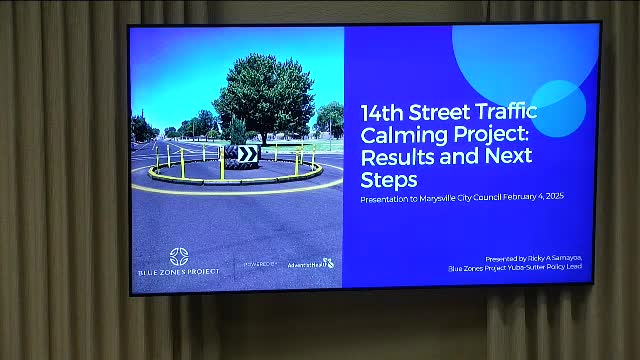
Ricky Samayo, public policy lead for Blue Zones Project in Yuba–Sutter, told the Marysville City Council on Tuesday that traffic-calming measures installed along Fourteenth Street have sharply reduced cut-through traffic and speeds, and he asked the council to greenlight a demonstration project at E and Twelfth streets.
Samayo said pre-installation counts taken March 27 showed 440 vehicles southbound at D Street from Fourteenth during peak periods; after the no-left-turn and other measures, that count fell to 33. He said southbound volumes on East Street rose from about 254 to roughly 1,325 vehicles in the same sample periods, a change he described as a 421% shift that indicated traffic had been diverted away from the residential cut-throughs.
The presentation emphasized safety: “Higher speed reductions … the survival rate is directly tied to vehicle speed,” Samayo said, arguing that slower speeds improve pedestrian survival and that the Fourteenth Street changes reduced risk near day-care centers and residences. He also said heavy-truck counts on D Street were zero in his sample, and that measured speeds on the wide streets were often 30–50 mph.
A resident who said he lives on D Street described seeing cars “flying down there 40, 50 miles an hour,” and called the changes “a real relief,” thanking the city for the signs directing drivers to E Street. Public works staff and council members asked whether signal timing (a flashing signal at Fourteenth and E) and the roundabout and speed bumps elsewhere could have affected the counts; Samayo said the post-installation picture is a combination of features and that the pre/post counts were taken at comparable times.
Blue Zones asked the council to allow the city to consider reusing remaining grant funds from the Fourteenth Street project (grant administered through SACOG) or to identify alternate funding, and to allow Blue Zones and city staff to pursue a short-term demonstration that could include bulb-outs, striping, art treatments and planter-based “quick builds” to narrow vehicle lanes and slow speeds. Vincenzo, the city’s public works director, told council members the original grant was written specifically for Fourteenth Street and that changes would require coordination with SACOG or use of city funds.
Council members and staff expressed support for more community engagement and data-driven pilots. Several members noted the need to plan permanent replacements for the temporary “quick-build” elements already on Fourteenth Street if the pilot proves effective.
Samayo and Blue Zones offered to help with community door-to-door engagement and to provide engineering partners; city staff agreed to convene follow-up meetings with Blue Zones and the Yuba County Office of Education to discuss scope, funding constraints and a target timeline for a pilot before spring. No formal council motion or vote on the demonstration project was taken during the meeting.
The council asked staff to return with details if the city can repurpose grant funds or identify other financing, and to provide final cost estimates and a community-engagement plan.