Get Full Government Meeting Transcripts, Videos, & Alerts Forever!
Get email alerts on the Care Court topic
No spam. Unsubscribe anytime.
Monterey County staff outline CARE Court rollout, warn of heavy court and housing workload
Summary
Behavioral Health presented the Community Assistance, Recovery and Empowerment (CARE) Act implementation plan and operational needs; board voiced concern about staffing, timeline and housing scarcity. County has two active petitions and no guaranteed state construction grants for care-era facilities.
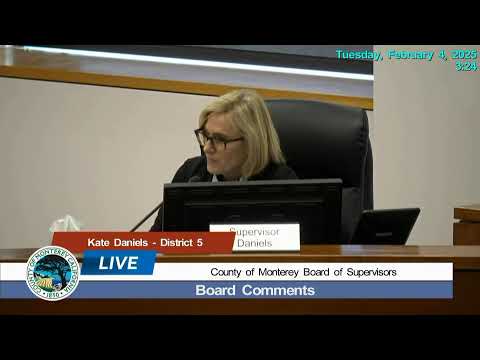
Monterey County officials outlined plans for implementing California's Community Assistance, Recovery and Empowerment (CARE) Act during a Board of Supervisors meeting on Feb. 4, describing the new court-supervised pathway for people with schizophrenia spectrum and other psychotic disorders and the county's preparations since the program launched statewide.
County Interim Behavioral Health Bureau Chief Melanie Rhodes told the board that Monterey County went live on Dec. 1, 2024 as part of cohort 2 and that the CARE process uses a civil-court petition to create a court-supervised, voluntary treatment pathway intended to stabilize people in the community with wraparound services, medication and housing.
Rhodes said the county convened multiagency planning teams led by Judge Culver with participation from the public defender, district attorney, court self-help center, public guardian and behavioral health staff, and won “start-up” funding for planning tasks. She warned, however, that CARE requires an extensive, ongoing workload for county behavioral health: preparing lengthy written reports before hearings, serving notices and reports personally, and providing wraparound services for the life of a case. "There is a total of 18 hearings for each case from start to finish," Rhodes said. "Each case can last almost three years from date of filing." She added that behavioral health must prepare reports before almost every hearing and personally serve respondents, which is staff-intensive.
Rhodes and staff described two primary ways a petition can be filed: a licensed clinician may provide a medical declaration that meets eligibility criteria; or petitioners can submit evidence that a respondent has had qualifying recent hospitalizations (e.g., two involuntary holds with a recent one within 60 days). Behavioral Health will attempt voluntary outreach and engagement for every referral and is the petitioner of record after an initial court intake hearing filed by another party.
Supervisors questioned procedures, funding and enforceability. Supervisor Lando called CARE an "expensive program" with many gray areas and urged careful monitoring; Supervisor Church and others said they supported the goal of keeping people stabilized in the community but pressed for clarity on costs and resources. County Chief Executive Officer Sonia Dela Rosa said the county received a one-time planning allocation of $348,000; the governor has proposed larger statewide funding but county allocations and ongoing funding levels remain to be determined.
Behavioral Health staff said initial statewide cohort data shows families filed the majority of petitions, with significant dismissal and diversion rates: of 557 petitions in the cohort data cited, about 39% were dismissed and another 362 people were voluntarily engaged and diverted prior to petition filing; around 100 care agreements were recorded in the dataset. Rhodes emphasized there are significant reporting requirements for counties and that data collection and IT work are already consuming staff time.
Officials acknowledged housing as a primary bottleneck. Rhodes said CARE requires behavioral health to prioritize housing for people with care agreements and that counties must take care recipients into account when allocating scarce housing slots; she noted differences in level-of-care needs across participants and that some existing county bridge housing may not meet the needs of people requiring more staffed, congregate settings.
Board members pressed a range of issues the county must address, including: how quickly CARE petitions proceed (Behavioral Health said the judge's prima facie review occurs in days, but Behavioral Health then has up to 30 days to prepare a report and a typical time from filing to an initial hearing can be about two months); who may file petitions; personal-service safety risks for staff; the potential liability and fines for failing to provide required services; and whether CARE will function as advocates advertised — staff cautioned CARE cannot compel people into treatment in the same way a conservatorship does.
Rhodes summarized the county posture: Monterey County has started two CARE petitions internally (one filed by a hospital, one by family members) and is building processes to handle outreach, the high volume of hearings, and the staffing/reporting burden. She said the county will submit required CARE implementation information and that Behavioral Health will continue cross‑system coordination with court partners and providers.
The Board did not vote on a new policy at the meeting; supervisors asked staff to continue reporting back with implementation details, funding updates and operational metrics as CARE cases move forward.