Get Full Government Meeting Transcripts, Videos, & Alerts Forever!
Get email alerts on the Fy26 Budget topic
No spam. Unsubscribe anytime.
Cecil County school leaders present FY26 budget with $6.1 million gap and state funding uncertainty
Summary
Superintendent and business services staff told the Board of Education of Cecil County that the FY26 draft operating budget includes projected increases but remains exposed to unsettled state legislation and potential county-level changes, leaving officials prepared to present tiered reductions if revenue falls short.
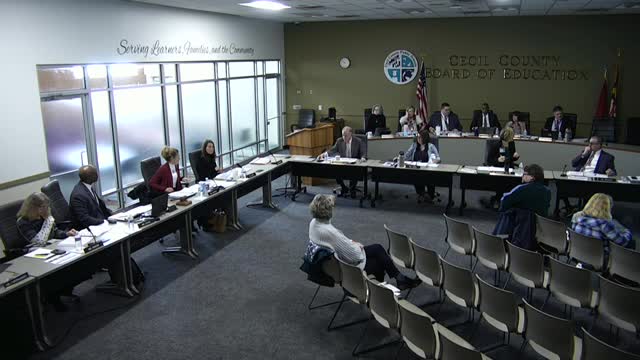
The Board of Education of Cecil County heard a preliminary review of the draft FY26 operating budget on Feb. 4, as Superintendent Doctor Lawson and business services staff outlined projected revenue changes, key cost drivers and next steps for the board.
Doctor Lawson said, “we're expecting a minimum of a $5,400,000 increase” from the state and noted a simultaneous local increase “a minimum of $1,600,000 from the county,” adding that the combination produces “a $6,100,000 increase in state and local revenue combined.” He warned that pending state legislation affecting the foundation formula and components of the Blueprint for Maryland’s Future could reduce the apparent increase and that the county executive may need to submit a budget before some state laws are final, requiring later adjustments.
The board was shown line-by-line detail for departmental budgets and told that business services prepared the roll-up and the supporting pivot-table detail for review. Ms. Sopa of business services explained how the binder maps to the slide roll-up and where members could find granular line items (for example, information technology detail on page 28 of the packet).
Why it matters: the draft budget is balanced around estimated state and local revenue that remain subject to change. Officials said they expect to return to the board with specific recommendations once county and state allocations are finalized; in the meantime they will prepare tiered reductions so the board can act promptly if revenue falls short.
Major budget drivers and uncertainties: - State and local revenue: Doctor Lawson described an expected combined increase of roughly $6.1 million but cautioned that changes to the Blueprint (including a possible pause of the “collaborative planning time” component) could reduce the net funds available. He noted that the collaborative planning time line item equals about $163 per student (roughly $2.3 million) and that concentration-of-poverty set-asides total about $1.9 million and are restricted to specified uses. - Pension and BRFAA: Board members asked whether a projected pension increase (discussed in county budget reconciliation/BRFAA processes) would be charged to the schools’ local share; Doctor Lawson said that remains unclear and that the school system has heard conflicting information. - Use of fund balance: business staff said the FY26 plan assumes use of fund balance and that staff will bring tiered options for reductions if actual revenue is lower than the draft. - Major recurring costs: salary/fixed charges, health care, and special education placements were identified as the largest portions of the budget and the most difficult to reduce without affecting staffing or services.
Board process and next steps: staff described a schedule that would include additional review sessions and a vote by the Board on Feb. 26, after which the approved request is sent to the county. If counties or the state revise allocations later, the system may need to reopen its budget for adjustments. Staff said they will prepare prioritized, tiered reductions keyed to revenue shortfalls so the board can act quickly when final county and state numbers arrive.
Ending: Board members asked clarifying questions about health-care assumptions, potential county support, and how specific restricted grants (for example, concentration-of-poverty funding) are reflected. Staff committed to returning with more detailed scenarios tied to specific revenue outcomes.