Get Full Government Meeting Transcripts, Videos, & Alerts Forever!
Get email alerts on the Homelessness topic
No spam. Unsubscribe anytime.
Houston officials outline $70 million plan to end street homelessness; committee hears seven contract extensions
Summary
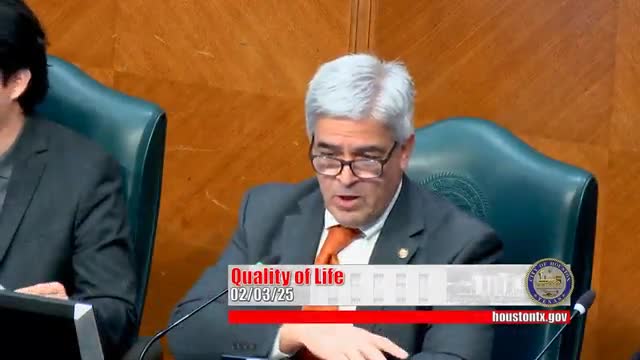
At a Houston City Council Quality of Life Committee meeting at City Hall, city housing officials and partner agencies outlined a mayoral plan that seeks to end street homelessness and described seven contract amendments that would extend Community Development Block Grant (CDBG) and Emergency Solutions Grant (ESG) funds for local homeless services providers.
At a Houston City Council Quality of Life Committee meeting at City Hall, city housing officials and partner agencies outlined a mayoral plan that seeks to end street homelessness and described seven contract amendments that would extend Community Development Block Grant (CDBG) and Emergency Solutions Grant (ESG) funds for local homeless services providers.
The presentations came as city officials and nonprofit partners described a recent uptick in homelessness locally and the structure for a mayoral initiative that officials say will target outreach, rapid rehousing, permanent supportive housing and diversion services. “This last year showed about 3,000 individuals face nightly homelessness, 1,100 unsheltered, the rest in transitional or temporary shelters,” Director Nichols said, summarizing the city’s point-in-time findings.
Why it matters: City leaders said the plan would combine federal, county, philanthropic and private funds to create more flexible local capacity — and to house people off the street immediately where possible. Director Nichols gave a two‑year funding target of $70 million for the initiative; officials said that figure covers outreach, rehousing and program operations rather than capital construction.
Plan overview
Director Nichols described the initiative’s priorities as outreach and personalized care; rapid rehousing; permanent supportive housing for people with disabling conditions; diversion programs that prevent shelter entry; hubs/shelters to coordinate intake and services; and support for operations such as a navigation center. Nichols said the mayor’s team expects to use a mix of city general funds, federal grants and philanthropic contributions and is pursuing additional county and transit (METRO) participation. He said HUD’s Continuum of Care award for FY‑25 — roughly $55 million to the lead agency — will support ongoing housing and services but is distinct from the mayor’s two‑year $70 million plan.
Nichols and partners gave a preliminary breakdown of how the $70 million might be allocated (presented as planning estimates, not final budgets): outreach ($3.3 million), rapid rehousing (about $45 million), permanent supportive housing (about $11 million), diversion and hub/shelter operations (roughly $3.8 million) and other program costs. Nichols cautioned the numbers are contingent on how funds arrive and on whether vouchers or other leveraged resources reduce annual costs.
Operational examples and a test case
Kelly Young, chief executive officer of the Coalition for the Homeless (the lead agency for the Continuum of Care), described a multi‑agency closure at Allen’s Landing where outreach, law enforcement, downtown partners and service providers coordinated to move people into housing and to keep the public space cleared. Young said, “Out of the 36… 17 people we moved straight into housing.” Keena Pace, chief operating officer for the Harris Center for Mental Health and IDD, described one client who received behavioral health care and “is now in a permanent and supportive housing slot and doing very, very, very well.”
Council members and law enforcement
Chief Larry Satterwhite and council members discussed enforcement and legal limits. The city’s civility/camping ordinance (referred to in committee as ordinance 43‑52 or 40‑3‑52 in the presentation) — which currently allows sleeping on sidewalks during certain hours — was raised as a policy tool that would require housing alternatives to be in place before expanded enforcement. Nichols and Satterwhite both emphasized that enforcement without rehousing and services risks harm and high public cost.
Contract amendments presented to committee
Housing Department staff presented seven first amendments to existing subrecipient agreements that would extend terms and add CDBG/ESG or related funds for nonprofit providers. No votes were taken at committee; council members requested additional performance data and said the items will return in the council packet for decision. The items presented were:
- Item 2a (Agenda ID 2a): First amendment with Harris County Housing and Community Development Department — up to $143,750 in CDBG and ESG to continue a homeless prevention program for about 25 households; extension through 2026‑06‑03. Harris County reportedly served about 68% of its goal and used 60% of funding as of Dec. 2024.
- Item 2b (Agenda ID 2b): Third amendment with The Salvation Army — up to $334,689.86 in CDBG and ESG to continue diversion, prevention and emergency shelter services for about 775 households; extension through 2026‑01‑31. Presentation said the agency has a long funding history with the city and no monitoring findings.
- Item 2c (Agenda ID 2c): First amendment with the Harris County Domestic Violence Coordinating Council — up to $944,657.15 in CDBG and ESG to provide lead administrative services for nonprofit domestic violence providers serving a minimum of 228 additional households; extension through 2026‑03‑31. As of Nov. 2024 the agency had served about 93% of its goal and expended roughly half its funds.
- Item 2d (Agenda ID 2d): First amendment with Catholic Charities of the Archdiocese of Galveston‑Houston — up to $264,705 in CDBG and ESG for homeless prevention and rapid rehousing services for approximately 70 households; extension through 2026‑03‑31. Presentation noted no monitoring findings and partial expenditure/performance to date.
- Item 2e (Agenda ID 2e): First amendment with Covenant House Texas — up to $341,541 (HHSP youth dollars plus CDBG/ESG) for services to youth (ages 18–24) experiencing or at risk of homelessness, covering emergency shelter, case management and essential services; extension through 2026‑03‑31. Presentation said Covenant House exceeded its goal and used about 89% of its funding as of Nov. 2024.
- Item 2f (Agenda ID 2f): First amendment with Coalition for the Homeless of Houston and Harris County — up to $153,335 in ESG and HOPWA funds for operation and maintenance of the Homeless Management Information System (HMIS); extension through 2026‑05‑31. Presentation said the coalition has administered HMIS for the community since 2012 and had no monitoring findings.
- Item 2g (Agenda ID 2g): First amendment with SEARCH Homeless Services — up to $376,669 in CDBG and ESG for rapid rehousing and case management serving about 100 households; extension through 2025‑12‑31. Presentation said SEARCH had reached 96% of its goal and expended about 93% of its funding as of Nov. 2024.
Staff and council requests for follow‑up
Council members pressed staff for clearer performance data for recurring vendors. Council Member Joaquin Martinez said, “Ultimately, we need housing first,” and Council Member Julian Ramirez asked that fact sheets and historical performance metrics accompany items in the Novus council packet so members can evaluate renewals. Assistant Director Melody Barr said, “I believe that in Novus, when we present this to city council, there's also a fact sheet that is also added as additional backup document.”
Next steps and how to help
Committee members did not vote on the presented amendments; the items were informational at this meeting and are expected to appear with backup in the formal council agenda for consideration. Director Nichols and coalition leaders encouraged philanthropic donations to the lead agency, the Coalition for the Homeless, which they identified as the central philanthropic intake for the initiative. Officials said they will continue outreach to Metro, Harris County, TxDOT and philanthropic partners to align operations and funding.
The committee closed with repeated requests from council members for ongoing updates, clearer contract performance metrics and attention to geographic equity in outreach and services across Houston’s districts. “This is an iterative process,” Nichols said; “it will change and grow,” as the city coordinates funding and operations toward ending street homelessness.