Get Full Government Meeting Transcripts, Videos, & Alerts Forever!
Get email alerts on the Criminal Justice topic
No spam. Unsubscribe anytime.
York County commonwealth's attorney and circuit court clerk outline courthouse services, drug‑court plans and title‑fraud response
Summary
Commonwealth's Attorney Kristen Reed and Circuit Court Clerk Kristen Nelson presented office operations, a planned county drug court and ongoing efforts to combat home‑title fraud, and described public services such as concealed‑weapon permitting and online record access.
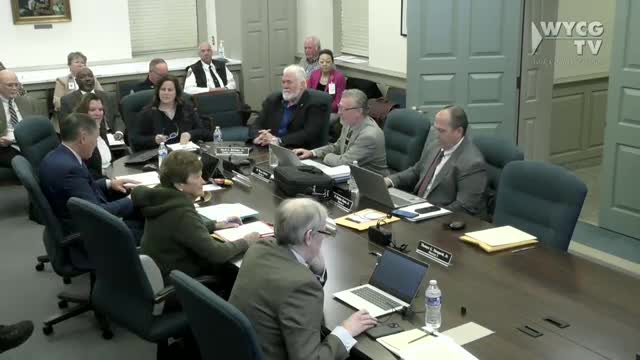
Kristen Reed, York County Commonwealth's Attorney, and Kristen Nelson, clerk of the circuit court, briefed the Board of Supervisors on Feb. 4 on the functions, staffing and public services of their offices and on efforts to address underlying causes of crime and growing title‑fraud concerns.
Reed said the commonwealth's attorney's office prosecutes all felonies, jailable juvenile and domestic relations matters, and many misdemeanors including DUI and weapons charges. She described a nine‑attorney office that includes a chief deputy and three victim‑witness advocates who meet victims at the courthouse, help with restitution paperwork and assist witnesses during proceedings. “We have 9 attorneys…5 out of the 9 attorneys all have more than 20 years experience,” Reed said.
Nelson described the circuit court clerk's role as the permanent repository for York County records, with archives that she said extend back to 1633. Her office manages case and records management, jury administration, election records, deeds and fiduciary records, and monthly restitution payments to victims. The clerk's office and the commonwealth's attorney both operate business hours she gave as 8 a.m. to 4:30 p.m.
Why it matters: the presentations detailed how county criminal prosecutions, court recordkeeping and customer-facing services are delivered and clarified where county residents should go for records, marriage‑license follow‑up and concealed‑handgun permits.
Reed and Nelson described several programs and changes in development. Reed said the county will open a drug court to provide alternatives to incarceration for people with substance‑use disorders; she said the court will be a weekly docket with testing, counseling and support to reduce recidivism and help participants maintain employment and housing. “It will be a weekly docket where…participants come in. They are drug tested. They are talked to about counseling, helping them get jobs, stable housing,” Reed said.
Nelson described steps the clerk's office is taking against increasingly visible home‑title fraud. She said a clerks' subcommittee formed in November is working with the Virginia Bar Association and the Virginia Land Title Association to create shared solutions and that a lack of technical integration among local computer systems complicates automated, locality‑level notification systems. “Part of the problem with creating these notification systems is many of the localities don't have integration with the computers that would allow for that,” Nelson said. She encouraged homeowners to use the clerk's online indexes to check recorded documents or to call the clerk's office for a quick look‑up at no charge.
Nelson outlined the clerk's electronic filing and records practices: cases have been digital since February 2014 and staff are pursuing back‑scanning for older records. She said her office has quotes for back‑scanning that would integrate with the Supreme Court's case management system and that she is reviewing kiosk options to help patrons obtain basic information, while flagging liability and accuracy concerns with public kiosk tools.
On concealed‑weapon permits, Nelson described a multi‑step process that begins at the clerk's office, proceeds to the sheriff's office for a background check, then returns to the clerk for final processing under the county's electronic system. Reed said her office also provides legal training for sheriff's deputies and handles voter‑fraud investigations and other advice to law enforcement.
Board members asked how the offices coordinate with district and juvenile courts; Reed and Nelson clarified the circuit court's role as the trial court for felonies and the district court's role in preliminary proceedings. Nelson also described the clerk's process for returned marriage licenses and the office's role in paying restitution when monthly payments arrive.
Ending: Both Reed and Nelson offered county contact points and said their offices are available to answer public questions about records or court procedures. Nelson said the clerk's staff will assist residents who want staff to look up the most recent recorded instrument for their name.