Get Full Government Meeting Transcripts, Videos, & Alerts Forever!
Get email alerts on the Death Penalty Intellectual Disability topic
No spam. Unsubscribe anytime.
Georgia committee hears bill to change how intellectual disability claims are decided in capital cases
Summary
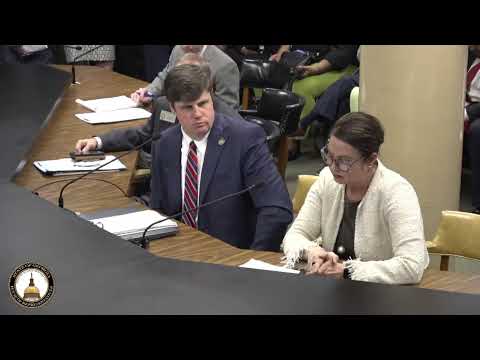
The Georgia House Judiciary Committee met for a hearing on House Bill 123, a measure that would lower the standard of proof for intellectual disability in capital cases to a preponderance of the evidence and require a separate pretrial hearing on the issue.
The Georgia House Judiciary Committee met for a hearing on House Bill 123 on a bill presented as altering how claims of intellectual disability are handled in capital cases.
Representative Werkheiser presented House Bill 123, saying the measure would do two things: change the standard of proof for intellectual disability from beyond a reasonable doubt to a preponderance of the evidence, and require a separate, pretrial hearing on the question of intellectual disability before the trial. “I believe it is incumbent upon the state to protect those who cannot protect themselves,” Representative Werkheiser said when introducing the bill.
The bill’s proponents, including Maisie Lynn Gertin of the Georgia Association of Criminal Defense Lawyers, told the committee Georgia is an outlier for requiring jurors to decide intellectual disability by a beyond-a-reasonable-doubt standard while simultaneously deciding guilt. Gertin said combining those determinations is “confusing” and “prejudicial,” and that House Bill 123 would align Georgia’s practice with other states that use a lower standard and separate the determinations.
Wright Barksdale, district attorney for the Elk Mulgie Judicial Circuit, and other prosecutors said they support lowering the standard of proof but strongly oppose the procedural changes in the bill. “The procedural changes to this bill would all but kill the death penalty in the state,” Barksdale said, arguing that the pretrial hearing and the bill’s structure would add appellate steps and repeated litigation that substantially lengthen and complicate capital cases.
Sheila Ross, testifying for defense interests, told the committee the bill as drafted creates what she described as “no exit ramp” for litigation: if a defendant loses a pretrial intellectual-disability proceeding, the matter could nevertheless be re-litigated during the trial and repeatedly on appeal. “The only exit ramp for this litigation is for the defendant to be found intellectually disabled somewhere along that route. Otherwise, it is nonstop continuous litigation on this same issue,” Ross said.
Committee members questioned both practical and constitutional implications, including whether a pretrial judge-only determination could be made final (precluding further jury consideration) and whether the proposed structure would encourage forum-shopping or otherwise shift fact-finding away from juries. Rep. Panitch and other members asked whether the procedural changes were necessary if the objective is only to lower the burden of proof; several prosecutors suggested narrower amendments that would change only the evidentiary standard rather than creating a trifurcated proceeding.
Witnesses cited statistics and past prosecutions during the discussion. Barksdale said that Georgia had 128 people on death row in 1999 and that the number has fallen substantially since then; he said five death sentences have been rendered in the state since 2011 and that no person with an intellectual disability has been executed in Georgia.
The committee had previously adopted its noncivil judiciary rules by acclamation at the start of the session. Members noted the hearing had a hard stop later in the afternoon because other legislative events were scheduled, and the chair encouraged continued negotiations among stakeholders and the bill’s author to refine the proposal.
No committee vote on House Bill 123 was taken during the hearing; the committee concluded with an invitation for proponents and opponents to meet with the author and committee chairs to pursue revisions.
The committee adjourned for the afternoon with further discussion on House Bill 123 expected at a later meeting.