Get Full Government Meeting Transcripts, Videos, & Alerts Forever!
Get email alerts on the Police Oversight Dig Cases topic
No spam. Unsubscribe anytime.
Civilian review board accepts multiple Inspector General findings; discusses transparency, virtual meetings and online complaint tracking
Summary
The board voted to accept the Department of Inspector General’s recommendations on dozens of Columbus Police Department complaint investigations, sustained a policy violation in one case, and discussed proposals for an online complaint tracker, virtual committee meetings and expanded public reporting.
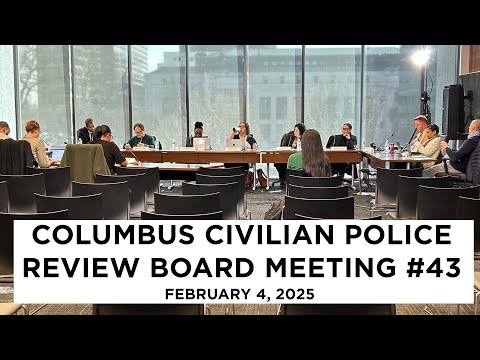
The Columbus Civilian Review Board voted to accept the Department of Inspector General’s (DIG) findings on a large number of citizen complaints against Columbus Police Department (CPD) officers and held extended discussion about transparency and procedural issues, including online complaint tracking and the possibility of virtual committee meetings.
The board’s vote approved the DIG’s recommended dispositions for multiple case files — including sustained, unfounded and exonerated findings — and separately accepted a DIG-added sustained finding that officers failed to notify dispatch in one incident.
The actions matter because they finalize the board’s formal response to DIG investigations and set the record on whether officer conduct violated CPD policy. Board members also used the meeting to press DIG and staff about patterns in traffic stops, choices about searches under exigent circumstances, outreach and how to make case information more accessible to residents.
Board Member Nathan summarized the DIG reviews and moved that the board accept the subcommittee recommendation on a long list of case numbers, saying, “I move to accept the DIG’s findings with respect to case [list of case numbers].” The motion was seconded and approved by voice/hand-raise; the board recorded the motion as carried. The board later moved and carried acceptance of an additional DIG finding in case 1042 that officers failed to advise the channel dispatcher of self-initiated activity, a violation the DIG recommended sustain.
DIG staff and the board’s subcommittees reviewed dozens of complaints in this session. Examples discussed on the record included: - Case 2023-02050208: the DIG considered an officer-involved shooting and concluded officers’ actions were supported by CPD policy; the matter was closed administratively. - Case 1042: DIG added a finding that officers failed to notify the channel dispatcher of the location and nature of self-initiated activity, resulting in no electronic CAD record; the DIG recommended and the board accepted a sustained finding. - Case 1456: DIG recommended a sustained finding for excessive force where an officer dragged a suspect down exterior stairs; the subcommittee and board agreed with the DIG. - Multiple other cases were discussed and recorded with recommendations of unfounded, exonerated or sustained depending on the allegation and supporting body-worn camera, CAD and other evidence.
During the review, board members questioned DIG investigators and staff about recurrent patterns. One recurring theme was whether traffic stops are being used as a pretext for narcotics investigations: board members asked DIG how it assesses the legitimacy of traffic stops and whether investigators review vehicle or body-worn camera footage for indicators such as failure-to-signal citations. DIG staff replied that traffic-stop reviews routinely include body-worn camera and vehicle video where available and that investigators assess whether the initial stop fell within CPD policy.
Board members also pressed for clarity about searches conducted under exigent circumstances after a reported stabbing at the Linden Recreation Center. An attorney advising the board explained that searches without warrants rely on the specific facts supporting exigent circumstances and that the reasonableness and scope of any protective sweep are case-specific. The DIG’s written finding for that matter concluded the officers’ actions were within policy and recommended closure as unfounded for the complainant’s allegations; the board’s subcommittee agreed.
Separately, members discussed an item about a Columbus officer’s social-media posts. Board members said they were seeking consistency in the DIG’s approach after a prior case was pursued even after a complainant withdrew the allegation. DIG staff said they had reviewed the referenced cases, confirmed one sustained outcome (case 0405) and agreed to follow up with the board about apparent discrepancies and underlying case numbers.
Beyond case dispositions, the board discussed steps to increase public transparency. Members asked DIG staff to explore a public, searchable online database where complainants could track the status of their complaints by case number, and where the board and the public could more easily review summaries, precinct-level trends and departures between DIG and board findings. DIG staff said they will research resource and technical costs, noted prior conversations with the city’s Office of Violence Prevention and other agencies, and agreed to follow up with specifics.
Members also raised the question of virtual committee meetings. A board member referenced recently enacted House Bill 257 as potentially authorizing remote meetings for city boards and commissions but noted possible conflicts with the city charter; the board’s attorney said she will research the interaction between the state statute and local charter authority and report back.
Board leadership and staff updates included an Inspector General update (DIG staff said they would distribute a written update later in the week) and an announcement that Terrence Hinton is expected to join the board and complete training around May. The board chair and staff also discussed procedural items: sending legal advisories to the full board rather than only to committees when questions arise; attempting to post more digestible case summaries in future reports; and presenting the board’s annual report to City Council.
The meeting closed after the board carried motions accepting the DIG’s recommended findings on the items reviewed. Several subcommittee members said they would follow up on outstanding questions about specific cases and on next steps for online publication and for possible presentations to City Council.