Get Full Government Meeting Transcripts, Videos, & Alerts Forever!
Get email alerts on the Hospitality Restaurants Economy topic
No spam. Unsubscribe anytime.
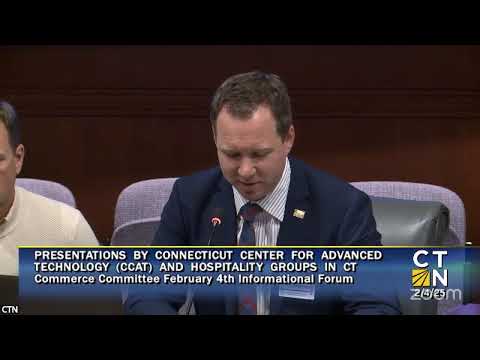
Restaurant owners tell Commerce Committee high wages, fees and regulations squeezing small operators
Summary
Representatives of restaurants and the Connecticut Restaurant Association urged lawmakers to slow minimum‑wage indexing, reinvest the 1% meals tax into tourism and workforce development, and address credit‑card swipe fees, energy costs and regulatory burdens that they say are shrinking margins and reducing entry‑level jobs.
Restaurant owners and trade group officials told the General Assembly Commerce Committee that rising labor costs, credit‑card and delivery fees, energy price pressure and expanding regulations are squeezing profit margins and shifting business models across the state.
Representative David Rutigliano, owner of SBC Restaurant Group, told the committee he has reduced staff and raised menu prices. “Given the financially slim profit margin, which now it stands about 3 to 5%, rising payroll costs force us to raise menu prices directly, fueling food service inflation,” he said.
Why it matters: Committee members heard that the restaurant and hospitality sector accounts for thousands of jobs and billions in sales in Connecticut; witnesses warned that continued cost escalation will favor larger chains and automation over independent, family‑run establishments.
The Connecticut Restaurant Association’s president and CEO Scott Dolch presented statewide numbers: the association estimates roughly 9,100 foodservice locations in Connecticut, about $12.2 billion in annual sales and roughly 50,000 employees. Dolch emphasized that 97 percent of full‑service restaurants are independently owned, a figure he said makes the sector vulnerable to consolidation.
On wages and tips, speakers urged caution over the state’s minimum‑wage indexing. Dolch noted Connecticut’s index uses the Employment Cost Index (ECI) and that the state’s minimum wage has increased quickly in recent years; the committee heard that Connecticut’s minimum wage is among the highest in the nation. Representative Retigliano and association witnesses said that while many servers rely on tips and a tip credit, other hourly roles that do not benefit from tip income have been most affected by the recurring increases.
Speakers pressed two policy priorities. First, they urged reinvesting the 1 percent meals and beverage tax back into hospitality: Dolch described a Connecticut Hospitality Fund proposal that would return 50 percent of the 1 percent to municipalities, allocate 30 percent to the state tourism office and 20 percent for workforce development. He said the 1 percent has generated “a little more than $400,000,000 since 2019,” and that tourism marketing budgets have dropped from $12.1 million in 2022 to a projected $4.5 million in 2025 if current funding levels continue.
Second, witnesses asked the legislature to reduce the burden of credit‑card swipe fees on merchants. Dolch said merchants in Connecticut collectively pay roughly $130 million in fees to collect state sales tax; he noted Illinois recently passed a law addressing interchange fees on sales‑tax collection and urged Connecticut to consider similar legislation.
Other issues raised included energy and utility costs, a proposed 24 percent natural gas increase pending regulator approval, responsibilities related to food‑waste and composting rules, the expanded model food code and new safety detector mandates that businesses say create compliance costs and administrative complexity.
Lawmakers asked for data and possible legislative solutions. Several members urged that the Commerce Committee examine minimum‑wage indexing, support reinvestment of meals tax receipts into tourism and workforce programs, and consider bill language to limit sales‑tax collection fees charged to merchants. No formal votes were taken at the hearing.
Speakers available for attribution in this report: Representative David Rutigliano (state representative and restauranteur); Scott Dolch (President & CEO, Connecticut Restaurant Association); Doug Palastena (owner/operator, Amber Room Colonnade catering venue); Phil Barnett (owner, Wooden Taps).