Get Full Government Meeting Transcripts, Videos, & Alerts Forever!
Get email alerts on the Water Infrastructure topic
No spam. Unsubscribe anytime.
Wyoming committee advances $hundreds million omnibus water construction bill after debate over LaPrele, Alkali Creek funding
Summary
The Agriculture, State & Public Lands & Water Resources Committee moved House Bill 117 after debate and amendments addressing funding shortfalls at LaPrele Dam and the Alkali Creek Reservoir.
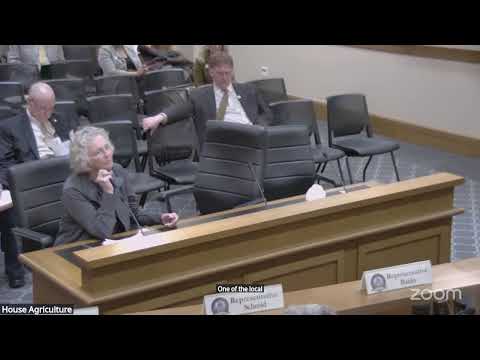
The Agriculture, State & Public Lands & Water Resources Committee moved House Bill 117, the annual omnibus water construction bill, by a 9-0 roll-call vote after debate and amendments that addressed funding for LaPrele Dam and the Alkali Creek Reservoir.
The bill provides spending authority for projects selected by the Water Development Commission and the Select Water Committee. Jason Mead, director of the Wyoming Water Development Office, told the committee the construction bill lists projects, funding terms, grants and loans, amendments to prior appropriations, and transfers between the water development accounts. Mead said the Water Development Program is funded from part of the mineral severance tax distribution account and that each construction project has been vetted through planning studies before consideration.
Why it matters: HB117 authorizes the state to allocate construction funds and to set terms for grants and loans that will shape municipal and irrigation water systems across multiple basins. The bill includes several large rehabilitation and new-development projects, cloud-seeding programs, small water project grants and amendments to prior projects that together represent the largest statewide capital program the committee handles.
Mead highlighted several projects and program totals in the bill. Section 1 (new development, Account 1) lists three projects and a $5,583,343 subtotal for that block; Account 2 (rehabilitation) lists 12 projects and totals $17,094,331. The bill also contains 12 amendments to prior appropriations, including time extensions and additional funds for delayed projects.
LaPrele shortfall and Alkali Creek transfer
Mead told the committee the LaPrele Dam reconstruction has a current high-end cost estimate of about $182 million and that about $92 million of federal bipartisan infrastructure law funding administered by the Bureau of Reclamation is available for construction, leaving a shortfall Mead described as roughly $90 million. Select Water Committee members had proposed using up to $60 million from the Legislative Stabilization Reserve Account (LISRA) to reduce that gap.
To partially cover the LaPrele need, the Select Water Committee proposed temporarily reverting $50 million from Alkali Creek Reservoir’s appropriation and transferring that money into Account 2 (rehabilitation) for LaPrele. Mead and other presenters explained the two projects are linked in the construction bill language: $50 million could be reverted from Alkali Creek to reduce the LISRA need dollar-for-dollar.
Alkali Creek sponsors and local residents strongly opposed reducing Alkali funding. John Joyce, chairman of the Nowood Watershed Improvement District, told the committee his district has worked on Alkali Creek for years, that NEPA and Corps 404 permits and a water storage permit were already in place, and that about 93% of land and easements for the project are secured. He said the project provides late-season irrigation, public fishing, recreation and fish habitat and asked the committee to restore the $50 million and extend the project timeline.
Several other local witnesses, including landowners and members of the Nowood Watershed Improvement District and the Anita Ditch Company, described the reservoir’s benefits for irrigation, recreation and fire response. Witnesses said Alkali Creek could store about 9,000 acre-feet and a surface area near 300 acres and that the project has already consumed state funds and permitting work.
Goshen tunnels and other cost increases
Mead also described rising cost estimates for the Goshen Irrigation District tunnel replacement (tunnels 1 and 2), which he said had an updated cost estimate near $130 million; the shortfall there was described in the committee record as roughly $20–22 million even after prior supplemental funds. Mead explained the Commission has used split funding strategies (preconstruction vs. construction dollars) to reduce time extensions on projects where easement acquisition slows work.
Cloud seeding study and small-project grants
Deputy director Barry Lawrence summarized a recent one-year assessment by the National Center for Atmospheric Research (NCAR) of the state’s cloud-seeding operations. Using one well-instrumented operational year, NCAR modeled additional precipitation and estimated a simulated seeding precipitation effect that translated to roughly 6,000–14,000 acre-feet of additional yield for that year and about 7,000 acre-feet routed into streamflow in the modeled basins. Lawrence reported an estimated cost per acre-foot for that year between about $56 and $124, with a midpoint near $81 per acre-foot. The bill also funds ground-based and airborne programs and maintains the small water project program (50% grants, not to exceed $35,000 per project; tabulated $1,500,000 for Account 1 small projects).
Transfers, ARPA replacement dollars and other provisions
Mead described an ARPA-related “replacement” provision: roughly $20–25 million of water-development funds freed through prior replacement by ARPA funds could be allocated for specific redundancy or municipal backup projects. The Select Water Commission ultimately recommended against continuing a broad redundancy program in favor of core project priorities, and the bill also contains language transferring some funds among water development accounts to match demand.
Committee action and amendments
A motion to move HB117 was made and seconded; during floor debate the committee adopted two substantive amendments. Representative Brian Provenza moved to change a reversion date for the Alkali Creek appropriation from 07/01/2026 to 07/01/2029 to give the project more time; Representative Provenza’s amendment was seconded and passed by voice vote. Representative Davis offered an amendment to add an additional study/funding item for LaPrele (an additional supply assessment) funded from LISRA; that amendment was seconded and passed.
Roll-call passage and next steps
The committee recorded a roll-call vote on House Bill 117 as amended: Representatives Banks, Davis, Eklund, Johnson, Otman, Provenza, Schmidt, Strauch and Chairman Winter voted Aye (9–0). The committee chair announced the motion carried and the bill will proceed to the next step in the process.
What the committee did not decide
Committee debate made clear it did not permanently cancel the Alkali project; the adopted reversion and the extension amendment change timing and availability of funds but do not foreclose future requests. Sponsors of both LaPrele and Alkali Creek signaled they will continue negotiations and may seek further appropriations or revisions on the floor.
Proponents’ concerns about landowner negotiations
Senator Sherry Steinmetz and local witnesses described ongoing easement negotiations that in some cases involve mediation and concerns about eminent domain. Steinmetz said the Select Water Committee inserted parameters to prevent use of eminent domain for Alkali Creek and asked for fair treatment of landowners who said they faced threats of condemnation. Multiple witnesses urged the committee to preserve funding while the parties finish negotiations.
Ending
HB117 as amended remains a major state water-construction appropriation package that includes new projects, rehabilitation work, cloud-seeding programs and several large multi-year projects with recent cost increases. The committee left several projects tied to negotiated outcomes (easements and permitting) and used amendments to shift reversion timing and authorize limited additional study and funding for LaPrele.
Speakers quoted in this article are identified in the committee record and include Jason Mead, Barry Lawrence, Senator Sherry Steinmetz, John Joyce and multiple local water district representatives and legislators.