Get Full Government Meeting Transcripts, Videos, & Alerts Forever!
Get email alerts on the Manufacturing Technology Training topic
No spam. Unsubscribe anytime.
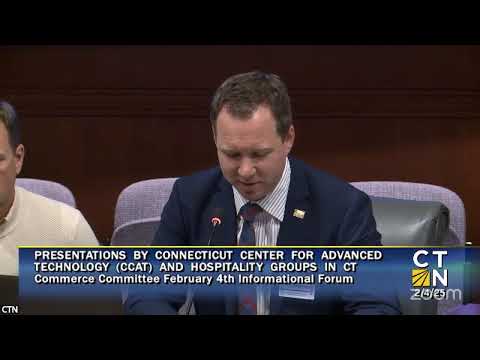
Connecticut Center for Advanced Technology outlines training, digital tools to help state manufacturers
Summary
CCAT told the Commerce Committee it operates three facilities, runs federal and state-funded programs and faculty fellowships, and supports small and medium manufacturers with digital thread, additive manufacturing and workforce training; lawmakers pressed for clearer budget breakdowns and outreach plans.
The Connecticut Center for Advanced Technology told the General Assembly Commerce Committee on an informational day that it is expanding training and technology programs intended to help Connecticut manufacturers adopt digital tools and compete for defense and aerospace work.
CCAT President and CEO Ron Angelo told the committee, “For more than 20 years, CCAT has been developing, implementing, and delivering many of the most impactful programs and services to Connecticut manufacturers of every size and from every sector.” The presentation emphasized CCAT’s work on digital thread workflows, non‑destructive testing, automation and additive manufacturing.
Why it matters: Committee members said the state’s manufacturing competitiveness hinges on small and medium suppliers upgrading digital skills and that Connecticut’s strengths in aerospace and the maritime industrial base make practical, near‑term technology adoption urgent.
Angelo and Chief Technology Officer Jackie Garofano described three CCAT facilities and a talent‑and‑training accelerator they said were built with federal and state support. “Our Talent and Training Accelerator houses a state of the art digital thread lab, additive workflows lab, a digital booster, and a talent launchpad,” Garofano said, noting CCAT’s role training faculty through a fellowship so university instructors can add digital coursework to curricula.
The presenters said CCAT works across a mix of federal, state and private funding sources, and that federal contracts—especially from the Department of Defense—can be large and multi‑year. Angelo cautioned that exact revenue shares vary year to year, saying the mix can be skewed by one or two large federal awards and declining to provide a firm percentage breakdown during the hearing.
Committee members asked for more specific budget and staffing details. Garofano said CCAT’s headquarters and largest team are based in East Hartford, the Advanced Technology Center is located on the RTX campus with “over a dozen engineers and technologists,” and the Advanced Composites Technology Center at Goodwin University has a smaller staff of three CCAT employees working with Pratt & Whitney on composite fan‑blade work.
Lawmakers pressed CCAT for help expanding outreach to small manufacturers and for deliverables the committee could share with constituents. Senator Hartley and others requested a clearer fiscal profile showing the proportions of federal, state and private revenue across recent years; Angelo said he would provide data to the committee.
CCAT also described participation in federal funding programs and company support for SBIR/STTR efforts. Garofano said CCAT appears on sbir.gov as a resource for companies seeking federal research awards and that CCAT can help firms with phase 1–3 SBIR/STTR work in partnership with universities.
Committee members and CCAT representatives repeatedly linked the organization’s work to Connecticut’s defense and aerospace supply chain, citing the state’s role in submarine design and the “maritime industrial base.” Angelo said that digital capabilities and workforce development are necessary to capture projected increases in defense sustainment and new platform work.
The session closed with CCAT offering to share outreach materials, training videos and data on funding sources and program outcomes. Committee members requested follow‑up materials on CCAT’s revenue profile, staffing by facility, and the faculty fellowship curriculum to evaluate how the state can support scaling of the center’s training and technology adoption efforts.
CCAT speakers available for attribution in this report: Ron Angelo, President and CEO; Jackie Garofano, Chief Technology Officer.