Get Full Government Meeting Transcripts, Videos, & Alerts Forever!
Get email alerts on the Public Art Mural Waverly Park topic
No spam. Unsubscribe anytime.
Neighbors seek murals at Waverly Park; commission presses redesign for drainage safety
Summary
Friends of Waverly Park requested Phase 1 approval to paint concrete drainage abutments and basketball supports; commissioners expressed concern about painting surfaces that contact stormwater, suggested alternatives and asked the group to return with Phase 2 designs that avoid water-contact surfaces.
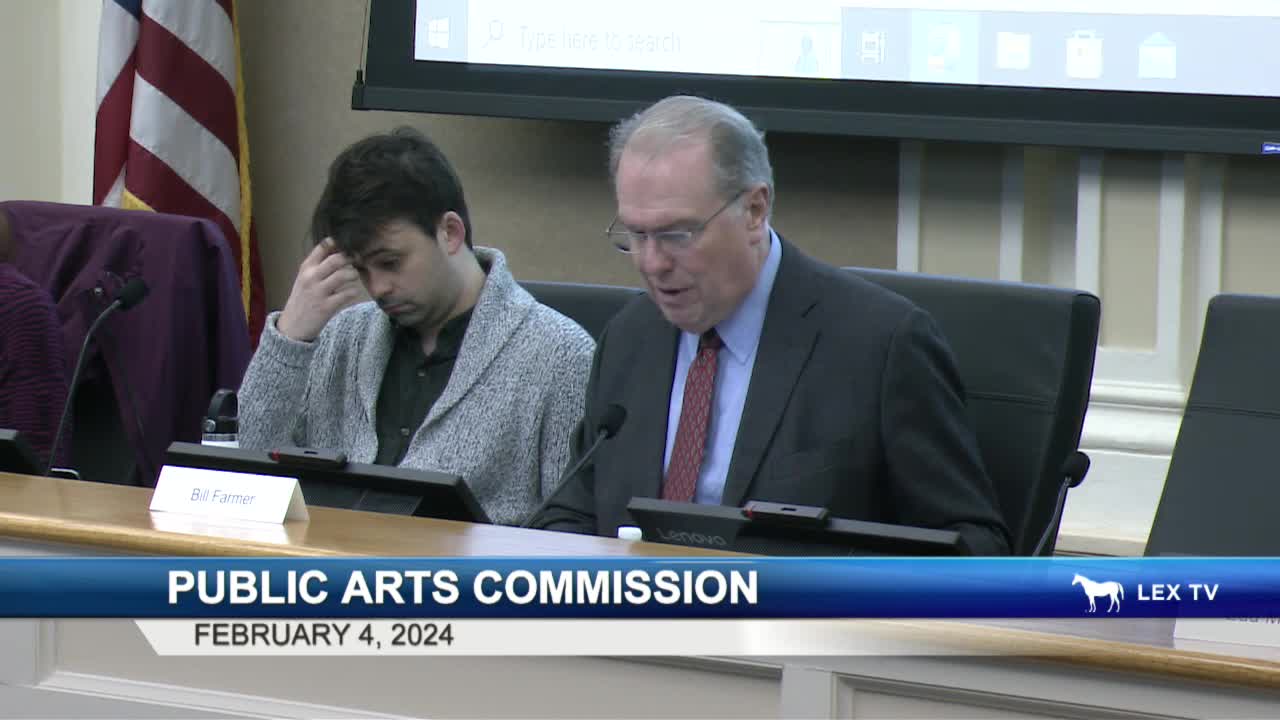
At a Lexington Public Art Commission meeting, residents asked to move a Phase 1 application for mural work at Waverly Park to Phase 2 after commission members raised environmental and durability concerns about painting concrete drainage channels.
Ed Monahan, a resident of Clemens Heights and a member of the Friends of Waverly Park volunteer group, said volunteers have spent two years removing invasive species and planting native trees and pollinator plantings at the neighborhood park. He described a Phase 1 proposal to paint two concrete drainage abutments, two concrete basketball-support posts and portions of a concrete drainage channel to reflect native-plant themes. Monahan said artist Sherry Graham Greene, who painted a mural in Meadowthorpe Park, has agreed to lead the design and community engagement.
The commission focused on environmental risks posed by painting surfaces that regularly contact runoff. "This is water runoff that's not gonna be treated. So this will enter our waterways," said a commission member who identified himself as a civil engineer. "I'm worried about the contaminants of the water. So I would be okay if you paint the exterior walls ... but anything that water is going to be rushing up against continuously every rain event, would probably not work." The commission member recommended consulting the Division of Water Quality before proceeding with paint on water-contact surfaces.
Speakers also discussed maintenance and logistics. Monahan said Council member Whitney Baxter has committed a 20% match of $8,910 toward the project. The applicant estimated about 900 square feet of painted surface and cited a budget figure of roughly $45 per square foot; the artist would provide a detailed Phase 2 budget. Monahan said Parks would need to power-wash the concrete and cut grass alongside one drainage ditch to allow volunteer access; he named Jeffrey Smith with Parks as the staff member previously contacted about grass cutting.
Commissioners suggested alternatives to painting channels exposed to flow, including riprap with vegetation, bioswales or planting approaches that provide water-quality treatment while improving appearance. "Maybe take those up with your artist in your group too," one commissioner said, referencing a successful riprap/planting treatment used at a McConnell's Trace park. Commissioners also proposed directing mural work toward surfaces that do not interact with runoff — for example, outer faces of abutments, basketball-pole exteriors, court borders or sidewalks — and encouraged the applicant to include community input in the design.
The commission did not reject the project. Members asked the applicants to return with a Phase 2 packet that includes design visuals, a site map showing locations and a refined budget; they also asked staff to provide resources on stormwater best-management practices and installation options. Parks’ agreement to power-wash and maintain grass was not confirmed during the meeting.
The applicant said volunteers and the artist will develop community-driven designs in Phase 2 and that the artist would include protective coatings where appropriate. The commission emphasized it wants to avoid any treatment that would increase pollution risk to downstream waterways and encouraged consultation with stormwater staff and the Division of Water Quality before any paint is applied to water-contact surfaces.
Monahan noted Waverly Park lies between Clays Mill and Clemens Drive and said the goal is to make a highly visible, neighborhood-accessible enhancement to the walking path and Bring Back the Bluegrass area. The commission agreed to help the applicants with Phase 2 materials and resources but did not authorize any commission funding in this meeting for the Waverly Park work; funding discussion centered on the council member match and on required Parks assistance.
Next steps: the Friends of Waverly Park will work with the artist to produce Phase 2 design proposals, a site map and a detailed budget; staff will provide stormwater and materials resources; and the group will return to the commission for Phase 2 consideration and any request for commission funding.