Get Full Government Meeting Transcripts, Videos, & Alerts Forever!
Get email alerts on the Police Surveillance topic
No spam. Unsubscribe anytime.
Cambridge council approves license-plate readers and phone-unlocking tool, sends drone request to committee after hours of public comment
Summary
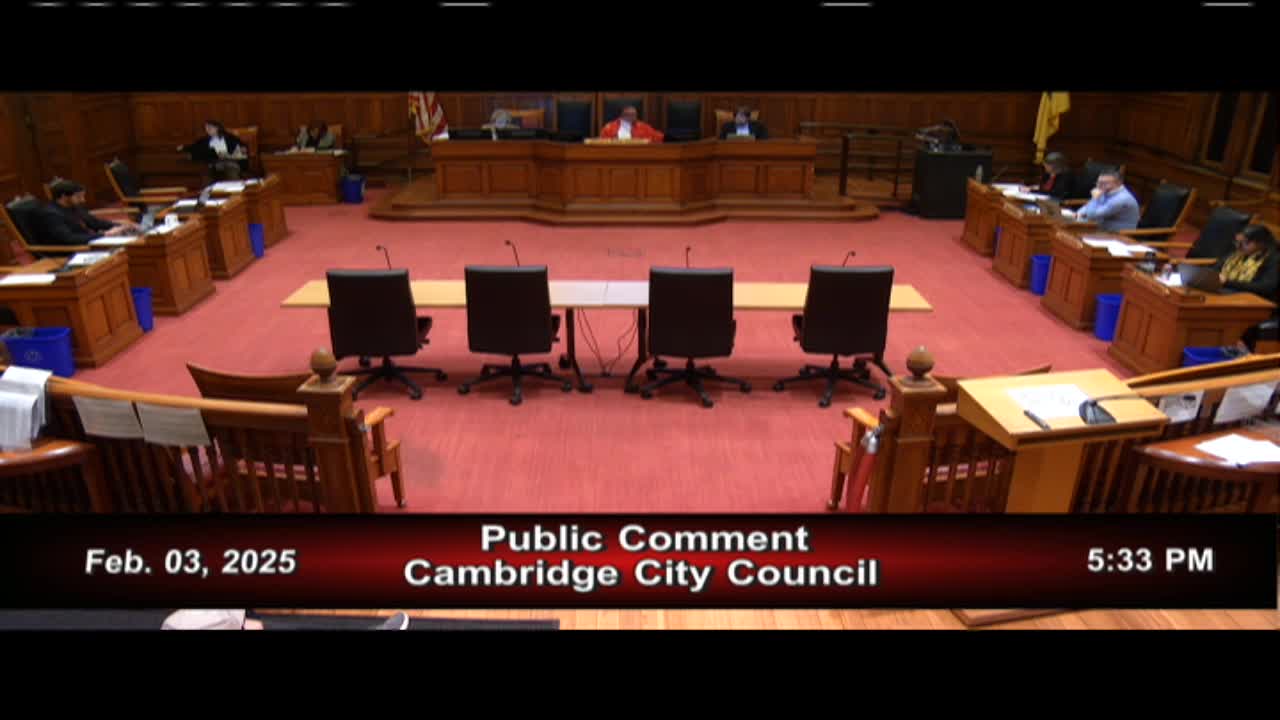
After more than two hours of public comment—mostly opposing new surveillance tools—the City Council voted to approve automated license-plate readers and a locked-device access tool for the Cambridge Police Department and referred a request to buy drones to the Public Safety Committee for further review.
The Cambridge City Council voted on Feb. 3 to authorize two surveillance tools for the Cambridge Police Department—automated license-plate readers and a locked-device access tool—and to send a separate request for remotely piloted aerial vehicles (drones) back to the Public Safety Committee for further review.
The votes followed a long public-comment period during which dozens of residents, students and union organizers urged the council to reject surveillance purchases. Speakers said the technologies would chill protests, enable racialized policing, and risk sharing data with federal agencies; many cited recent local incidents and national examples. Councilors and city officials, including Commissioner Paul Ilo of the Cambridge Police Department, said the tools would be limited by existing city policy and state law and argued some tools could help investigators solve violent crimes.
The vote outcome: automated license-plate readers and the locked-device access tool were approved by the council, while the drone request was referred to the Public Safety Committee for more discussion and narrower limits. Council minutes record that the motion on the two approvals passed with an affirmative vote (6 yes, 3 no) and that the drone item was not adopted that evening and instead was scheduled for committee consideration.
Why it mattered: Testimony from more than 40 people focused on concerns that the technologies would be used to monitor protests, undocumented immigrants and students. Several speakers said federal grant sources (the Urban Area Security Initiative / FEMA) tied to the drone and other requests raised further concerns about data-sharing with state or federal agencies. Supporters on the council and in the police department said the tools would be used only for qualifying criminal investigations, traffic/pedestrian safety and limited exigent situations and stressed city rules that bar facial recognition and that require reporting.
Council and police explanations: Cambridge Police Commissioner Paul Ilo and Deputy Superintendent John Boyle described how each tool would be used. They said automated license-plate readers (ALPRs) would be placed at fixed locations, capture plate images in public spaces and compare those images to investigative lists (stolen cars, AMBER alerts) with data deleted after 30 days unless retained for an active investigation. They said the phone-access technology would be used only under legal authority—warrants, exigent circumstances or owner consent—and would be restricted to specially trained investigators. Police described drones as an officer-safety and search-and-rescue tool and said they would not be used for facial recognition.
What the council did: Councilors debated the balance between civil-liberties risks and public-safety benefits. A motion to approve the ALPR and phone-unlock requests passed. The council referred the drone request to the Public Safety Committee for additional public hearings and more specific operational limits.
Next steps: The drone request will return to the Public Safety Committee for additional hearings and possible redrafting of operational limits. The council directed staff to include the approvals for ALPRs and the locked-device tool in the city’s surveillance reporting and oversight process required by city ordinance.
Context: Much of the public comment referenced recent local incidents and national examples where surveillance technologies were deployed around protests. The council’s vote followed a staff presentation, a police explanation of intended uses, and questions from councilors about data sharing, legal thresholds and enforcement.