
Clayton County school board votes to opt out of state’s HB 581 homestead cap
Get AI-powered insights, summaries, and transcripts
Sign Up Free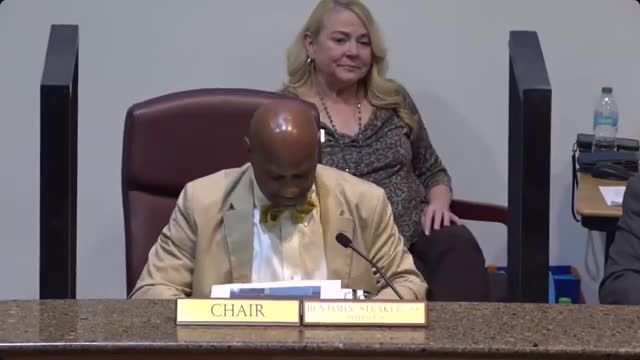
Summary
After a public hearing with residents split between homeowner tax relief and school-budget concerns, the Clayton County Board of Education voted unanimously to opt out of House Bill 581, citing projected revenue losses for district operations.
The Clayton County Board of Education voted unanimously to opt out of House Bill 581, the state measure that would cap year-to-year increases in taxable assessed values of homesteaded properties, after a public hearing and a financial presentation by the district finance officer.
Ramona Bivens, chief financial officer for Clayton County Public Schools, told the board that HB 581 “provides a statewide floating homestead exemption for all local governments, including school districts,” and that the measure would limit increases in assessed value for homestead properties to the annual rate of inflation. Bivens said the law would not affect non-homestead (commercial) property valuations and that existing homestead exemptions — regular, senior, disability and certain veteran and survivor exemptions — would remain in place.
Bivens framed the decision around district operations and projected revenue. She presented past-year estimates and forward-looking scenarios, stating that “had this bill been in place over the previous 7 years ... the district would have potentially lost an estimated $35,000,000 over the 6 year period,” and that under a set of assumptions the district could lose roughly $38,000,000 over five years if it did not opt out.
Bivens also said the Georgia Department of Revenue will use the Consumer Price Index for All Urban Consumers (CPI-U) to set the inflation index each January; for 2024, she reported, the department would not set an inflation rate, meaning that “the assessed value on the person's homestead from 2024 will not change for this year. So, we would not recognize any growth at all. 0 growth.” She described the effect on district revenue as “flat,” and warned that flat property-tax revenue would constrain the district’s ability to fund salaries, instructional supplies, maintenance and safety measures.
Public comment at the hearing was divided. Drew Andrews, identifying himself as a Clayton County homeowner, said the community had already expressed a preference at the ballot box and urged the board to honor it: “Our community overwhelmingly voted for House Bill 581. And as you know, our vote is our voice,” Andrews said. Tiffany Sanders, another homeowner, echoed concerns about rising household costs and said, “This was a referendum. People came out and voted that we wanted this.”
Other speakers told the board they were worried about the district budget if the board allowed the cap to remain. Bivens outlined district revenue composition as roughly 60% state QBE funding and 40% local property tax revenue for maintenance and operations; she noted federal funds usable for operations are under 1% of the district’s budget. Bivens said the district’s millage is capped at 20 mills by the Georgia Constitution and that the district currently levies 19.6 mills, limiting its ability to offset any revenue loss.
The board also heard questions connecting capital projects and operating funds. One resident asked why a new building such as North Clayton was approved while operating revenues were in question; the chair explained that capital projects are funded from a separate sales-tax (the one-cent SPLOST) bucket and do not come from the operating property-tax funds that would be affected by HB 581.
After deliberation during the business portion of the agenda, the board accepted the superintendent’s recommendation to opt out of HB 581. Board member Miss Goree moved to accept the superintendent’s recommendation and Victoria Williams seconded. The motion passed unanimously.
Board chair Benjamin Straker acknowledged the community’s concerns about taxes and said he and Superintendent Anthony Smith had been informally discussing possible relief options with county commissioners and other elected officials, and that the board would continue to explore options.
Votes at a glance
- Opt out of HB 581 (superintendent recommendation): Motion moved by Miss Goree; seconded by Victoria Williams. Vote: 9 yes, 0 no, 0 abstain. Outcome: approved. Note: Opting out requires a resolution to be filed with the Georgia Secretary of State by March 1, per the district presentation.
- Approval of certified employee re-election list (with exceptions numbered 77 and 102 on the central office list): Motion moved by Miss Baker; seconded by Miss Hill. Vote: 8 yes, 0 no, 1 abstention. Outcome: approved.
- Consent agenda (financial report, budget amendments, construction reports, purchasing, personnel changes), minus two lease items (Chamber of Commerce and Clayton County Foundation): Motion moved by Joy Cooper; seconded by Mark Christmas. Vote: 9 yes, 0 no, 0 abstain. Outcome: approved.
- Lease agreement — Clayton County Foundation: Motion moved by Joy Cooper; seconded by Mark Christmas. Vote recorded as 8 yes, 0 no, 1 abstention. Outcome: approved.
- Lease agreement — Chamber of Commerce: Pulled from the consent agenda for further correction and review; vote deferred/tabled.
- Policy series K: Motion to accept as presented. Vote: 9 yes, 0 no, 0 abstain. Outcome: approved.
- Policy series L: Motion to accept as presented. Vote: 9 yes, 0 no, 0 abstain. Outcome: approved.
What it means
By voting to opt out, the board chose to preserve the district’s current ability to recognize growth in property assessments for school operating revenue. District leaders and the board pointed to projected cumulative revenue losses if HB 581 were allowed to apply to the district, and they cited the procedural requirement that a governing authority that chooses to opt out must advertise and hold three public hearings and file a resolution by March 1.
The board’s decision does not alter existing homestead exemptions in Georgia law; it declines the new statewide cap provided by HB 581. Officials and several public speakers acknowledged the competing priorities: homeowners who supported HB 581 as immediate tax relief, and school officials who said the cap would reduce operating revenue for teachers’ pay, classroom supplies and facilities maintenance.
Next steps
The board’s resolution to opt out will be filed as required. Board leadership and the superintendent said they will continue informal talks with county leaders to explore targeted relief options for homeowners and other strategies to address the district’s revenue constraints.