Get Full Government Meeting Transcripts, Videos, & Alerts Forever!
Get email alerts on the Eviction Moratorium Act 202 Mediation topic
No spam. Unsubscribe anytime.
Maui Council committee readies mediation, outreach as eviction moratorium ends Feb. 5
Summary
Council members and county and state officials briefed the Maui County Council—s Water, Social Services and Parks Committee on implementation of Act 202—s renter-landlord mediation and county rental-assistance programs ahead of the Feb. 5 end of the eviction moratorium; no formal vote was taken and the item was deferred for follow-up.
Maui County officials, nonprofit mediators and tenant advocates on Monday discussed steps to implement Act 202 and coordinate rental-assistance and outreach after the county—s wildfire-era eviction moratorium ends at 12:01 a.m. on Feb. 5.
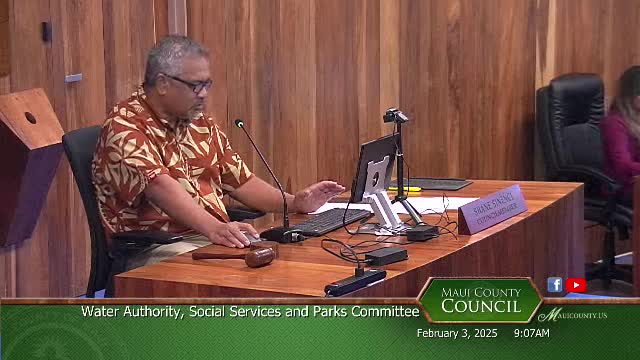
The committee heard that Act 202 establishes a state-funded mediation process for unpaid-rent disputes and that county-funded rental-assistance contractors are prepared to help applicants. Committee Chair Shane Senencio opened the Feb. 3 meeting of the Water, Social Services and Parks Committee, which included Vice Chair Gabe Johnson and multiple council members, and invited testimony and agency briefings on the transition.
Why it matters: Advocates said timely outreach and available rental assistance will be critical to prevent evictions, reduce pressure on the county court system and limit further housing instability for wildfire survivors and other residents. Speakers also urged clarity from state agencies about which parts of the governor—s emergency proclamations remain in force and how Act 202—s tiered mediation thresholds will work.
What officials said
Tia Hartsock, director of the Office of Wellness and Resilience in the governor—s office, told the committee that her office has been coordinating with Maui Mediation Services, the judiciary and local groups "to try and line up resources" for when the moratorium ends. "We are here to share some details on possible funding support," Hartsock said.
Yvonne (Bevan in portions of the transcript) Bowers, executive director of Maui Mediation Services, said her agency "will be processing all of the cases that come under Act 202" and has posted resources and an example notice landlords must provide to tenants. Bowers said mediators and an administrative appropriation from the legislature will fund contracted mediators but that outreach funding is limited.
Priscilla Valu, Maui Mediation Services— landlord-tenant case coordinator, described the agency—s intake and scheduling process: "Tenants have 15 days to respond to the eviction notice. Once we receive the eviction notice, then we will contact the tenant, give them an intake, determine whether they are wildfire victims... From there, we will also do scheduling, scheduling a mediation with the landlord and tenant." Valu emphasized that if a tenant fails to appear or cancels a mediation, the landlord may proceed to court.
Community groups and legal service providers urged clear, fast public information and more rental assistance. Jordan Hawker of Maui Housing Hui said, "The point of Act 202 for mediation is to provide an amicable way forward for landlords and tenants," and called for wider rental-assistance eligibility beyond people who were directly displaced by the fires. Leslie Matthews, a managing attorney whose firm provides housing legal services, said, "Mediation? Absolutely. But a large number of these cases will be going to court."
Existing county rental-assistance programs
Deputy Director (Department of Housing) staff told the committee the county appropriated $3,000,000 for rental assistance across four contracted agencies (MEO, Women Helping Women, K—01hala Ake Ola and Family Life Center). To date the department reported about $2.7 million encumbered and roughly $2.2 million spent across the programs, and the agencies had capacity to continue issuing assistance. The deputy director said the department can reallocate remaining funds among the four providers as needs evolve.
Questions and service gaps
Speakers and council members asked how quickly mediations can occur, how tenants will be notified, how language and outreach barriers will be addressed and what additional funding would be needed for a broad media push to notify tenants of their rights and options. Maui Mediation Services said it has produced one-page flyers in multiple languages and asked for support to pay for broader advertising; the agency said mediations under prior pandemic-era rules typically lasted less than two hours but that outcomes vary.
Legal and program clarifications provided in the meeting
- Act 202: described by presenters as creating a free, state-funded mediation process for rent disputes. The committee was told the law uses tiered thresholds: beginning Feb. 5 tenants owing four or more months of rent can request mediation; thresholds change thereafter (e.g., a three-month threshold described for March and lower thresholds later in the summer for landlord-initiated evictions).
- Tenant response window: Maui Mediation Services said tenants generally have 15 days to respond to an eviction notice to trigger intake and mediation scheduling.
- If a tenant does not appear for or cancels mediation, the landlord may proceed with eviction filings in court.
- The Attorney General—s Office is receiving complaints about possible violations of the emergency proclamation and the residential rent freeze; the AG—s office was identified as the point of contact for complaints (hawaiiag@hawaii.gov).
Contacts and resources mentioned
- Maui Mediation Services landlord-tenant phone lines: (808) 344-4255 and (808) 446-0511 and email landlordtenanthelp@Mauimediation.org (as provided by the agency during testimony).
- County rental-assistance contractors: MEO, Women Helping Women, K—01hala Ake Ola and Family Life Center (contracted by the Department of Housing).
Committee action and next steps
The committee did not take a formal roll-call vote on policy changes. Chair Shane Senencio said staff would follow up with the judiciary, the attorney general—s office and county departments to collect case counts and clarify program rules; the chair then proposed and the committee registered no objections to deferring further action to allow staff follow-up. The committee also heard that the governor—s office would continue posting clarifying materials and that a public information event was scheduled the same day at MEO from 3:30 p.m. to 6 p.m.
What was not decided
No ordinance or county-level regulation was adopted during the meeting. County staff said they would analyze program funds and consider whether reallocated administrative dollars could be used for outreach; the committee deferred further decisions pending those follow-ups.
Ending
The committee recessed for a short break and then resumed, heard further questions and closed the meeting with staff commitments to provide numbers from the judiciary and the attorney general—s office.