Get Full Government Meeting Transcripts, Videos, & Alerts Forever!
Get email alerts on the Parks And Environment topic
No spam. Unsubscribe anytime.
Dozens urge Wake County to protect Lake Crabtree County Park amid RDU redevelopment plans
Summary
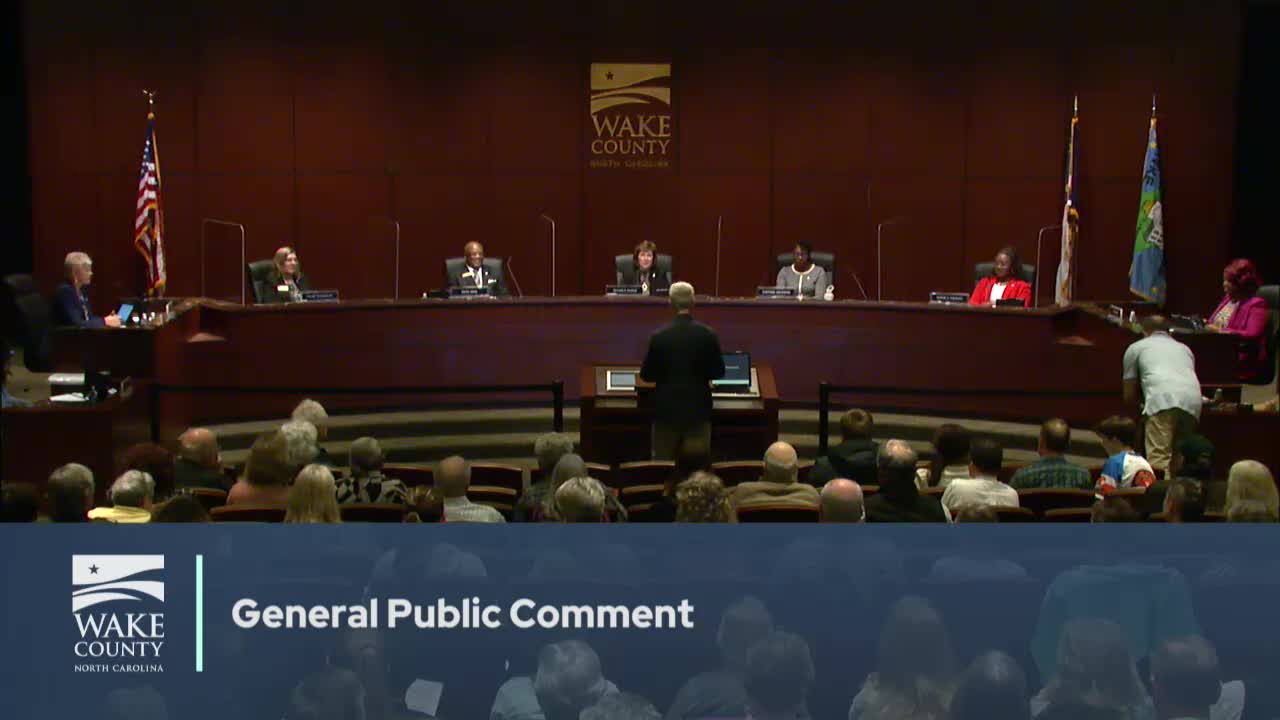
Dozens of residents and trail advocates told Wake County commissioners on Feb. 3 that Lake Crabtree County Park should remain public land and that existing trails and forested acres should not be redeveloped by the Raleigh-Durham Airport Authority.
Dozens of residents and outdoor-recreation advocates spoke during the board’s public-comment period on Feb. 3, 2025, urging Wake County officials to block or buy land at Lake Crabtree County Park that the Raleigh-Durham Airport Authority (RDU) may redevelop.
Speakers described Lake Crabtree’s trail network and forested acreage as a regional recreation asset that serves mountain bikers, families, adaptive cyclists, hikers and children. Several commenters said the airport authority—while managing the parcel—does not own it outright and that the land has been used as a public park for roughly 30 years.
“Once this land is gone, it’s gone forever,” said Allen Piercy, who called the park a diminishing green-space resource and urged commissioners to consider their stewardship legacy.
Speakers raised a mix of procedural and environmental concerns. Beth Harrelson, who identified herself with North Carolina Adaptive Sports, said volunteers and organizations invested about $8,000 in lumber for adaptive bridges and many hours of labor to make trails accessible to cyclists with disabilities. She said the parcel’s future is uncertain because state law, she said, limits a ground lease at the site to 40 years but that commercial developers generally require longer terms for construction financing.
Several speakers recounted the site’s history. A presenter who traced the park’s planning to the 1950s argued that RDU took management control of the land decades ago and that FAA-approved airport property boundaries from the 1970s and 1980 did not include Lake Crabtree. Speakers asked why the county would allow the airport authority to repurpose land long planned for recreation.
Environmental concerns included potential disturbance of PCB-contaminated sediments and increased runoff and flooding if forested uplands are cleared for development. Lauren Wilkins and Melanie Walker said the public meeting hosted by the airport authority the prior week had been oversubscribed—Walker said about 100 people were turned away—and that the authority’s security presence and public outreach left many residents feeling excluded from planning.
Youth and organized-sports groups also testified. Riders associated with the North Wake Trailhawks and other youth teams said Lake Crabtree is the nearest beginner-friendly mountain-biking venue for many students; multiple young riders said team practices would be jeopardized if the trails were removed. Ryder Bates, a seventh grader who races with South Wake Trailhawks, told commissioners the team practices at Lake Crabtree twice a week from October through May.
Environmental advocates and trail groups asked the board to use its position as one of the airport’s public owners to block redevelopment, enforce existing zoning, or purchase the land for permanent public use. Jean Spooner, chair of the Friends of William B. Umstead State Park, told commissioners Wake County has leverage as a quarter-owner of RDU-managed property and urged enforcement of the county’s existing zoning for the parcel.
The clerk told commissioners 65 comments had been submitted online and would be distributed to the board. No formal board action was taken during public comment; commissioners later discussed the issue in advisory reports and several said they supported exploring options, including purchase if feasible.
Speakers and organizations represented in remarks included North Carolina Adaptive Sports, the Umstead Coalition, Sound Rivers (Neuse Riverkeeper), North Wake and South Wake Trailhawks, the campus community alliance for environmental justice at NC State, and multiple local residents and civic leaders. Commenters asked the county to require more transparency from RDU, to delay any vendor confirmation until a public plan is developed, and to use county tools—such as zoning enforcement, purchase, or funding—to preserve the site.