Get Full Government Meeting Transcripts, Videos, & Alerts Forever!
Get email alerts on the Child Witness Procedures topic
No spam. Unsubscribe anytime.
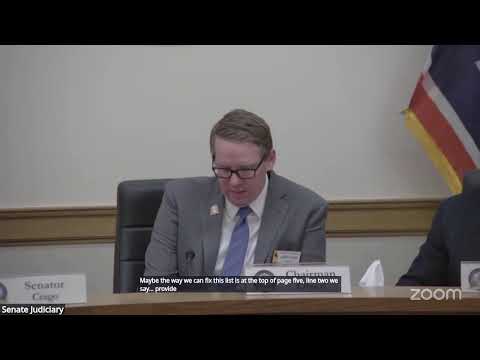
Committee OKs changes to allow child witnesses to testify outside defendant's presence; age threshold raised to 18
Summary
The Senate Judiciary Committee voted to report Senate File 100 to the floor after adopting amendments that expand age coverage and give courts authority to provide reasonable accommodations — including live closed‑circuit testimony — for child witnesses in certain criminal cases.
The Senate Judiciary Committee voted to report Senate File 100 to the floor after adopting amendments that expand the bill's age coverage and clarify that courts may provide reasonable accommodations to child victims testifying in criminal cases.
Sponsor Senator Schueller told the committee the bill would let a child under the statute's age cutoff testify outside the presence of the defendant and jury in cases involving sexual assault, child abuse, human trafficking and certain violent felonies if a court finds that in‑court testimony would cause more than de minimis emotional distress and that remote testimony is necessary to protect the child's welfare. “Before allowing this remote testimony, here's the key. The court has to hold a hearing, and they decide if testifying in the courtroom would cause the child to suffer more than de minimis emotional distress,” Schueller said.
The draft permits live closed-circuit television or other secure real-time technology, allows a support person to be present for the child, and lists other accommodations including sufficient breaks and, optionally, a certified therapeutic dog. Sponsors cited other states' models, including South Dakota, and court decisions addressing the Sixth Amendment's confrontation clause when explaining why the accommodation would pass constitutional scrutiny in appropriate cases.
Multiple witnesses representing law enforcement, child advocacy centers and direct victims supported the bill. Mike Thompson, chief of police in Evansville and chair of a DFS oversight council, said prosecutors often rely on victim testimony and that many cases depend on a child's ability to testify without being retraumatized. “Victims' testimony is absolutely critical,” Thompson said. Stacy Nelson, executive director of the Children's Advocacy Project in Natrona County, described the center's model in which trained forensic interviewers conduct a recorded, developmentally appropriate interview that prosecuting attorneys and investigators watch from another room.
Several witnesses urged expanding the protected age. Senator Kolb moved an amendment to change the age references from 16 to 18; witnesses and the sponsor supported that change and the committee adopted it. The committee also amended one section to instruct courts to “provide reasonable accommodations to the child, including but not limited to” a list of enumerated options, giving judges the ability to tailor protections.
Committee members debated the balance between protecting child victims and preserving defendants' confrontation rights; several members said they wanted to leave discretion with the courts. The committee rejected attempts to convert permissive "may" language into a mandatory "shall" in several places, keeping the statute permissive and dependent on a court finding in each case.
After public testimony, the committee recorded a roll-call vote on final passage: Senators Crago, Crum, Kolb and Chairman Olsen voted aye; one senator was recorded as excused. The clerk announced “4 ayes and 1 excused.” The committee reported the bill favorably and indicated it would proceed toward the next calendar steps.
The bill as amended lets courts use guarded, real-time remote testimony for child witnesses (amended to cover those under 18), requires a hearing and findings about emotional distress and necessity, and instructs courts to offer reasonable, case-specific accommodations.