Get Full Government Meeting Transcripts, Videos, & Alerts Forever!
Get email alerts on the Ranked Choice Voting topic
No spam. Unsubscribe anytime.
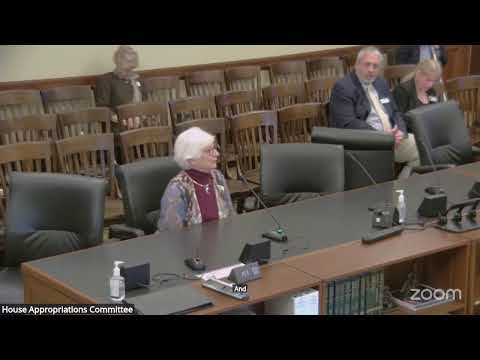
Appropriations committee advances bill to ban ranked‑choice voting amid equipment and policy concerns
Summary
House Bill 165, which would prohibit ranked‑choice voting in Wyoming, was advanced by the House Appropriations Committee on a 5–1 vote. Supporters cited voter confusion and ballot exhaustion; county clerks and election administrators noted equipment and certification limitations.
The House Appropriations Committee voted to advance House Bill 165, a measure that would amend state election code to prohibit ranked‑choice voting in Wyoming and add ballot‑format clarifications.
Representative Joe Webb, the bill sponsor, told the committee that the proposal would bar any governmental entity from authorizing a ranked‑choice system and would amend statutory ballot language to clarify how many votes a voter may cast for multi‑seat contests. "It's a pretty simple bill, pretty straightforward," Webb said when introducing the proposal.
Supporters who testified included a state official who said they had previously opposed ranked‑choice proposals and described technical and implementation problems seen elsewhere. The official argued ranked‑choice systems can produce "ballot exhaustion"—where ballots lack preferences in later rounds—and can produce winners who did not receive the most first‑choice votes.
County Clerk Rimmer told the committee that current Wyoming voting equipment could be programmed to capture rank preferences, but the certified tabulation algorithm to produce an instant‑runoff outcome would require external software or a third‑party vendor not currently certified with the state's tabulation equipment. Rimmer cited Wyoming statute "22 11 1 0 3 d and e" (as referenced in testimony) when describing certification requirements for election technology and said relying on a third party would add time and complexity to result tabulation.
Veil Simmons, speaking as a civic educator, said she opposed the prohibition — not because she supports ranked‑choice voting in principle, but because she believes the practice cannot be implemented in Wyoming without legislative action and existing equipment limitations. "RCV cannot be implemented in Wyoming unless the legislature passes a bill to do so," Simmons told the committee, adding that most contests in Wyoming have too few multi‑candidate races to justify the change.
Other organizations offered mixed views. Brett Moline of the Wyoming Farm Bureau Federation said his members favor a ban and described the bill as a proactive step. Era Aronow of the Rocky Mountain Farmers Union testified that her organization supports ranked‑choice voting; she identified her group as nonpartisan and representing family farmers across multiple states.
After discussion, a motion to advance the bill carried. The roll call recorded five ayes (Representative Angelos, Representative Hamilton, Representative Pendergraft, Representative Smith, Chairman Bair), one no (Representative Sherwood) and one excused (Representative Olamand). The committee record shows the committee adopted the sponsor’s language as presented and moved the bill to the floor; Representative Webb was asked to manage the measure on the House floor.
The committee hearing also included questions from members about municipal capability, equipment certification, and whether the statute’s proposed language might unintentionally affect paper ballot overvotes; members discussed and rejected one amendment on that point. The record indicates officials and clerks expect greater tabulation time and additional certification steps if ranked‑choice voting were implemented, which factored into supporters’ arguments for the prohibition.
With committee approval, House Bill 165 will be scheduled for floor consideration; no floor date was provided in the committee minutes.